



Black-eyed Susan
(Rudbeckia hirta var. pulcherrima)
Conservation • Wetland • Description • Habitat • Ecology • Use • Distribution • Taxonomy
|
|
||||||||||||||||||||||||

Description |
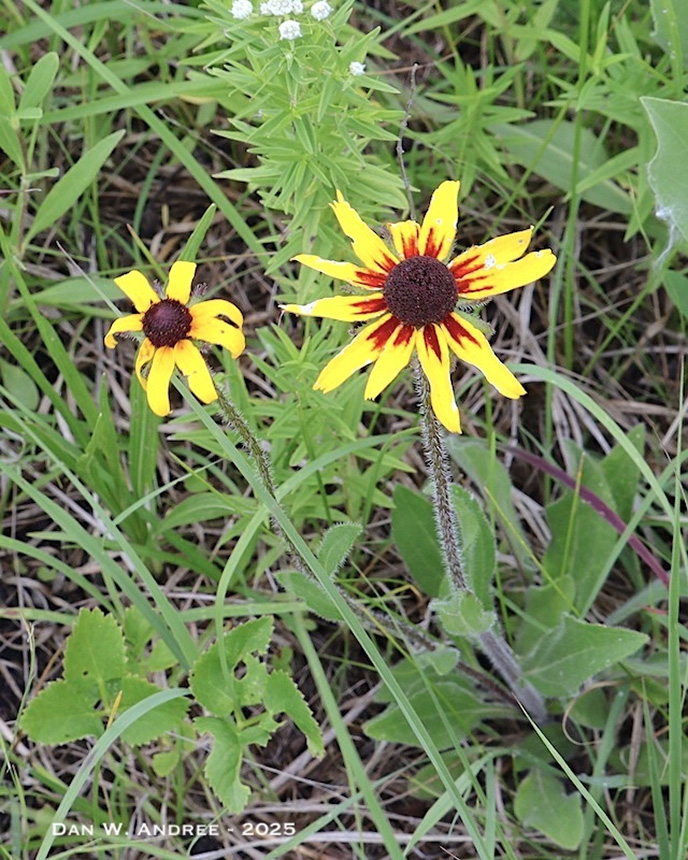
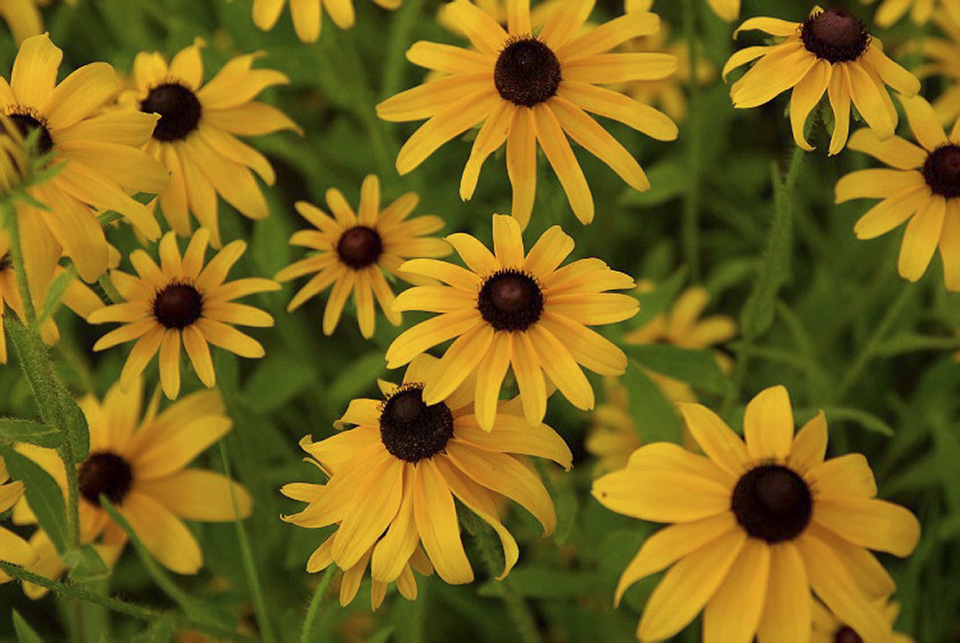
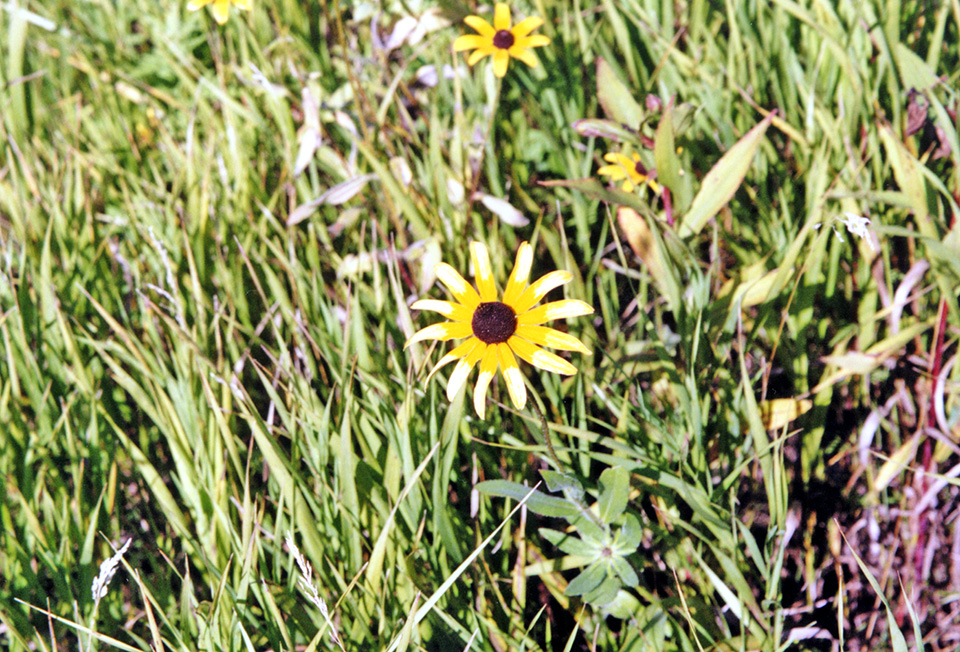
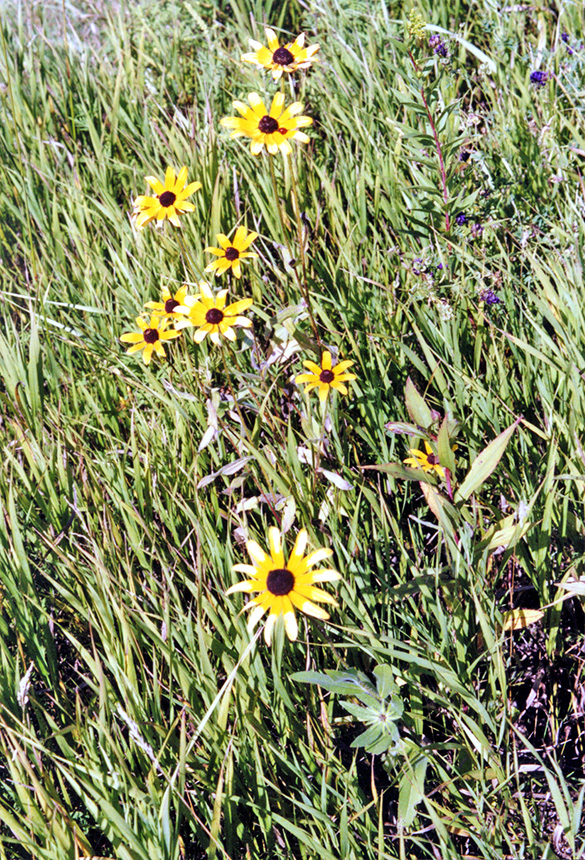
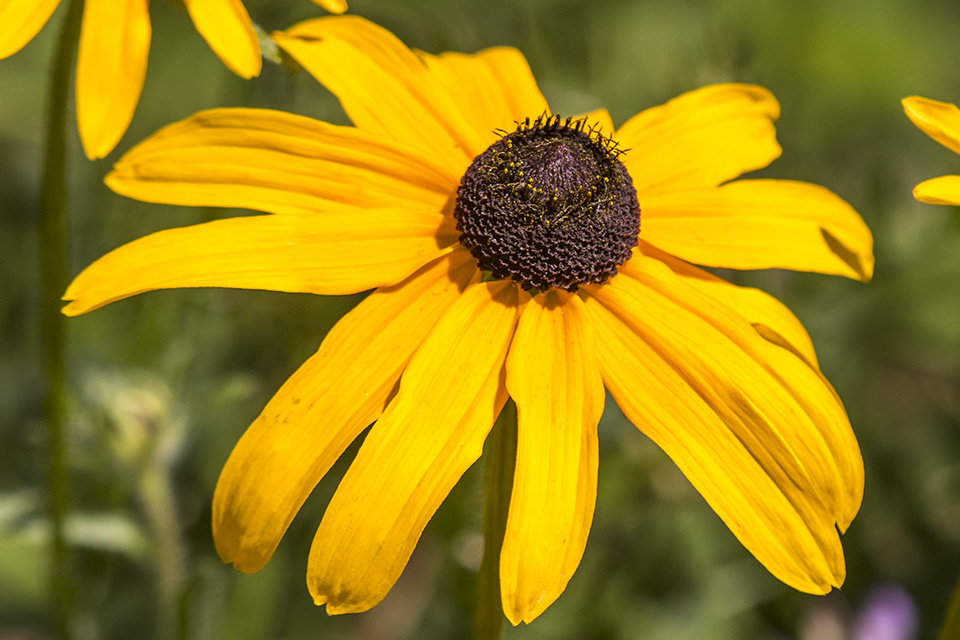
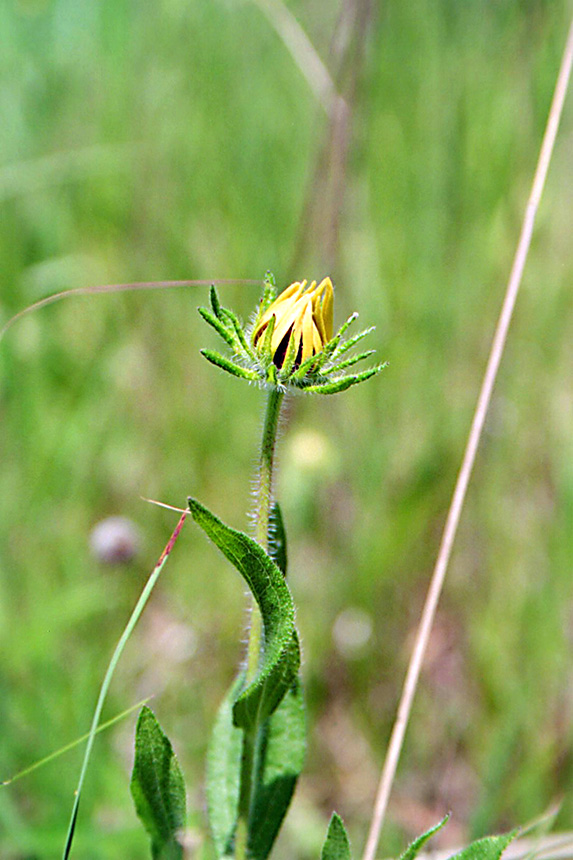
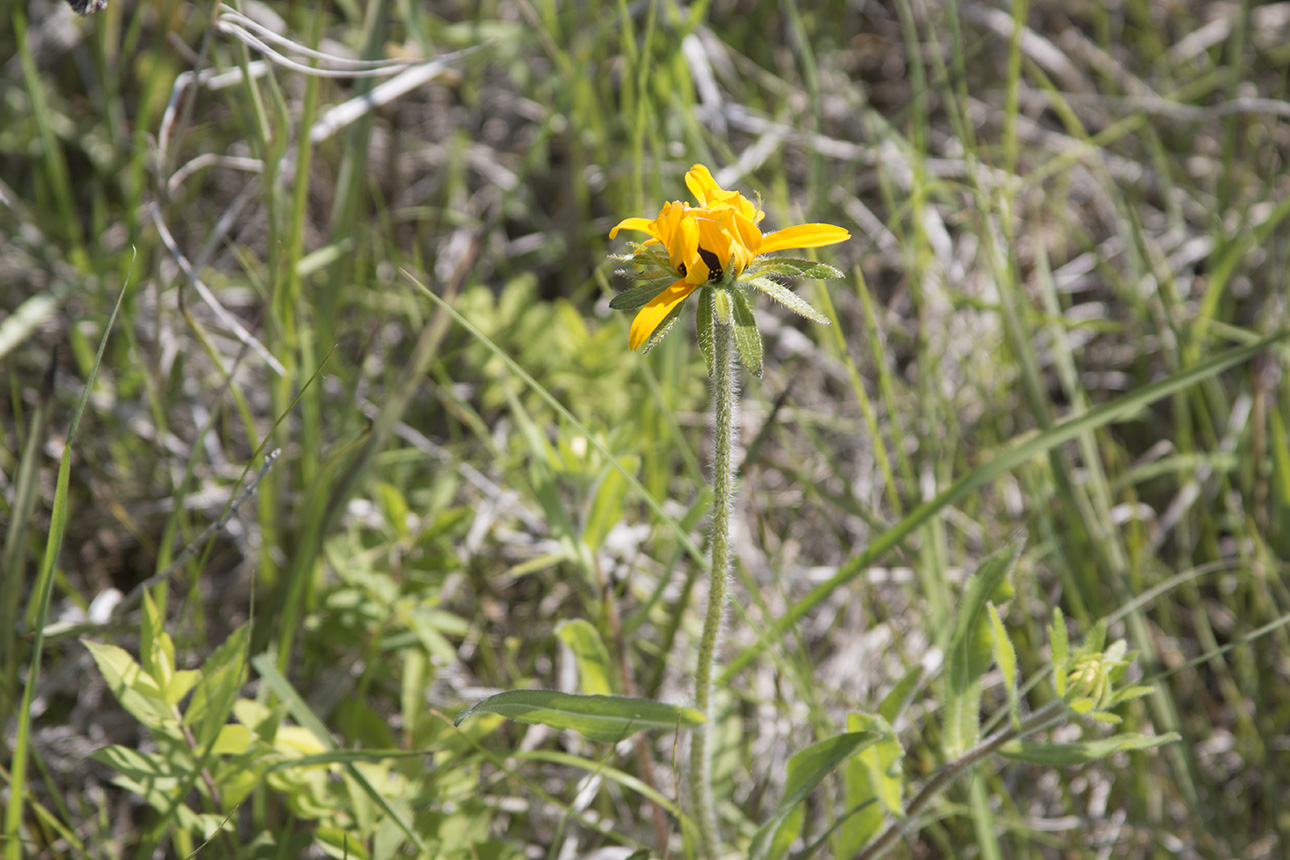
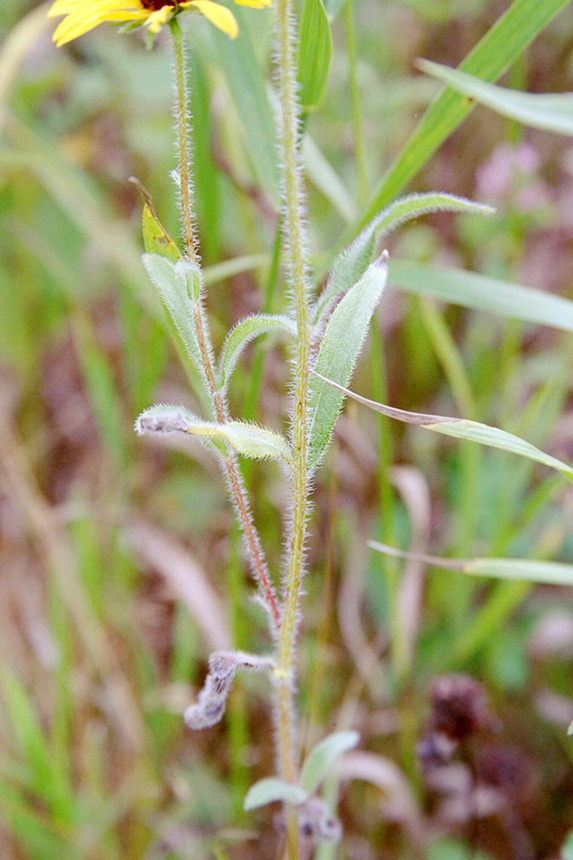
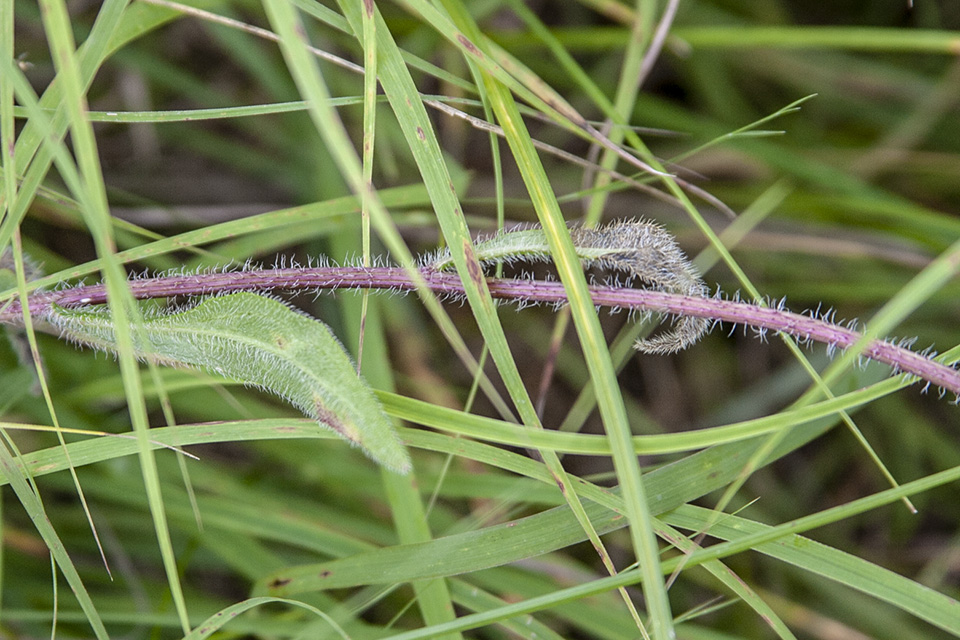
Black-eyed Susan is a 12″ to 36″ tall, erect, biennial or short-lived perennial forb that rises on one to several stems usually from a taproot, sometimes from only fibrous roots. The stems are erect, usually branched mostly above the middle, ridged, and sparsely to densely covered with short, spreading to ascending hairs. They are not glaucous. Stem leaves are alternate. Basal and lower stem leaves are on long, winged leaf stalks. They are inversely lance-shaped, tapered or angled at the base, and rounded or tapered to a blunt point at the tip. They are 2″ to 11¾″ long, ¼″ to 1¼″ wide, 3 to 5 times as long as wide. The upper and lower surfaces are sparsely to moderately hairy with spreading to loosely ascending hairs. They are usually rough to the touch and are not glaucous. The margins are usually untoothed but sometimes have widely spaced, fine, sharp, forward-pointing teeth. Basal and lower stem leaves are sometimes present at flowering. Middle and upper stem leaves are stalkless or on short, winged leaf stalks. They are lance-shaped, egg-shaped, or elliptic, the uppermost almost linear, rounded or squared at the base, and rounded or tapered to a blunt point at the tip. They are ¾″ to 8″ long, and ⅛″ to 1½″ wide. The upper leaves are clasp the stem at the base. The upper and lower surfaces are sparsely to moderately hairy with spreading to loosely ascending hairs. They are usually rough to the touch and are not glaucous. The margins are usually untoothed but sometimes have widely spaced, fine, sharp, forward-pointing teeth. The inflorescence is a single flower head at the end of each stem and branch. Each flower head is on a hairy stalk that is up to ⅓ of the plant height. The bracts at the base of the flower head are lance-shaped to linear, moderately to densely hairy, with moderate to dense spreading hairs on the margins. The flower heads are 2″ to 3″ wide. There are 8 to 21 yellow ray florets and numerous brown disk florets. The disk is in the shape of a flattened cone. The flower heads are not fragrant. The fruit is a dry, black, oblong, 4-angled, 1 ⁄16″ to ⅛″ long cypsela with no fluffy tuft of hairs attached. |
Height |
12″ to 36″ |
Flower Color |
Yellow ray florets, brown disk florets |
Similar Species |
Brown-eyed Susan (Rudbeckia triloba var. triloba) is a bushy plant with smaller flower heads. The flower heads have no more than 15 ray florets. At least some of the larger leaves are 3- lobed. Basal and lower stem leaves are often absent at flowering time. |
Habitat |
Dry to wet. Prairies, forest openings, roadsides, disturbed areas. Full to partial sun. |
Ecology |
Flowering |
June to October |
Pests and Diseases |
|
Use |
Black-eyed Susan is the state flower of Maryland. |
Distribution |
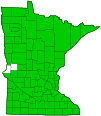
||
|
Sources |
|
| 7/4/2024 | ||
Nativity |
||
Native |
||
Occurrence |
||
Common |
||
Taxonomy |
|
Kingdom |
|
Subkingdom |
Pteridobiotina |
Phylum |
Tracheophyta (Vascular Plants) |
Class |
|
Order |
Asterales (Sunflowers, Bellflowers, Fanflowers, and Allies) |
Family |
Asteraceae (Sunflowers, Daisies, Asters, and Allies) |
Subfamily |
Asteroideae |
Tribe |
Heliantheae (Sunflowers and Allies) |
Subtribe |
Rudbeckiinae (Black-eyed Susans, Coneflowers, and Prairie Coneflowers) |
Genus |
Rudbeckia (Black-eyed Susans and Coneflowers) |
Section |
Rudbeckia |
Species |
Rudbeckia hirta (Black-eyed Susan) |
Subordinate Taxa |
|
|
|
Synonyms |
|
Rudbeckia hirta var. corymbifera Rudbeckia hirta var. lanceolata Rudbeckia hirta var. sericea Rudbeckia hirta var. serotina Rudbeckia longipes Rudbeckia sericea Rudbeckia serotina Rudbeckia serotina var. corymbifera Rudbeckia serotina var. lanceolata Rudbeckia serotina var. sericea |
|
Common Names |
|
black-eyed Susan blackeyed Susan eastern black-eyed Susan |
|
Glossary
Bract
Modified leaf at the base of a flower stalk, flower cluster, or inflorescence.
Clasping
Describing a leaf that wholly or partly surrounds the stem but does not fuse at the base.
Cypsela
A dry, one-chambered, single-seeded fruit, formed from a single carpel, with the seed attached to the membranous outer layer (wall) only by the seed stalk; the wall, formed from the wall of the inferior ovary and also from other tissues derived from the receptacle or hypanthium, does not split open at maturity, but relies on decay or predation to release the contents.
Glaucous
Pale green or bluish gray due to a whitish, powdery or waxy film, as on a plum or a grape.
Winged leaf stalk
A leaf stalk with a leaf-like or membrane-like extension along both sides.
Visitor Photos |
||
Share your photo of this plant. |
||
This button not working for you? |
||
Dan W. Andree |
||
 |
 |
|
Wildflower Yellow with Red |
Crab Spider Twin Valley Prairie SNA... |
|
Alfredo Colon |
||
 |
|
|
Nancy Falkum |
 |
Wayne Rasmussen |
 |
MinnesotaSeasons.com Photos |
||
 |
 |
|
Plant |
Plant |
|
 |
 |
|
Flower head |
||
|
||
|
||
Plant |
|
|
 |
 |
|
Flower head |
Flower head |
|
 |
 |
|
Bud |
Bud |
|
 |
 |
|
Stem |
||
|
||
|
||
Stem |
|

Slideshows |
Rudbechia hirta |
About
Flekksolhatt |
Black Eyed Susan |
About
Copyright DianesDigitals |
Black-eyed Susan (Rudbeckia hirta) |
Rudbeckia hirta BLACK-EYED SUSAN |
Visitor Videos |
||
Share your video of this plant. |
||
This button not working for you? |
||
|
Other Videos |
||
Minnesota Native Plant - Black-Eyed Susan (Rudbeckia Hirta var. Pulcherrima) |
About
Published on Jul 15, 2013 This video shows the common Minnesota native plant, Black-Eyed Susan (Rudbeckia Hirta var. Pulcherrima). A beautiful native that is commonly used in native and non-native plantings. |
Sweet Blackeyed Susan - Rudbeckia subtomentosa blooming at Ion Exchange |
About
Uploaded on Aug 1, 2011 Earthyman views Sweet Blackeyed Susan (Rudbeckia subtomentosa) blooming at Ion Exchange in Northeast Iowa in July http://www.ionxchange.com |
Rudbeckia flower time lapse Carol's |
About
Uploaded on Sep 2, 2009 Time-lapse Rudbeckia flower. |

Visitor Sightings |
||
Report a sighting of this plant. |
||
This button not working for you? |
||
Dan W. Andree |
Location: Dalby WMA, Norman Co. Mn. |
 |
Alfredo Colon |
Location: Albany, NY |
 |
Alfredo Colon |
Location: Albany, NY |
 |
| Dan W. Andree 7/2/2024 |
Location: Twin Valley Prairie SNA Crab Spider Twin Valley Prairie SNA... |
|
| Nancy Falkum 6/26/2022 |
Location: Weaver Dunes Preserve, Cox Unit |
|
| Wayne Rasmussen 6/25/2016 |
Location: Oxbow Park & Zollman Zoo |
|
MinnesotaSeasons.com Sightings |
||
|
Created: 9/4/2004 | Last Updated: 7/4/2024 © MinnesotaSeasons.com. All rights reserved. |