



twinleaf
(Jeffersonia diphylla)
Conservation • Description • Habitat • Ecology • Use • Distribution • Taxonomy
Conservation Status |
|
|||||||
| IUCN Red List | not listed |
|||||||
| NatureServe | N5 - Secure S3 - Vulnerable |
|||||||
| Minnesota | Special Concern |
|||||||
Description |
||
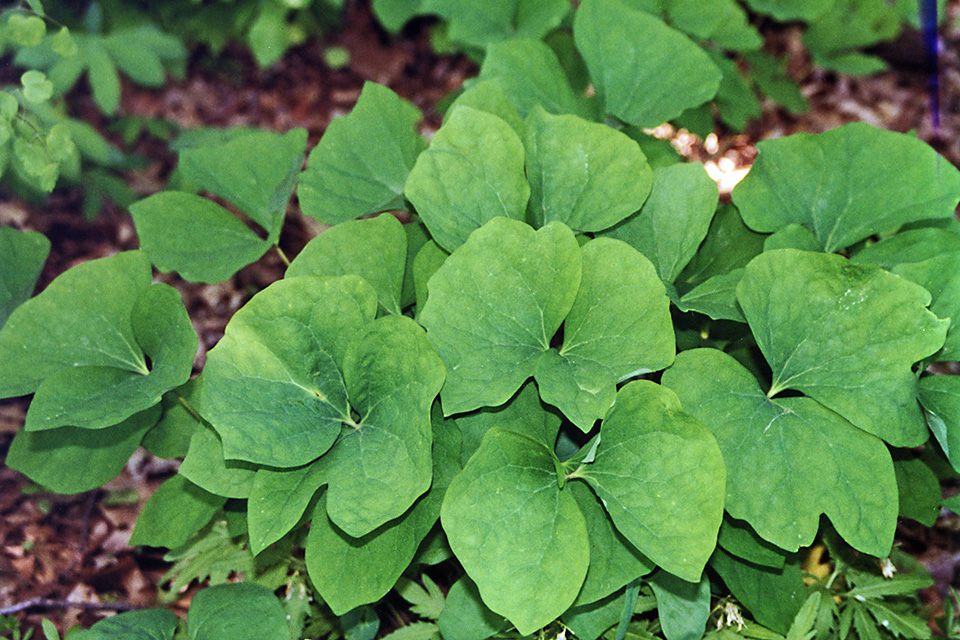
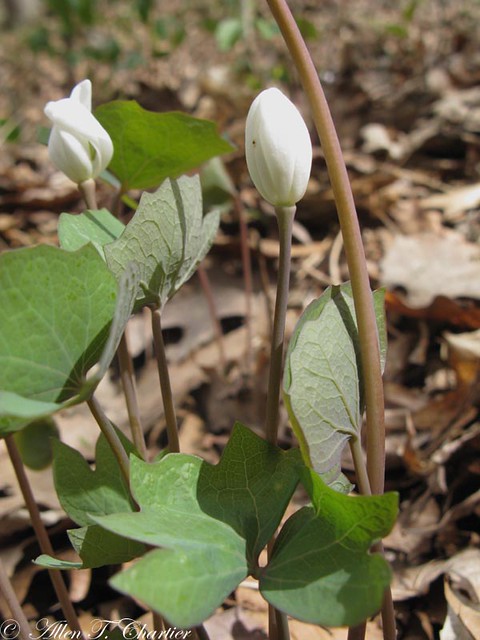
Twinleaf is a 4″ to 8″ tall, erect, perennial forb that rises from a short, horizontal rhizome. Typically 4 to 8 leaves and a single flowering stalk are produced from each rhizome. There are no central stems. The leaves are all basal. They are alternate, 6″ to 7″ wide, and compound, divided into 2 kidney-shaped segments. Each leaf is borne on a 3½″ to 8″ long, slender leaf stalk. The leaf segments are untoothed and sometimes have shallow lobes. The upper surface is bluish green. The lower surface is whitish green. After flowering the leaves continue to grow, eventually reaching 7″ to 17″ in height at maturity. The inflorescence is a solitary flower at the end of a 4″ to 8″ tall, leafless flowering stalk (scape). It is usually taller than the leaves. The flowers are ⅜″ to 1⅛″ wide. There are 4 petal-like sepals that drop early, usually 8 white petals, and 8 stamens. The fruit is brownish, egg-shaped or pear-shaped, leathery, capsule-like, ¾″ to 1½″ long and ⅓″ to ⅔″ wide. It has a hinged, helmet-like lid and contains 10 to 25 seeds. The seeds have fleshy appendages attached (elaiosomes) which attract ants. The ants carry the seeds back to their nests, thus dispersing the seeds. |
||
Height |
||
4″ to 8″ at flowering |
||
Flower Color |
||
White |
||
Similar Species |
||
May-apple (Podophyllum peltatum) leaves are not compound. The flower droops from the axil of two leaves. The fruit is a yellow berry. |
||
Habitat |
||
Moderate moisture. Woods. |
||
Ecology |
||
Flowering |
||
April to May |
||
Pests and Diseases |
||
|
||
Use |
||
|
||
Distribution |
||||
|
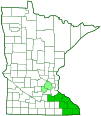
Sources The sighting from Hennepin County is in the Eloise Butler Wildflower Garden and Bird Sanctuary. The sighting from Carver County is in the Minnesota Landscape Arboretum. Neither sighting (light green on the map) is “outside of cultivation.” |
|||
| 7/1/2023 | ||||
Nativity |
||||
Native |
||||
Occurrence |
||||
Uncommon |
||||
Taxonomy |
|||
| Kingdom | Plantae (Plants) | ||
| Subkingdom | Pteridobiotina | ||
| Phylum | Tracheophyta (Vascular Plants) | ||
| Class | Magnoliopsida (Dicots) | ||
Order |
Ranunculales (Buttercups, Poppies, and Allies) | ||
Family |
Berberidaceae (barberry) | ||
| Subfamily | Berberidoideae | ||
| Tribe | Berberideae | ||
| Subtribe | Epimediinae | ||
Genus |
Jeffersonia | ||
Subordinate Taxa |
|||
|
|||
Synonyms |
|||
Podophyllum diphyllum |
|||
Common Names |
|||
American twin leaf American twinleaf ground squirrel-pea helmet-pod jeffersonia rheumatism root rheumatism-root twinleaf yellowroot |
|||
Glossary
Elaiosome
A fleshy structure, rich in lipids and proteins. attached to a seed, that attracts ants to aid in seed dispersal.
Rhizome
A horizontal, usually underground stem. It serves as a reproductive structure, producing roots below and shoots above at the nodes.
Visitor Photos |
|||||
Share your photo of this plant. |
|||||
| This button not working for you? Simply email us at info@MinnesotaSeasons.com. Attach one or more photos and, if you like, a caption. |
|||||
|
|||||
MinnesotaSeasons.com Photos |
|||||
 |
|||||

Slideshows |
||
| Jeffersonia diphylla (Twinleaf) Allen Chartier |
||
|
||
Visitor Videos |
|||
Share your video of this plant. |
|||
| This button not working for you? Simply email us at info@MinnesotaSeasons.com. Attach a video, a YouTube or Instagram link, or a cloud storage link. |
|||
Other Videos |
|||
| Twinleaf (Jeffersonia diphylla) PrairieMoonNursery |
|||
About
Uploaded on May 4, 2010 http://www.PrairieMoon.com - Twinleaf blooms mid-April while the woodlands are still fairly open here at Prairie Moon Nursery in SE MN. Jeffersonia diphylla is called 'Twinleaf' for its obvious double leaves |
|||
| Twinleaf (Jeffersonia Diphylla ) wvoutdoorman |
|||
About
Published on Mar 24, 2012 Twinleaf (Jeffersonia Diphylla )in the sprouting,flowering and seed stage of the growth cycle |
|||

Visitor Sightings |
|||||
Report a sighting of this plant. |
|||||
| This button not working for you? Simply email us at info@MinnesotaSeasons.com. Be sure to include a location. |
|||||
|
|||||
MinnesotaSeasons.com Sightings |
|||||
|
|||||
|
Created: Last Updated: © MinnesotaSeasons.com. All rights reserved. |