Mudpuppy - Species Profile
Conservation • Description • Habitat • Ecology • Distribution • Taxonomy
Conservation Status
IUCN Red List
LC - Least Concern
NatureServe
N5 - Secure
S3 - Vulnerable
Minnesota
Special Concern
Species in Greatest Conservation Need
Description
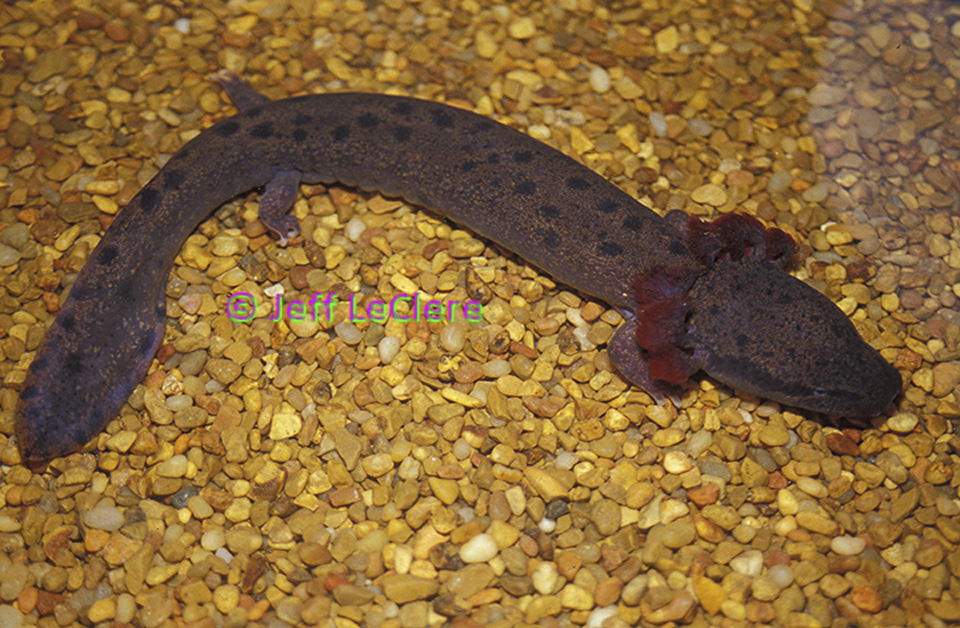
Mudpuppy, also called common Mudpuppy, is a common, large salamander. It is the largest and the only completely aquatic salamander in Minnesota. It occurs in the United States from Maine to North Carolina, west to Minnesota and eastern Oklahoma, and in southern Canada from Quebec to Manitoba. It is found in large lakes, reservoirs, large and medium-sized rivers, and sluggish streams.
Adults can be 8″ to 19″ (20 to 49 cm) in length but they average 13″ (33 cm) in length.
The head is squarish and flattened. The eyes are tiny. At the base of the head there are bushy, deep red, external gills. Adults in silty waters have larger gills, those in well-oxygenated waters have shorter gills. The tail is short and flattened vertically, fin-like. The legs are short and flattened. All of the feet have four toes. The upper side is rusty-brown to gray or nearly black with few to many black or blackish-blue spots. The belly is gray and sometimes has a few spots.
Juveniles are black with two yellow stripes on the back.
Size
Total length: 8″ to 19″ (20 to 49 cm)
Similar Species
Habitat
Large lakes, reservoirs, large and medium-sized rivers, and sluggish streams
Ecology
Behavior
Mudpuppies are solitary. They spend the day concealed under rocks, logs, or weeds, and come out at night to feed. In muddy or heavily vegetated waters they may also be active during the day. They usually walk on the bottom, but they can also swim like fish.
Lifespan
15 to 25 years or sometimes longer in captivity
Life Cycle
Mudpuppies are active year-round, they do not hibernate.
Larva Food
Adult Food
Mudpuppies are opportunistic feeders. They eat anything that they can catch, especially crayfish, but also amphibians, fish, aquatic insects, eggs, worms, mollusks, and carrion.
Distribution
Sources
Biodiversity occurrence data published by: Minnesota Biodiversity Atlas (accessed through the Minnesota Biodiversity Atlas Portal, bellatlas.umn.edu. Accessed 1/10/2026).
HerpMapper. 2026. HerpMapper - A Global Herp Atlas and Data Hub. Iowa, U.S.A. Available http://www.herpmapper.org. (Accessed: 1/10/2026).
USGS National Amphibian Atlas. https://armi.usgs.gov/atlas/. Accessed 1/10/2026).
Occurrence
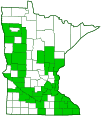
Widespread, common, and locally abundant in Minnesota.
Taxonomy
Class
Amphibia (Amphibians)
Order
Caudata (Salamanders)
Family
Proteidae (Mudpuppies and Olm)
Genus
Necturus (Mudpuppies and Waterdogs)
Subordinate Taxa
Three subspecies were previously recognized. Lake Winnebago Mudpuppy (Necturus maculosus stictus) has been described as having many small spots on the back and a weak dark eyeline, but it is not widely accepted.
In 1991, an div (Canant and Collins, 1991) proposed raising the subspecies Red River Mudpuppy (N. m. louisianensis) to full species level. Most sources, including GBIF and Amphibian Species of the World Online, accept the move and recognize no subspecies of N. maculosus. AmphibiaWeb rejects the move, citing the lack of supporting data.
Synonyms
Menobranchus lacepedii
Menobranchus lateralis
Menobranchus maculatus
Menobranchus sayii
Menobranchus tetradactylus
Necturus lateralis
Necturus luteus
Necturus maculatus
Necturus phosphoreus
Necturus tetradactylus
Phanerobranchus cepedii
Phanerobranchus tetradactylus
Proteus canadensis
Proteus tetradactylus
Siredon hyemalis
Sirena maculosa
Triton lateralis
Common Names
Common Mudpuppy
Large Mudpuppy
Mudpuppy