Spotted Salamander - Species Profile
Conservation • Description • Habitat • Ecology • Distribution • Taxonomy
Conservation Status
IUCN Red List
LC - Least Concern
NatureServe
N5 - Secure
S3 - Vulnerable
Minnesota
Special Concern
Species in Greatest Conservation Need
Description
Spotted Salamander is a medium to large sized mole salamander. It occurs in the United States from Maine to northern Georgia, west to eastern Minnesota and eastern Texas, and in southern Canada from Nova Scotia west to Ontario. It was first discovered in Minnesota in Pine County in 2001, then in Carlton County in 2005. It is found in mature deciduous, coniferous, and mixed forests with shallow seasonal ponds or small shallow wetlands that do not contain fish.
Adults are 6″ to 10″ (15 to 25 cm) in length. Females tend to be larger than males.
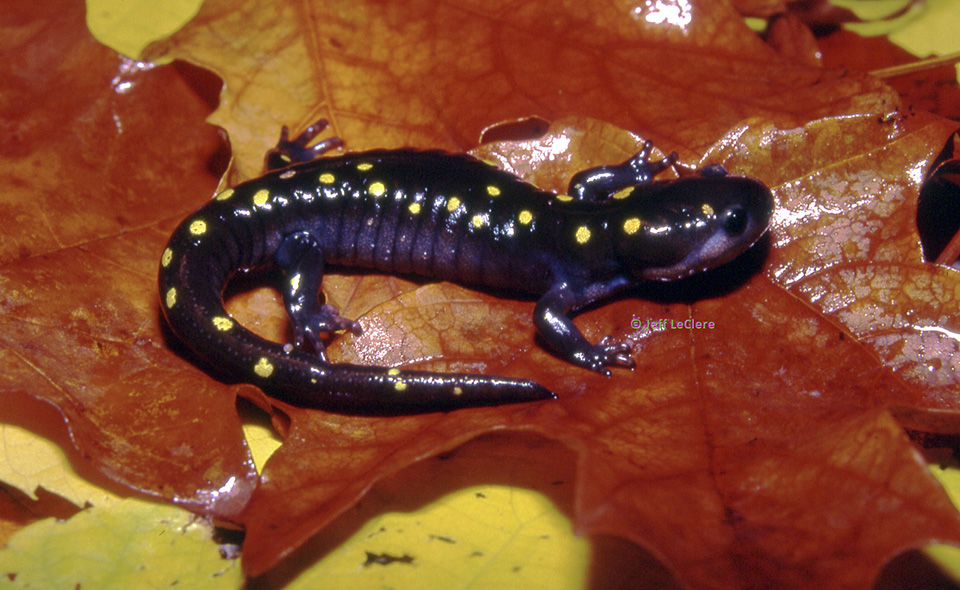
The head is wide and is often swollen at the back of the jaw. The snout is broadly rounded. The lower lip is gray. The body is stout. On each side between the forelimbs and the ventral area there are 11 to 13 prominent vertical depressions (costal grooves). The skin is soft and moist. There are four well-developed limbs that project sidewards. The hind legs have five toes. The fore legs have four toes. The upper side of the body is black or dark gray with two irregular rows of round yellow spots extending from the top of the head to the tip of the tail. Occasionally some or all of the spots on the head are orange. Unspotted individuals, albinos, and partial albinos are rare. The underside is gray and unspotted.
Size
Total length: 6″ to 10″ (15 to 25 cm)
Similar Species
Habitat
Mature deciduous, coniferous, and mixed forests with shallow season ponds or small shallow wetlands that do not contain fish.
Ecology
Behavior
The adult spends most of its time under a log or rock or in an abandoned animal burrow, usually within 100 meters of the pond in which it hatched. It normally emerges only on rainy nights, and then only if there is not enough food underground. During breeding season, it emerges and returns to its pond.
When threatened it will respond by lowering its head, arching its back and tail, head butting, snapping, and waving its tail.
Large glands on the back and tail exude a milky, toxic liquid in response to a predator.
Lifespan
Usually 20 to 25 years, sometimes up to 30 years, in the wild
Life Cycle
Larva Food
Insects, mosquito and other insect larvae, water fleas, copepods, and other small aquatic invertebrates.
Adult Food
Usually 20 to 25 years, sometimes up to 30 years, in the wild
Distribution
Sources
Biodiversity occurrence data published by: Minnesota Biodiversity Atlas (accessed through the Minnesota Biodiversity Atlas Portal, bellatlas.umn.edu. Accessed 1/10/2026).
HerpMapper. 2026. HerpMapper - A Global Herp Atlas and Data Hub. Iowa, U.S.A. Available http://www.herpmapper.org. (Accessed: 1/10/2026).
USGS National Amphibian Atlas. https://armi.usgs.gov/atlas/. Accessed 1/10/2026).
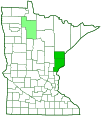
There are two historical records in Beltrami County from 1950 (light green on the map). There are no Minnesota records from any other source outside of Pine and Carlton Counties.
Occurrence
Rare in Minnesota
Taxonomy
Class
Amphibia (Amphibians)
Order
Caudata (Salamanders)
Family
Ambystomatidae (Mole Salamanders)
Genus
Ambystoma (Mole Salamanders)
Subordinate Taxa
Synonyms
Amblystoma maculatum
Ambystoma carolina
Ambystoma carolinae
Ambystoma punctatum
Ambystoma subviolaceum
Ambystome argus
Camarataxis maculata
Lacerta maculata
Lacerta subviolacea
Salamandra argus
Salamandra maculata
Salamandra margaritifera
Salamandra punctata
Salamandra subviolacea
Salamandra venenosa
Salamandroidis subviolacea
Siredon maculatus
Common Names
Spotted Salamander
Yellow-spotted Salamander