



spotted spurge
(Euphorbia maculata)
Conservation • Wetland • Description • Habitat • Ecology • Use • Distribution • Taxonomy
|
|
||||||||||||||||||||||||
Description |
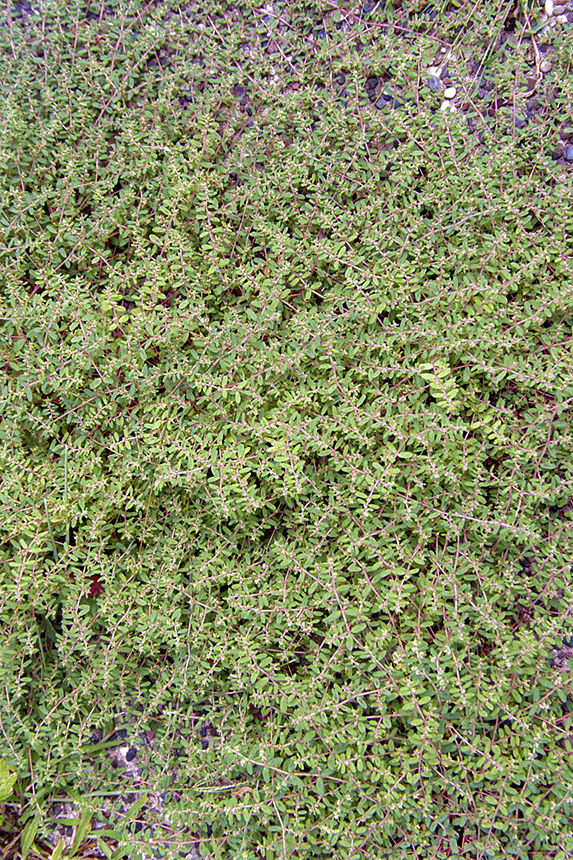
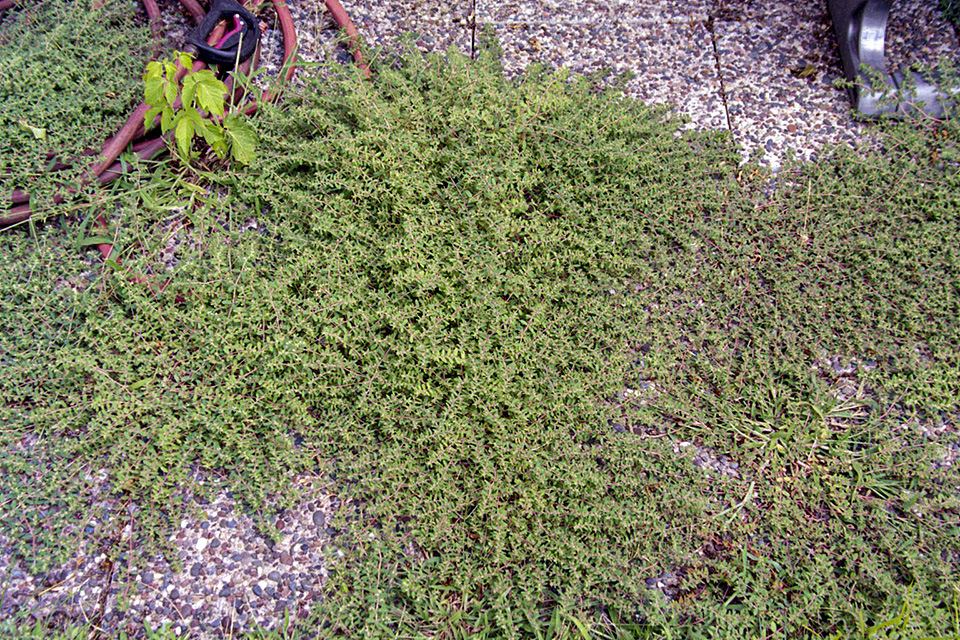
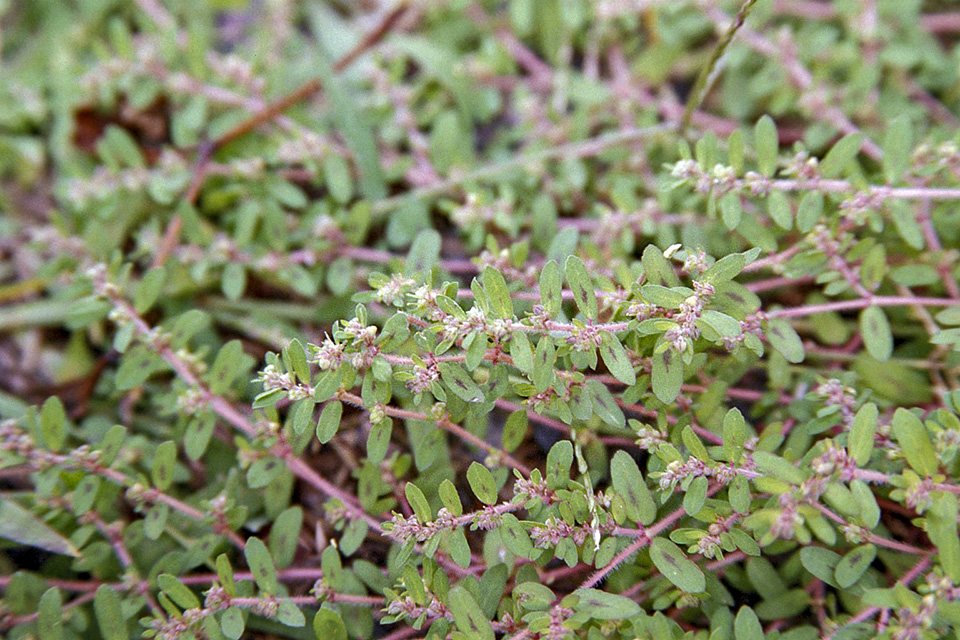
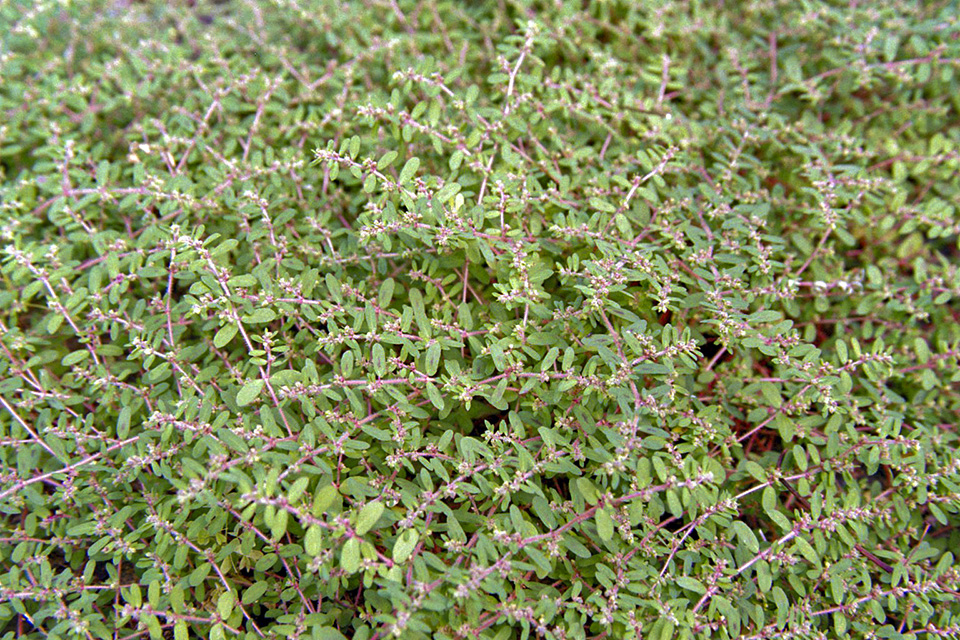
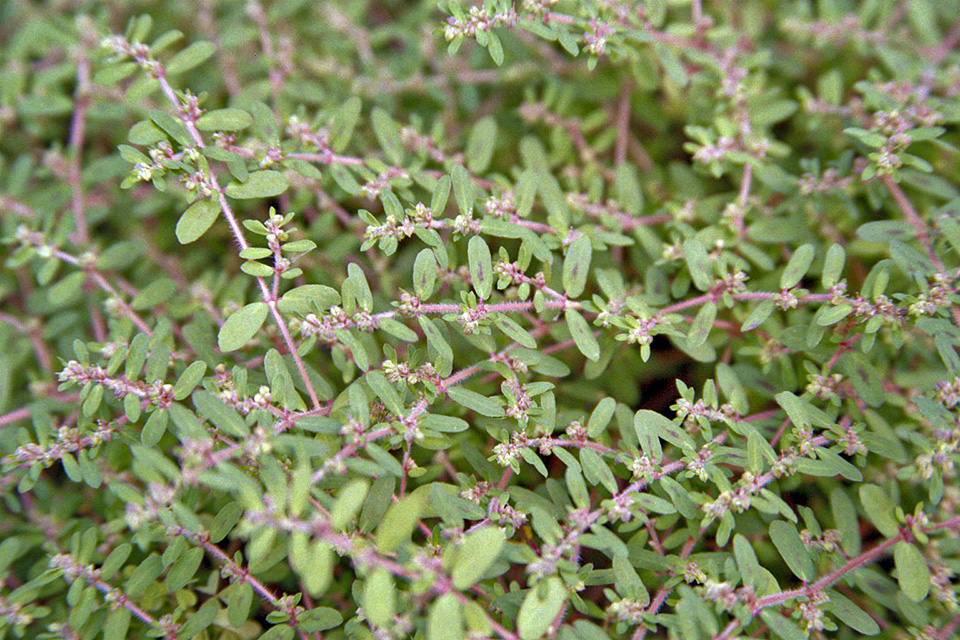
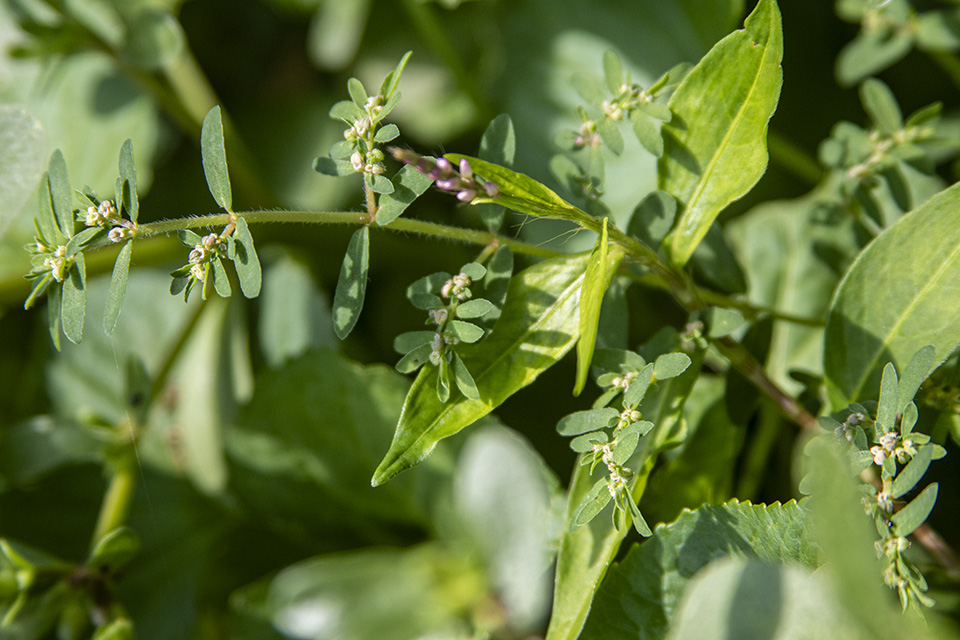
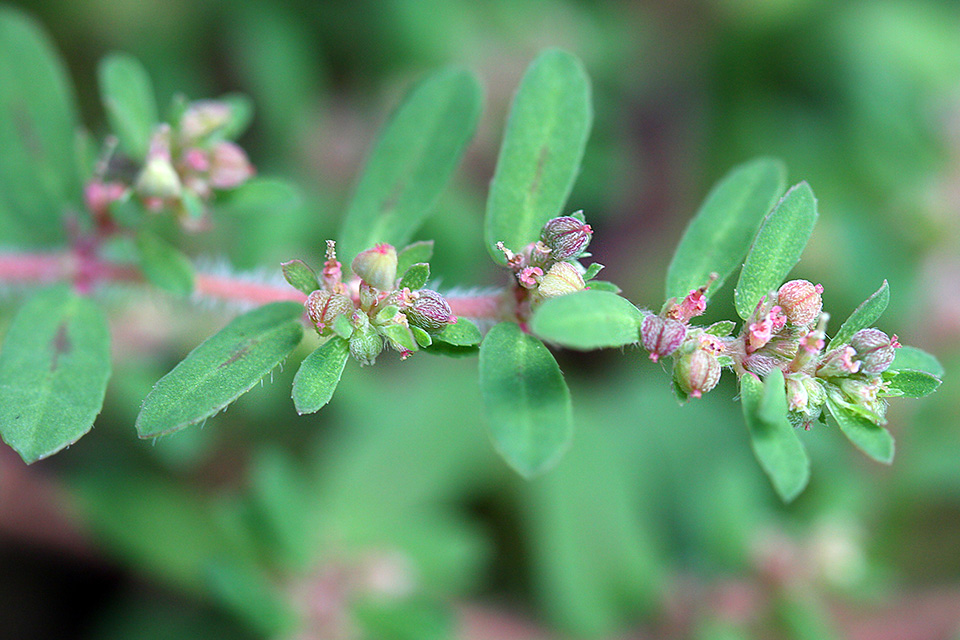
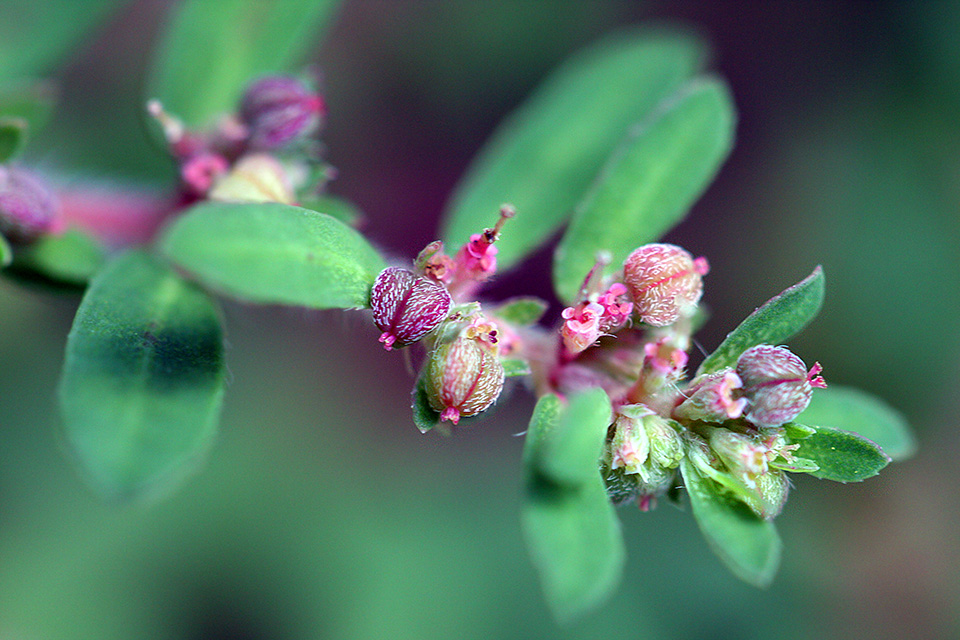
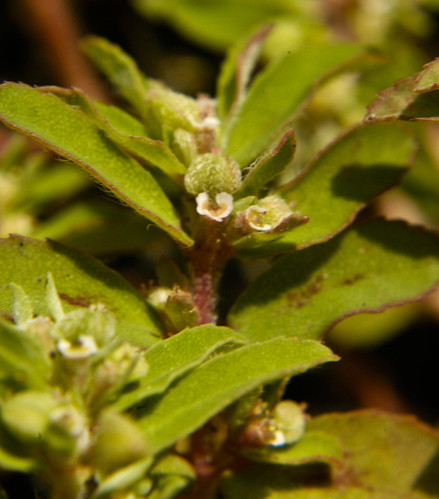
Spotted spurge is a prostrate, usually less than 1″ tall, annual forb that rises from a slender taproot. It forms a circular mat. All parts of the plant emit a milky sap when broken. The stems are thick, round, up to 16″ long, and frequently branched at the base. They become red in strong sun. Young stems and are densely hairy, older stems less so. The plant does not root at the nodes. Leaves are opposite, oblong or oblong egg-shaped to linear-oblong, often widest below the middle. They are 3 ⁄16″ to ⅝″ long, and a third to half as wide. They are rounded at the tip, rounded and asymmetrical at the base. They are on leaf stalks up to 1 ⁄16″ long. The upper surface is deep green, often with a reddish spot near the middle. The reddish spot is the source of this plant’s common name and species epithet. The lower leaf surface is covered with a whitish, waxy bloom (glaucous). The margins are shallowly toothed. Young leaves are hairy, older leaves less so. What appear to be flowers are actually false flowers (cyathia) common to the Euphorbiaceae (spurge) family. The inflorescence is usually a small, leafy cluster of cyathia, sometimes a single cyathium, rising from a leaf axil. The cyathium is less than ⅛″ wide. It is on a stalk up to ⅛″ long. There are no petals or sepals. A single floral bract is formed into a hairless, 1 ⁄16″ long cup (involucre). The involucre is split on one side ¼ to ⅓ of its length. There are 4 white, spreading, petal-like lobes at the tip. There are 2 to 5 male flowers and a single female flower in the cyathium. The male flower has 1 stamen. The female flower has a 3-valved, hairy, seed capsule hanging alongside the involucre. The fruit is a 3-lobed, hairy capsule with 3 seeds. |
Height |
Prostrate: usually less than 1″ in height |
Flower Color |
Cream |
Identification |
The three lobed capsule identifies this as a spurge. The prostrate form, the red spot on the leaves, and the hairy stems and seed capsules identify this as spotted spurge. |
Similar Species |
Nodding spurge (Euphorbia nutans) stems are usually ascending, sometimes erect. Prostrate knotweed (Polygonum aviculare) is similar in form and appearance. However, it does not emit milky sap from broken stems and leaves. It has a sheath that surrounds the stem above each leaf axil. |
Habitat |
Dry. Meadows, open woods, lawns, gardens, sidewalk cracks, and other disturbed sites. Full sun. |
Ecology |
Flowering |
May to September |
Pests and Diseases |
|
Use |
|
Distribution |
||
|
Sources |
|
| 7/2/2024 | ||
Nativity |
||
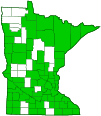
Native |
||
Occurrence |
||
Common |
||
Taxonomy |
|
Kingdom |
|
Subkingdom |
Pteridobiotina |
Phylum |
Tracheophyta (Vascular Plants) |
Class |
|
Order |
Malpighiales (Nances, Willows, and Allies) |
Family |
Euphorbiaceae (spurge) |
Subfamily |
Euphorbioideae |
Tribe |
Euphorbieae |
Subtribe |
Euphorbiinae |
Genus |
Euphorbia (spurges) |
Subgenus |
Chamaesyce |
Section |
Anisophyllum (sandmats) |
Spotted spurge was formerly classified as Chamaesyce maculata. Species were originally assigned to the genus Chamaesyce based on the structure of the reproductive organs. Genus wide molecular studies in 2002, 2006, 2007, and 2010 have all unequivocally placed them in the genus Euphorbia, where they were subsequently transferred. |
|
Subordinate Taxa |
|
Synonyms |
|
Chamaesyce maculata Chamaesyce mathewsii Chamaesyce supina Chamaesyce tracyi Euphorbia supina |
|
The species epithet maculata is derived from the Latin word maculatus, and means “spotted”. It refers to the reddish spot often but not always near the middle of the leaves of this plant. |
|
Common Names |
|
eye-bane eye-bright large spurge milk-purslane nodding spurge prostrate spurge slobber-weed spotted sandmat spotted sand-mat spotted spurge stubble spurge wart-weed |
|
Glossary
Axil
The upper angle where the leaf stalk meets the stem.
Bract
Modified leaf at the base of a flower stalk, flower cluster, or inflorescence.
Cyathium
The false flower of the spurge (Euphorbiaceae) family, consisting of a cup-like involucre surrounding a cluster of small flowers.
Glaucous
Pale green or bluish gray due to a whitish, powdery or waxy film, as on a plum or a grape.
Involucre
A whorl of bracts beneath or surrounding a flower, flower head, or flower cluster.
Linear
Long, straight, and narrow, with more or less parallel sides, like a blade of grass.
Node
The small swelling of the stem from which one or more leaves, branches, or buds originate.
Sepal
An outer floral leaf, usually green but sometimes colored, at the base of a flower.
Visitor Photos |
||
Share your photo of this plant. |
||
This button not working for you? |
||
|
||
|
||
MinnesotaSeasons.com Photos |
||
 |
 |
|
 |
 |
|
 |
 |
|
 |
 |

Slideshows |
Euphorbia supina SPOTTED CREEPING SPURGE |
|
Visitor Videos |
||
Share your video of this plant. |
||
This button not working for you? |
||
|
Other Videos |
||
Roswell Lawn Care- Weed Pro: Spotted Spurge Weed |
About
Uploaded on Apr 28, 2009 http://www.weedpro.com. WeedPro® Lawn Care - Call us for Free Quote 770-WeedPro - Serving the Metro Atlanta area - Organic, 100% Natural, Traditional weed, lawn and yard services for both commercial and residential. In this video we discuss basic yard / turf maintenance tips. Our goal at Weed Pro Lawn Care is to enhance and promote natural processes in your lawn, encouraging a strong healthy soil of microorganism will insure a green healthy lawn. This video is an overview about Spotted Spurge. |
Off-Grid John: Department of Foraging 7/26/2011-Purslane & Spurge. |
About
Uploaded on Jul 9, 2011 Another video that points out the difference between a wild edible (Purslane) and a non-edible mimic (Spurge). Purslane is a succulent with a mildly sour taste and is high in Omega 3's. I am a forager and recommend learning about this activity, but do not take this video as a recommendation on its own...DO YOUR RESEARCH and learn to identify wild edibles before you eat them. Use the universal edibility test when encountering new wild edibles to test for toxicity and allergic reactions. |

Visitor Sightings |
||
Report a sighting of this plant. |
||
This button not working for you? |
||
Christa |
This weed has infested my garden and has been nothing but a headache to manage. I wish it would go away! |
|
MinnesotaSeasons.com Sightings |
||
|
Created: Last Updated: © MinnesotaSeasons.com. All rights reserved. |