



variegated scouring rush
(Equisetum variegatum ssp. variegatum)
Conservation • Wetland • Description • Habitat • Ecology • Use • Distribution • Taxonomy
Conservation Status |
|
|||||||
| IUCN Red List | not listed |
|||||||
| NatureServe | N5 - Secure SNR - Unranked |
|||||||
| Minnesota | not listed |
|||||||
Wetland Indicator Status |
||||||||
| Great Plains | FACW - Facultative wetland |
|||||||
| Midwest | FACW - Facultative wetland |
|||||||
| Northcentral & Northeast | FACW - Facultative wetland |
|||||||
Description |
||
Variegated scouring rush is an erect, 4″ to 18″ tall, evergreen, unbranched perennial that rises from rhizomes. The stems are erect, slender, 1 ⁄32″ to 3 ⁄32″ in diameter, green, unbranched, and hollow. They have 5 to 12 vertical ridges with silica deposits making them rough to the touch. They are evergreen, lasting more than one year. The central cavity is ¼ to ⅓ the diameter of the stem. The portion of the stem between the nodes is up to several inches near the bottom, becoming progressively shorter as they ascend the stem. The leaves are reduced in size, fused together for part of their length, and appressed against the stem, forming a collar-like sheath around the nodes. The sheaths are 1 ⁄16″ to 3 ⁄16″ long, poorly marked at the base, and slightly flared outwards at the tip. They are green with a black band at the tip only. At the tip of the sheath are 5 to 12 free lobes appearing as tiny teeth. The teeth have a black, 1 ⁄16″ wide, 2-ridged stripe in the center and conspicuous white translucent margins. The teeth are not jointed and usually persist. A solitary, spore-bearing cone is borne at the end of each fertile stem. The cone is small, ⅜″ long or less, circular in cross-section, and elliptic in long section. It ends with a small but conspicuous, abrupt, flexible point at the tip (apiculate). Infertile stems are similar to fertile stems but lack the terminal cone. The cone falls off after releasing spores. |
||
Height |
||
4″ to 18″ |
||
Similar Species |
||
Scouring rush horsetail (Equisetum hymale ssp. affine) is a much taller plant, usually reaching 24″ to 48″ tall. The stems are much thicker, ⅛″ to ½″ in diameter. The sheaths appear squarish, are tan, grayish, or white, and have a black band at both the base and the tip. There are 14 to 50 vertical ridges on the stem and the same number of teeth on the sheath. The teeth are jointed. The cone is longer, ⅜″ to 1″ long. Smooth scouring rush (Equisetum laevigatum) is a taller plant, reaching 12″ to 36″ tall. The stems are thicker, ⅛″ to 5 ⁄16″ in diameter, lighter green, smooth to the touch, and annual. There are usually 16 to 30 vertical ridges on the stem and the same number of teeth on the sheath. The teeth are jointed and fall off promptly at maturity. The cone is longer, ⅜″ to 1″ long, rounded at the tip, and often inconspicuously apiculate. |
||
Habitat |
||
Wet. Thickets, bogs. |
||
Ecology |
||
Sporulation |
||
|
||
Pests and Diseases |
||
|
||
Use |
||
The stems are unbranched or have few irregular branches. They are coated with an abrasive silica, and were used for scrubbing cooking pots. This, along with their rush-like appearance, gave rise to the common name “scouring rush”. |
||
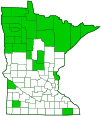
Distribution |
||||
|
Sources |
|||
| 6/8/2023 | ||||
Nativity |
||||
Native |
||||
Occurrence |
||||
|
||||
Taxonomy |
|||
| Kingdom | Plantae (Plants) | ||
| Subkingdom | Pteridobiotina | ||
| Phylum | Tracheophyta (Vascular Plants) | ||
| Subdivision | Polypodiophytina | ||
| Class | Polypodiopsida (ferns) | ||
| Subclass | Equisetidae (horsetails) | ||
Order |
Equisetales (horsetails) | ||
Family |
Equisetaceae (horsetail) | ||
Genus |
Equisetum (horsetails) | ||
| Subgenus | Hippochaete (scouring rushes) | ||
| Species | Equisetum variegatum (variegated scouring rush) | ||
Monotypic genus, family, and order Subgenus Living fossil |
|||
Subordinate Taxa |
|||
|
|||
Synonyms |
|||
Equisetum hyemale ssp. variegatum Equisetum variegatum var. anceps Hippochaete variegata |
|||
Common Names |
|||
variegated horsetail variegated scouring rush variegated scouring-rush variegated scouringrush |
|||
Glossary
Apiculate
Ending in a short, abrupt, flexible point.
Node
The small swelling of the stem from which one or more leaves, branches, or buds originate.
Rhizome
A horizontal, usually underground stem. It serves as a reproductive structure, producing roots below and shoots above at the nodes.
Visitor Photos |
|||||
Share your photo of this plant. |
|||||
| This button not working for you? Simply email us at info@MinnesotaSeasons.com. Attach one or more photos and, if you like, a caption. |
|||||
|
|||||
MinnesotaSeasons.com Photos |
|||||
|
|||||

Slideshows |
||

Visitor Videos |
|||
Share your video of this plant. |
|||
| This button not working for you? Simply email us at info@MinnesotaSeasons.com. Attach a video, a YouTube link, or a cloud storage link. |
|||
Other Videos |
|||
| Northern Scouring Rush Horsetail Equisetum variegatum A Bush craft medicinal Herb AdamSurvivingAmerica |
|||
About
Published on Sep 7, 2012 Information on scoring rush greater horsetail. Not to be confused with the field horestail. This is a video from my old channel, AccordingtoAdam1826, that was closed due to uncertain circumstances. We are back on the new channel, Adam hall000, and posting all of the old videos. These videos are property of Adam Hall. This is in the horetail family and have an evergreen, hollow-stemmed, rough-surfaced, jointed primitive perennial. They can grow up to 5 feet. They have jointed, apparently leafless, rough, finley ribbed, nonbranching stems. They are found mostly in moist, sandy soils, along streambanks and pond edges. Used also as a scour pad. In Chinses medicine it is prescribed for swelling, rednedd of the eyes, and bleeding. Information found in Western Medicinal plants and herbs by Steven Foster and Christopher Hobbs. This plant information and statements in these videos are for educational purposes only and should not be construed to be medical advice, diagnosis or treatment. If you are unsure of the plant, don't eat it or touch it. We assume no legal liability or responsibility for injuries resulting from what you take out of the information provided in this video. Make sure you can positively identify a plant before eating it. Some plants are poisonous, and misidentification could possibly result in serious illness or death. |
|||

Visitor Sightings |
|||||
Report a sighting of this plant. |
|||||
| This button not working for you? Simply email us at info@MinnesotaSeasons.com. Be sure to include a location. |
|||||
|
|||||
MinnesotaSeasons.com Sightings |
|||||
|
|||||
|
Created: Last Updated: © MinnesotaSeasons.com. All rights reserved. |