



white ash
(Fraxinus americana)
Conservation • Wetland • Description • Habitat • Ecology • Use • Distribution • Taxonomy
Conservation Status |
|
|||||||
| IUCN Red List | not listed |
|||||||
| NatureServe | N5 - Secure SNR - Unranked |
|||||||
| Minnesota | not listed |
|||||||
Wetland Indicator Status |
||||||||
| Great Plains | FACU - Facultative upland |
|||||||
| Midwest | FACU - Facultative upland |
|||||||
| Northcentral & Northeast | FACU - Facultative upland |
|||||||
Description |
||
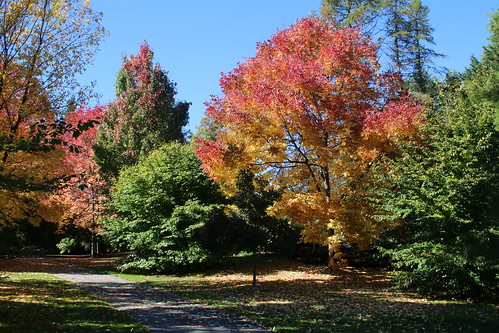
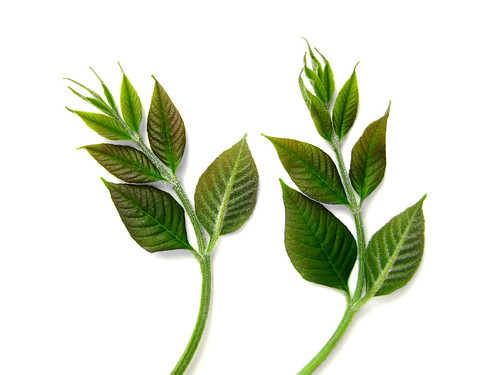
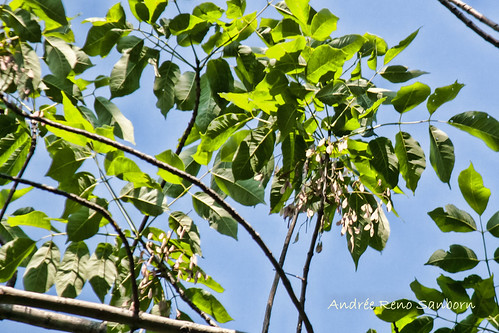
White ash is a moderately fast-growing deciduous tree. In Minnesota mature trees are usually 40′ to 70′ tall and 10″ to 24″ in diameter at breast height. Large individuals can reach over 80′ in height and 40″ in diameter. It is a moderately long-lived tree, reaching up to 200 years old. The trunk is straight and often unbranched nearly to the top. The crown is dense, narrow, and pyramid-shaped. The root system is deep where soil conditions permit. The crown is dense and usually rounded, sometimes irregular. The bark on young trees is smooth and greenish-gray. It does not become flaky. As it ages it develops firm, narrow, raised, corky ridges. The ridges are interlaced and form a diamond-shaped pattern, and is identical to the bark of green ash. The twigs are stout, round or oval in cross section, shiny, hairless, green or purplish, with scattered white dots (lenticels). The buds are dark brown. The terminal bud is 3 ⁄16″ to 9 ⁄16″ long, wider than long, blunt, and reddish-brown. The uppermost pair of lateral buds occurs at the base of the terminal bud. The leaf scars are half-round and on well-developed branches are deeply notched at the top. The buds originate well within the notch. The leaves are deciduous, opposite, and pinnately compound. They are 8″ to 12″ long and are divided into 5 to 9, usually 7, leaflets. The leaflets are all clearly stalked. They are arranged in opposite pairs with 1 terminal leaflet. They are oval to lance-shaped, 2¾″ to 5″ long, and 1″ to 2″ wide. They are tapered at the base and taper to a point at the tip, often to an abrupt point with concave sides along the tip. The upper surface is dark green and hairless. The lower surface is distinctly paler or white and hairless except along the veins. The margins have infrequent, rounded teeth above the middle or are sometimes untoothed. In autumn the leaves turn yellow or bronze-purple and are shed as individual leaflets, not entire leaves. The tips of the leaflets do not droop. Male and female flowers are borne on separate trees. They are borne in branched clusters in all parts of the crown. They are purplish, small, and inconspicuous, and have no petals. They appear in April to May just before or at the same time as the leaves. The fruit is a 1″ to 2″ long, ⅛″ to 5 ⁄16″ wide samara consisting of a flattened seed case with a dry, flattened, papery, wing. The wing is rounded or notched at the tip, and encloses ⅓ of the seed case. The seed case is nearly as thick as wide, less than 6½ times as long as wide, and much thicker than the wing. It contains a single seed. The samara ripens in late summer and is dispersed from September to December. |
||
Height |
||
40′ to 70′ |
||
Record |
||
The champion white ash in Minnesota is on state property near Canton, in Fillmore County. In 2009 it was measured at 87′ tall and 156″ in circumference (49½″ in diameter), with a crown spread of 77′. |
||
Flower Color |
||
Purplish |
||
Similar Species |
||
Blue ash (Fraxinus quadrangulata) twigs are 4-angled, or winged. |
||
Habitat |
||
Dry to moist. Upland forests. |
||
Ecology |
||
Flowering |
||
April to May |
||
Pests and Diseases |
||
|
||
Use |
||
|
||
Distribution |
||||
|
Sources |
|||
| 4/30/2023 | ||||
Nativity |
||||
Native |
||||
Occurrence |
||||
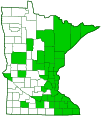
Widespread and common in eastern United States, uncommon in Minnesota |
||||
Taxonomy |
|||
| Kingdom | Plantae (Plants) | ||
| Subkingdom | Pteridobiotina | ||
| Phylum | Tracheophyta (Vascular Plants) | ||
| Class | Magnoliopsida (Dicots) | ||
Order |
Lamiales (Mints, Plantains, Olives, and Allies) | ||
Family |
Oleaceae (Olive) | ||
| Tribe | Oleeae | ||
| Genus | Fraxinus (Ashes) | ||
| Section | Melioides | ||
Synonyms |
|||
Fraxinus americana var. biltmoreana Fraxinus americana var. crassifolia Fraxinus americana var. curtissii Fraxinus americana var. juglandifolia Fraxinus americana var. microcarpa Fraxinus biltmoreana |
|||
Common Names |
|||
| white ash | |||
Glossary
Lenticel
A corky, round or stripe-like, usually raised, pore-like opening in bark that allows for gas exchange.
Pinnate
On a compound leaf, having the leaflets arranged on opposite sides of a common stalk. On a bryophyte, having branches evenly arranged on opposite sides of a stem.
Samara
A dry fruit consisting of a seed attached to a papery wing; one seeded in Elms and Ashes, two-seeded in Maples.
Visitor Photos |
|||||
Share your photo of this plant. |
|||||
| This button not working for you? Simply email us at info@MinnesotaSeasons.com. Attach one or more photos and, if you like, a caption. |
|||||
|
|||||
MinnesotaSeasons.com Photos |
|||||
|
|||||

Slideshows |
||
| Fraxinus americana Blake C. Willson |
||
|
||
About
White Ash |
||
| Fraxinus americana - White Ash Virens (Latin for greening) |
||
|
||
| White Ash (Fraxinus americana) Andree Reno Sanborn |
||
|
||
| White ash (Fraxinus americana) Jim Hamilton |
||
About
Uploaded on Jun 20, 2008 A brief species overview of white ash (Fraxinus americana). |
||
Visitor Videos |
|||
Share your video of this plant. |
|||
| This button not working for you? Simply email us at info@MinnesotaSeasons.com. Attach a video, a YouTube link, or a cloud storage link. |
|||
Other Videos |
|||
| Trees with Don Leopold - white ash ESFTV |
|||
About
Uploaded on Oct 2, 2011 |
|||
| How to Identify a White Ash Tree About.com |
|||
About
Published on Jun 8, 2012 White ash trees are beautiful, North American trees notable for their compound leaf structure. This video from About.com will show you how to identify a white ash tree. |
|||
| How to tell White, Black, & Green Ash Apart Gregor Wilke |
|||
About
Published on Aug 27, 2012 A tutorial of how to tell the America's 3 most common Eastern Ash trees apart. Fraxinus nigra (Black Ash) Fraxinus pennsylvanica (Green Ash) and Fraxinus americana (White Ash) can be confusing to tell apart to the average eye. This tutorial is designed to point out the main differences between the trees, so that after a bit of practice anyone can I.D. these trees in the field, or in their yard. Knowing what kind of ash tree you have, or are dealing with may be especially important with the onset of Emerald Ash Borer and determining what value your ash trees may hold. Check out my other tutorials! How to Do a Backflip- http://www.youtube.com/watch?v=9E3WFKxmQNs Mac Green Screen Tutorial- http://www.youtube.com/watch?v=QYjQt-eC748 |
|||
| White Ash identification video ( Fraxinus Americana ) wvoutdoorman |
|||
About
Published on Aug 3, 2012 A Video to help with white ash identification ( Fraxinus Americana ) |
|||
| How to Identify an Ash Tree, EAB, & Signs of Infestation.wmv muddawg4x4 |
|||
About
Uploaded on Apr 29, 2011 The Wisconsin Department of Agriculture has released a new educational video on the Emerald Ash Borer and how you can identify an ash tree, the Emerald Ash Borer beetle, and signs of infestation. For more information go to www.emeraldashborer.wi.gov/ |
|||

Visitor Sightings |
|||||
Report a sighting of this plant. |
|||||
| This button not working for you? Simply email us at info@MinnesotaSeasons.com. Be sure to include a location. |
|||||
|
|||||
MinnesotaSeasons.com Sightings |
|||||
|
Created: Last Updated: © MinnesotaSeasons.com. All rights reserved. |