



yellow trout lily
(Erythronium americanum ssp. americanum)
Conservation • Description • Habitat • Ecology • Use • Distribution • Taxonomy
Conservation Status |
|
|||||||
| IUCN Red List | not listed |
|||||||
| NatureServe | N5 - Secure SNR - Unranked |
|||||||
| Minnesota | not listed |
|||||||
Description |
||
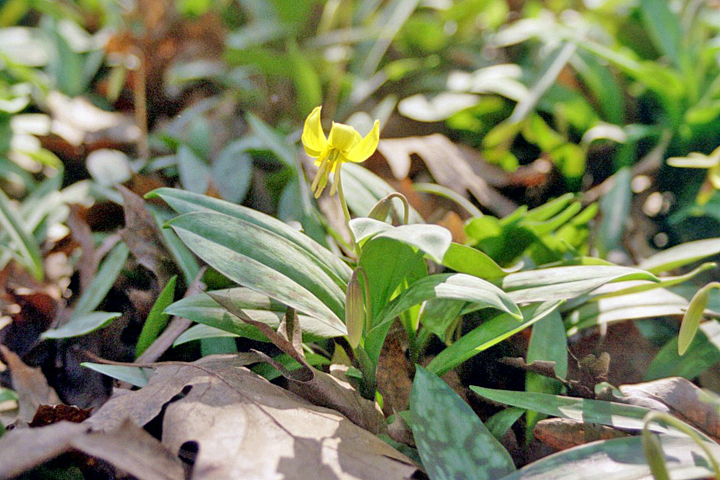
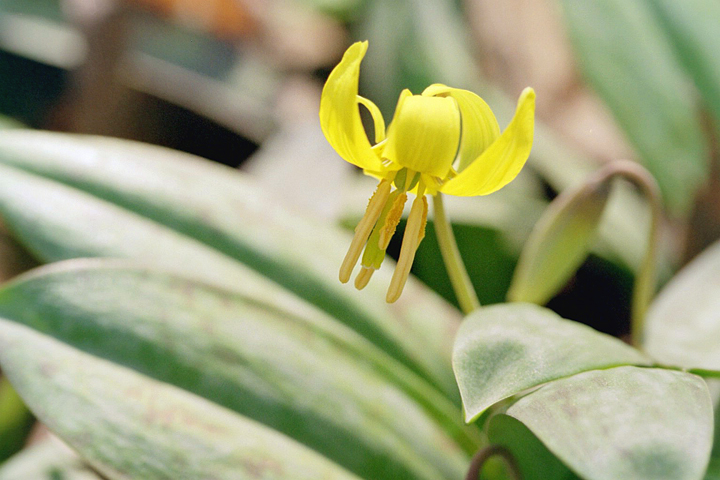
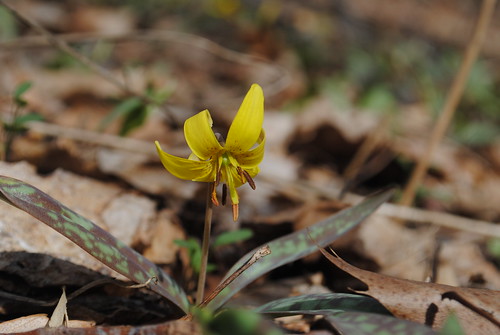
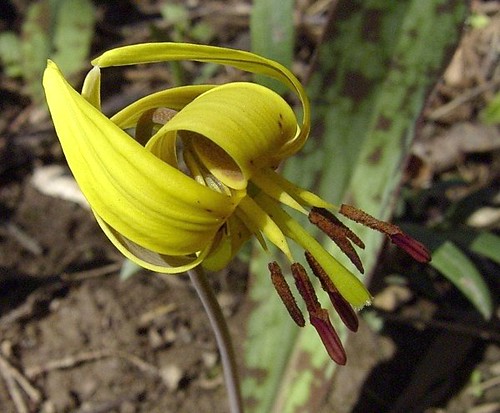
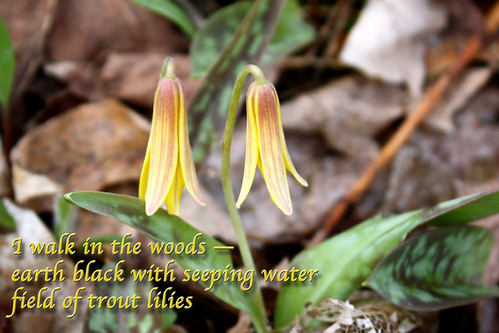
Yellow trout lily is a 4″ to 8″ tall, erect, perennial that rises from a short, vertical, thickened, underground stem (corm). It is usually found in large colonies. Most plants are one-leaved and nonflowering. Flowering plants have two leaves. The leaves appear to originate at the base, but they actually originate below ground, about halfway up the underground stem. They are arranged in pairs but are not exactly opposite. They are 3″to 9″ long, lance-shaped, untoothed, fleshy, green, mottled or spotted with silver, and covered with a whitish, waxy coating. The inflorescence is a solitary flower hanging downward at the end of a stout, nodding stem. The stem is 4″ to 6″ tall, hairless and leafless. The flower has 3 petals and 3 identical-looking sepals, collectively called tepals. The tepals are ⅔″ to 2″ long, lance-shaped, and yellow. They may be spotted toward the base. They flare outward, extending nearly to the horizontal, eventually curving backward. The anthers are up to ½″ long and red, becoming yellow when covered with pollen. The fruit is an egg-shaped, 3-celled capsule, ⅜″ to ⅔″ wide. It is held off the ground horizontally at maturity. At the summit it is squared off or convex or ends abruptly in a small, slender point. |
||
Height |
||
4″ to 8″ |
||
Flower Color |
||
Yellow, sometimes with spots near the base |
||
Similar Species |
||
Minnesota dwarf trout lily (Erythronium propullans) is a rare, much smaller plant, 1½″ to 4″ in height. The leaves are 1½″ to 5″ long. The flower is white. The tepals are about ½″ long. White trout lily (Erythronium albidum) has white flowers. The fruit is held erect. |
||
Habitat |
||
Moist. Woods. |
||
Ecology |
||
Flowering |
||
April to May |
||
Spring Ephemeral |
||
Yellow trout lily is a true spring ephemeral. All of the parts of the plant that are above ground will have disappeared by the time the forest canopy has developed in June. |
||
Pests and Diseases |
||
|
||
Use |
||
|
||
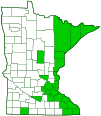
Distribution |
||||
|
Sources |
|||
| 5/13/2023 | ||||
Nativity |
||||
Native |
||||
Occurrence |
||||
|
||||
Taxonomy |
|||
| Kingdom | Plantae (Plants) | ||
| Subkingdom | Pteridobiotina | ||
| Phylum | Tracheophyta (Vascular Plants) | ||
| Class | Liliopsida (Monocots) | ||
Order |
Liliales (Lilies, Supplejacks, and Allies) | ||
Family |
Liliaceae (lilies) | ||
| Subfamily | Lilioideae | ||
| Tribe | Tulipeae | ||
Genus |
Erythronium (fawn lilies) | ||
| Species | Erythronium americanum (yellow trout lily) | ||
Some sources, including GRIN, place the genus Erythronium in the tribe Lilieae. Other sources, including iNaturalist, separate Erythronium with the genus Tulipa and six other genera into the tribe Tulipeae. |
|||
Synonyms |
|||
|
|||
Common Names |
|||
amberbell American trout-lily dog-tooth violet trout lily yellow adder’s tongue yellow dog-tooth violet yellow trout lily yellow trout-lily |
|||
Glossary
Lanceolate
Lance-shaped; much longer than wide, thickest toward the base, and gradually tapering toward the tip.
Oblanceolate
Reverse lanceolate; much longer than wide, thickest toward the tip, and gradually tapering toward the base.
Tepal
Refers to both the petals and the sepals of a flower when they are similar in appearance and difficult to tell apart. Tepals are common in lilies and tulips.
Visitor Photos |
|||||
Share your photo of this plant. |
|||||
| This button not working for you? Simply email us at info@MinnesotaSeasons.com. Attach one or more photos and, if you like, a caption. |
|||||
|
|||||
MinnesotaSeasons.com Photos |
|||||
Plant |
|||||
 |
|||||
Flower |
|||||
 |
 |
||||

Slideshows |
||
| Erythronium americanum Zi W |
||
|
||
| Trout Lily DianesDigitals |
||
|
||
About
Copyright DianesDigitals |
||
| Trout Lily (Erythronium americanum) Andree Reno Sanborn |
||
|
||

Visitor Videos |
|||
Share your video of this plant. |
|||
| This button not working for you? Simply email us at info@MinnesotaSeasons.com. Attach a video, a YouTube link, or a cloud storage link. |
|||
Other Videos |
|||
| MyNature Apps; Identifying a Trout Lily, Erythronium americanum MyNatureApps |
|||
About
Uploaded on May 3, 2011 How to identify a Trout Lily, Erythronium americanum. Brought to you by MyNature Apps, www.mynatureapps.com |
|||
| 07 Erythronium americanum Séquence 9-Vivaces printanières 1.m4v Jeanfilm2 |
|||
About
Uploaded on Jan 9, 2010 L'Érythrone d'Amérique du printemps à l'automne. Erythronum americanum de la primavera hasta el otoño. Dog's tooth violet from spring to fall. |
|||
| Erythronium americanum with Dan Jaffe newenglandwild |
|||
About
Published on May 18, 2013 New England Wild Flower Society propagator and stock bed grower, Dan Jaffe, examines one of NEWFS's favorite native ephemerals species Erythronium americanum, the American trout lily including growth form, edibility and planting options. |
|||
| Trout Lily (Erythronium americanum) wvoutdoorman |
|||
About
Published on Mar 27, 2012 Trout Lily (Erythronium americanum) I show the roots and different stages of the plant to help identify |
|||

Visitor Sightings |
|||||
Report a sighting of this plant. |
|||||
| This button not working for you? Simply email us at info@MinnesotaSeasons.com. Be sure to include a location. |
|||||
|
|||||
MinnesotaSeasons.com Sightings |
|||||
|
Created: Last Updated: © MinnesotaSeasons.com. All rights reserved. |