Mink Frog - Species Profile
Conservation • Description • Habitat • Ecology • Distribution • Taxonomy

Conservation Status
IUCN Red List
LC - Least Concern
NatureServe
N5 - Secure
S5 - Secure
Minnesota
not listed
Description
Mink frog is a medium size frog, 1¾″ to 3″ long at maturity.
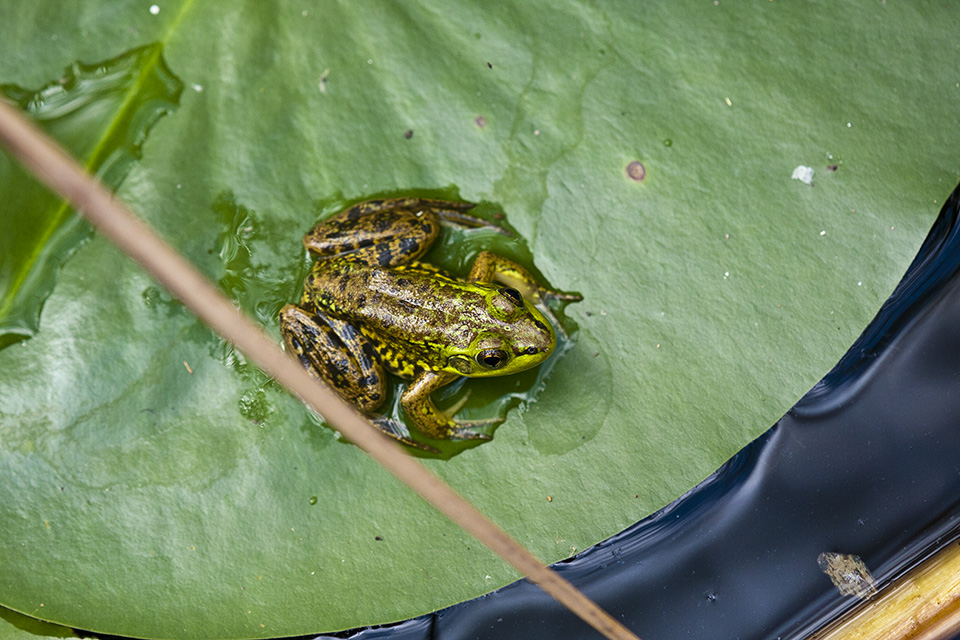
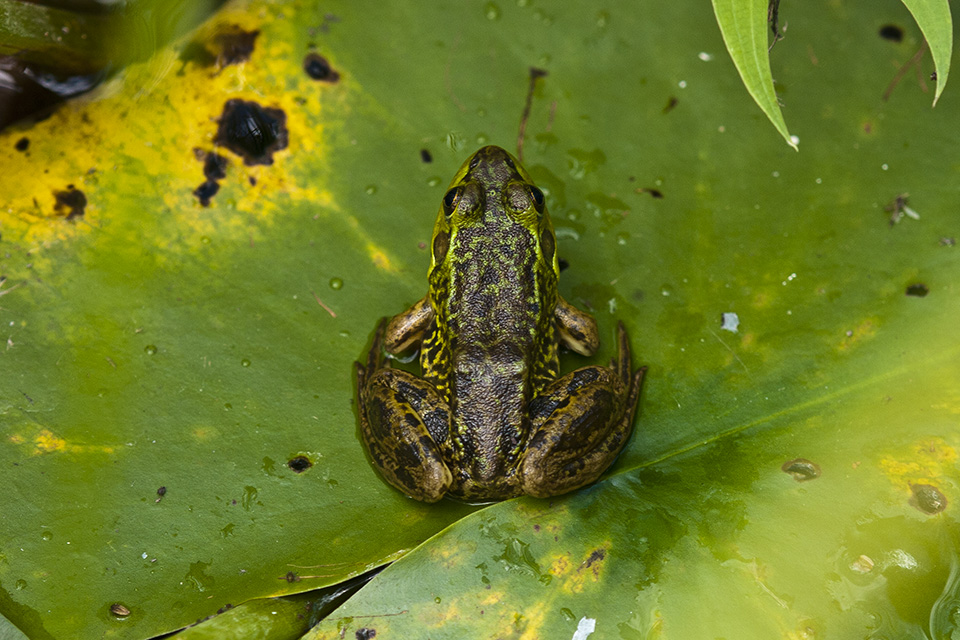
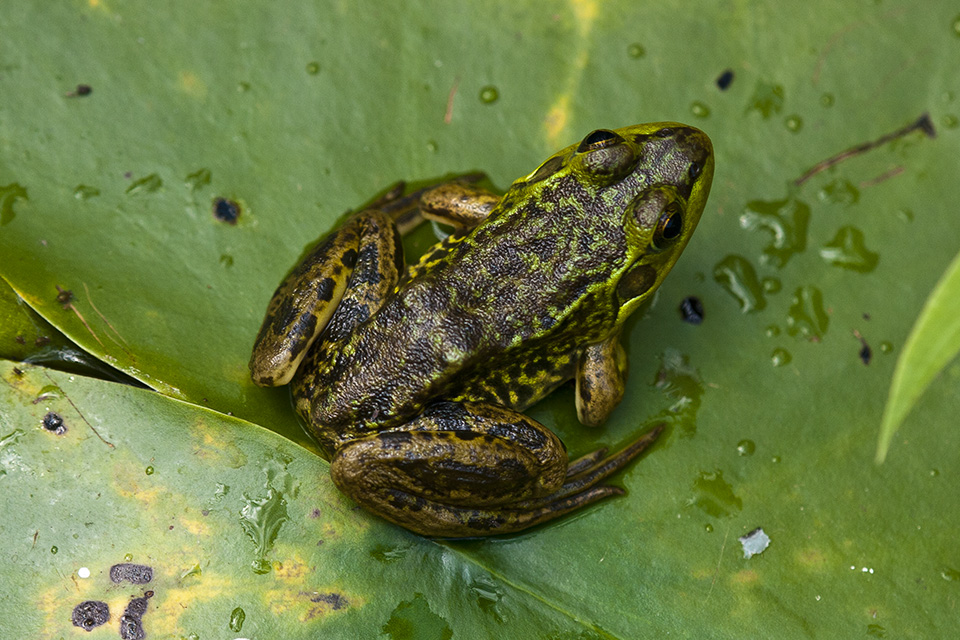
The background color is olive-brown to green. The back and sides are covered with dark brown spots or mottling. The chin, throat, and belly are yellowish-white, and may have gray spotting or mottling. The skin is smooth, not warty. When rubbed the skin emits a mink-like odor that has been compared to rotting onions. Raised ridges (dorsolateral folds) on the back, if present, are usually weakly developed. Few individuals have prominent dorsolateral folds.
The disk covering the ear opening (tympanum) in males is larger than the eye. In females it is the same size or slightly smaller than the eye.
The hind feet has a broad web covering all of the toes, with only the tip of the fourth toe free.
Size
Total length: 1¾″ to 3″
Voice
Amphibian Research and Monitoring Initiative (ARMI), Midwest Region
Frog and Toad Calls
Similar Species
North American Green Frog (Lithobates clamitans) always has well-defined dorsolateral folds on the back. The hind feet are only partially webbed. The skin does not produce a rotting onion odor when rubbed.
Habitat
Lakes, ponds, slow areas of rivers, deep bogs.
Ecology
Behavior
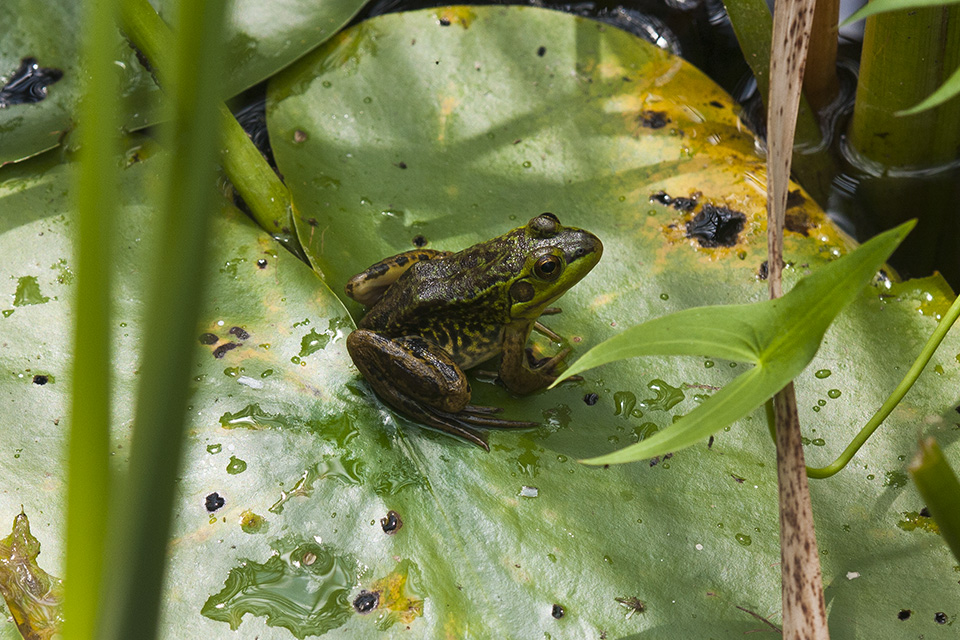
Adults can often be seen sitting on lily pads.
Lifespan
Males: 3 years
Females: 4 years
Life Cycle
Between late May and August the female lays a mass of 500 to 4,000 eggs under water on the submerged stem of an aquatic plant. The egg mass often detaches and sinks to the bottom. The amount of time the eggs take to hatch is variable.
When the egg hatches a tadpole emerges. Some tadpoles metamorphose into froglets after about one year, others require two years. At the time of metamorphosis the froglets are almost 60% of their final adult size.
To avoid freezing, overwintering tadpoles and adults hibernate in the mud at the bottom of the same water they inhabited the rest of the year. They enter hibernation in late September and emerge in late April or early May.
Most Mink Frogs live only 1 or 2 years after metamorphosis. Males sometimes survive 3 years, females sometimes 4 years.
Tadpole Food
Algae
Adult Food
Spiders, snails, dragonflies, whirligig and other beetles, earthworms, and other invertebrates.
Distribution
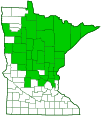
Sources
Biodiversity occurrence data published by: Minnesota Biodiversity Atlas (accessed through the Minnesota Biodiversity Atlas Portal, bellatlas.umn.edu. Accessed 1/7/2026).
HerpMapper. 2026. HerpMapper - A Global Herp Atlas and Data Hub. Iowa, U.S.A. Available http://www.herpmapper.org. (Accessed: 1/7/2026).
USGS National Amphibian Atlas. https://armi.usgs.gov/atlas/. Accessed 1/7/2026).
Occurrence
Common
Taxonomy
Class
Amphibia (Amphibians)
Order
Anura (Frogs and Toads)
Family
Ranidae (True Frogs)
Genus
Lithobates (American Water Frogs)
Genus
In 2006, Frost et al. transferred most North American true frogs from the genus Rana to Lithobates, a controversial decision initially met with resistance. While Stuart, Pauly et al., and other systematic reviews rejected the change in 2008 and 2009, the transfer has since gained near-universal acceptance by 2024. Amphibian Species of the World, GBIF, NatureServe, iNaturalist, Society for the Study of Amphibians and Reptiles (SSAR), UniProt, and USGS ARMI National Amphibian Atlas use the name Lithobates septentrionalis.
In 2016, a consortium of Rana researchers from Europe, Asia, and North America showed that transferring the species to Lithobates caused problems of paraphyly in other genera. In that same year, Yuan et al. returned all North American true frogs to the genus Rana, using subgenera for all of the well-defined species groups within Rana. AmphibiaWeb uses the name Rana septentrionalis.
A recent div (Dubois, Alain et al., 2021) proposed a new “phylogenetic taxonomy and nomenclature” of extant amphibians (subclass Lissamphibia). In the proposed taxonomy, the subgenus Aquarana is raised to full species rank, and Lithobates septentrionalis becomes Aquarana septentrionalis. Catalog of Life, HerpMapper, ITIS, and NCBI use the name Aquarana septentrionalis.
Subordinate Taxa
Synonyms
Aquarana septentrionalis
Rana septentrionalis
Rana sinuata
Common Names
Mink Frog