


House pseudoscorpion
(Chelifer cancroides)
Conservation • Description • Habitat • Ecology • Distribution • Taxonomy
Conservation Status |
|
||||
| IUCN Red List | not listed |
||||
| NatureServe | NNR - Unranked |
||||
| Minnesota | not listed |
||||
Description
House pseudoscorpions are small, exotic, predacious arachnids. They are highly synanthropic, meaning they thrive in habitats associated with humans, and they are the pseudoscorpions most commonly encountered by humans. They are most often reported in houses, barns, stables, chicken coops, bee hives, and other human-built structures. They are sometimes found in sinks or bathtubs, where they went in search of water but were unable to climb up the slippery sides to get out. They feed on a variety of small invertebrates, including mites, booklice, and fruit flies.
House pseudoscorpions are believed to be native to Europe and parts of Asia. They were introduced into North America accidentally. As the first Europeans came to the new world, they brought with them books, paper goods, hay, straw, agricultural goods, and firewood. Pseudoscorpions, feeding on pests like booklice, mites, and carpet beetle larvae, were likely transported along with the people and goods.
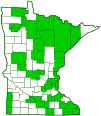
House pseudoscorpions are now cosmopolitan, occurring on all continents worldwide except Antarctica. They are commonly recorded in Europe, North Africa, Central Asia, and North America, but there are very few records in other regions. They occur throughout most of the United States and southern Canada, but they are absent from the Deep South, the Great Plains, and the Great Basin.
Adults are small, ⅛″ (3 to 4 mm) in length. The body is pear shaped, flattened, and reddish brown.
The front part of the body (cephalothorax) has distinct lateral keels. The surface is granular, and there are numerous large granules scattered among the smaller ones. There are two eyes. The last part of the jaws (chelicera), called the hand, has a granular surface and 4 long, bristle-like hairs (setae). The pedipalps are very long and have pincer-like claws (chelae) at the tip. The chelae have a fixed finger and a movable finger. Both fingers are untoothed, and both have a small but well-developed venom apparatus at the tip.
The rear part of the body (abdomen) has 12 segments but only 10 segments are visible. The upper part of each segment (tergite) is clearly defined. On males, tergites 1 through 4 or 5 have distinct lateral keels.
All of the legs have 6 segments. The third segment (femur) on the first and second pair of legs are a different shape than those on the third and fourth pairs. On all legs, the last segment (tarsus) is undivided, and it has a pair of claws at the tip. The claws are split (bifid) on all legs except for the front legs of the male. On the fourth pair of legs, the claws have an accessory tooth. On the male, the tarsus on the first pair of legs does not have a spine at the tip.
Size
Total Length: ⅛″ (3 to 4 mm)
Similar Species
Habitat
Houses, barns, stables, chicken coops, bee hives, and other human-built structures
Ecology
Season
Year round
Behavior
Life Cycle
Food
Small invertebrates
Distribution |
||
|
Sources |
|
| 12/4/2025 | ||
Occurrence |
||
Common and widespread |
||
Taxonomy
Class
Order
Pseudoscorpiones (Pseudoscorpions)
Suborder
Iocheirata
Infraorder
Panctenata
Zoosection
Elassommatina
Superfamily
Cheliferoidea
Family
Cheliferidae
Subfamily
Cheliferinae
Tribe
Cheliferini
Genus
Chelifer
Subordinate Taxa
Synonyms
Acarus cancroides
Chelifer cancroides ssp. cancroides
Chelifer cancroides ssp. orientalis
Chelifer granulatus
Chelifer hermannii
Common Names
house false-scorpion
house pseudoscorpion
Glossary
Cephalothorax
The front part of the body of various arthropods, composed of the head region and the thoracic area fused together. Eyes, legs, and antennae are attached to this part.
Chelicerae
The pair of stout mouthparts, corresponding to jaws, in arachnids and other arthropods in the subphylum Chelicerata.
Femur
On insects and arachnids, the third, largest, most robust segment of the leg, coming immediately before the tibia. On humans, the thigh bone.
Pedipalp
The second pair of appendages on the cephalothorax of an arachnid, positioned behind the chelicerae. Their function varies widely among groups. They serve as sensory organs for harvestmen, pincers for pseudoscorpions, and copulatory organs for male spiders.
Seta
A stiff, hair-like process on the outer surface of an organism. In Lepidoptera: A usually rigid bristle- or hair-like outgrowth used to sense touch. In mosses: The stalk supporting a spore-bearing capsule and supplying it with nutrients. Plural: setae. Adjective: setose.
Tarsus
On insects, the last two to five subdivisions of the leg, attached to the tibia; the foot. On spiders, the last segment of the leg. Plural: tarsi.
Tergite
The upper (dorsal), hardened plate on a segment of the thorax or abdomen of an arthropod or myriapod.
Visitor Photos
Share your photo of this arachnid.
This button not working for you?
Simply email us at info@MinnesotaSeasons.com.
Attach one or more photos and, if you like, a caption.
Bill Reynolds |
|
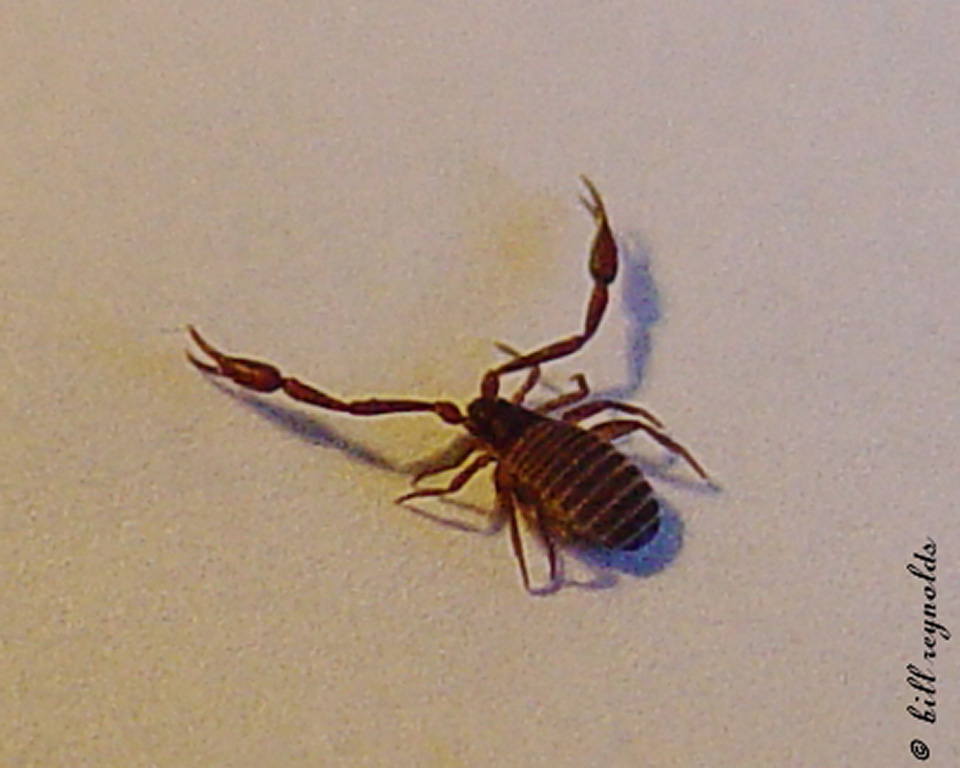
Pseudoscorpion Looking through the Arachnid catalog I didn't see any record for a Pseudoscorpions. Maybe you have them elsewhere. In case not, here is a photo of one I took a few years back. |
MinnesotaSeasons.com Photos
|

Slideshows
Visitor Videos
Share your video of this arachnid.
This button not working for you?
Simply email us at info@MinnesotaSeasons.com.
Attach a video, a YouTube link, or a cloud storage link.
Other Videos
Chelifer cancroides - Pseudoscorpion - Bücherskorpion
Young Waldschrat
House pseudoscorpion. GRĀMATU MĀŅSKORPIONS, Chelifer cancroides.
Anna Grincuka
House Pseudoscorpion (Cheliferidae: Chelifer cancroides?) on Wall
Carl Barrentine

Visitor Sightings
Report a sighting of this arachnid.
This button not working for you?
Simply email us at info@MinnesotaSeasons.com.
Be sure to include a location.
Bill Reynolds
August 2014

Location: Pennington Co. MN
Looking through the Arachnid catalog I didn't see any record for a Pseudoscorpions. Maybe you have them elsewhere.
In case not, here is a photo of one I took a few years back.
MinnesotaSeasons.com Sightings