Purple Jellydisc
(Ascocoryne sarcoides complex)
Information
Conservation • Description • Habitat • Ecology • Distribution • Taxonomy
Conservation Status
IUCN Red List
not listed
NatureServe
not listed
Minnesota
not listed
Description
The name Purple Jellydisc refers to a group of closely related fungi known as the Ascocoryne sarcoides complex. In Minnesota, this complex primarily consists of two species: Ascocoryne sarcoides and Ascocoryne cylichnium. While they appear nearly identical as gelatinous, wine-purple discs, they are technically distinct. Most field observations are grouped under this complex because they cannot be reliably separated without microscopic analysis of their spores or the presence of specific asexual structures.
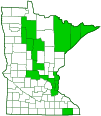
Purple Jellydisc is a widespread and common fungus. It occurs in Europe, Asia, Australia, and North America. In North America it occurs from Maine to Minnesota, south to Illinois and Georgia, on the West Coast, and in adjacent Canadian provinces. It is uncommon in Minnesota, where it is at the western edge of its range. It is found in the fall grouped or clustered in deciduous forests and woodlands on well-rotted hardwood stumps and logs. It obtains its nutrients from rotting wood (saprobic).
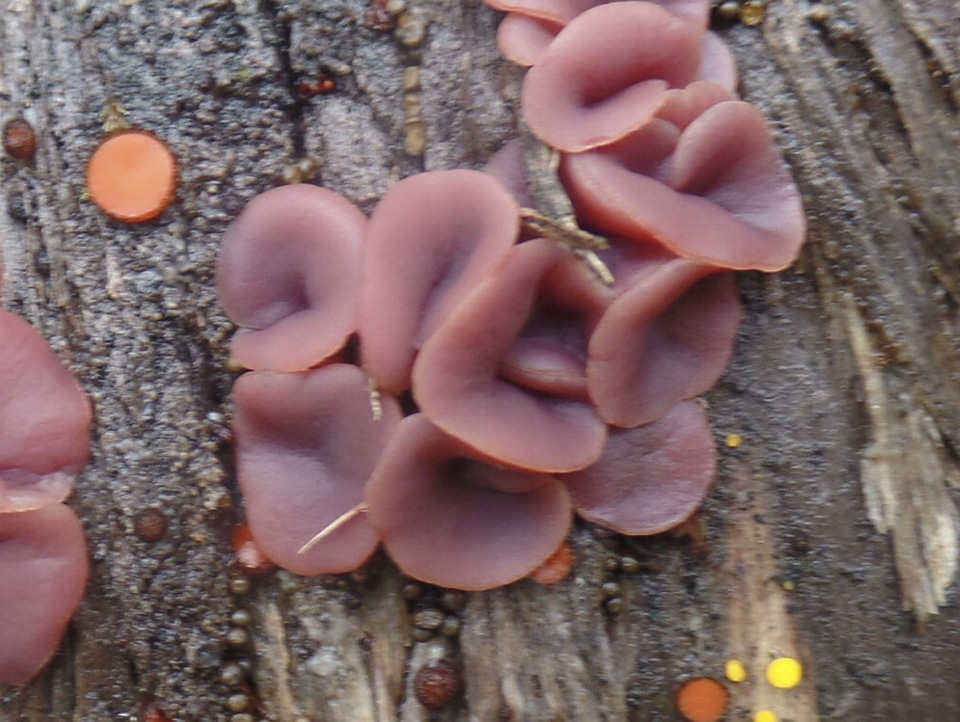
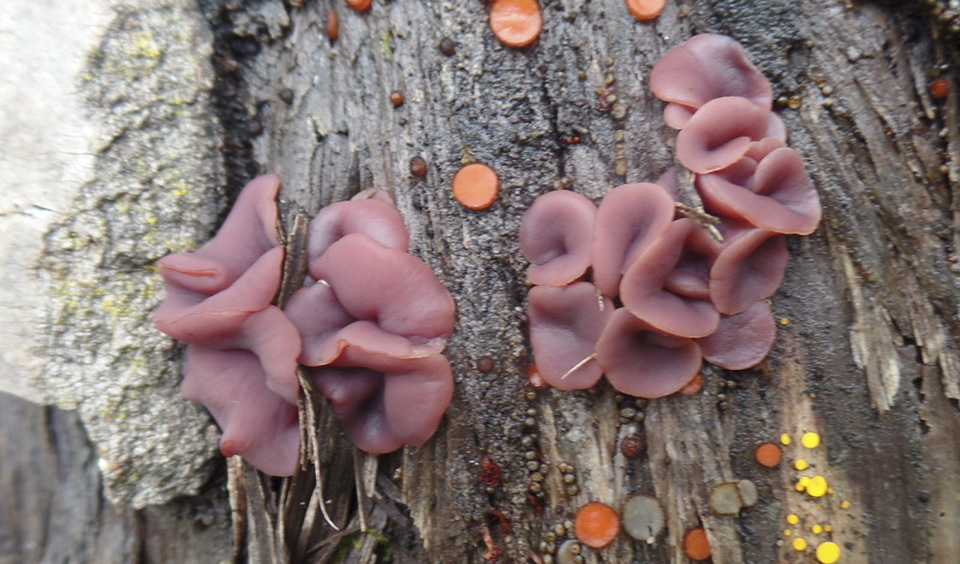
When young, Purple Jellydisc is a lumpy, irregular, gelatinous, purple or wine-red mass up to 8″ (20 cm) across. In this, the anamorphic stage, it reproduces asexually and does not produce spores. It appears brain-like and looks like a jelly fungus. As it ages the lobes flatten out into 3 ⁄16″ to ⅞″ (5 to 22 mm) wide disc-shaped or cup-shaped fruiting bodies. When mature, it looks like a disc fungus. The upper surface is more or less hairless, the under surface is covered with short straight hairs (fuzzy). There is no stem but there is sometimes a short, poorly-defined, stem-like base. In this, the teleomorphic stage, it reproduces sexually and produces spores.
The flesh is odorless and the taste is not distinctive. It is not considered edible.
Identification and the Asexual Stage
While the purple discs (the teleomorph or sexual stage) of these two species are nearly identical, Ascocoryne sarcoides frequently produces a distinct asexual stage (anamorph) that can serve as a helpful “tell.” This stage appears as small, purple, finger-like stalks or cushions, often growing in clusters on the same piece of wood near the discs. If these firm, club-shaped structures are present, the specimen is almost certainly A. sarcoides, as A. cylichnium is not known to produce this prominent asexual form.
Without the presence of these asexual "fingers," or the use of a microscope to examine the spores, the two species cannot be separated with certainty. Most observations of the purple discs alone are simply referred to the Ascocoryne sarcoides complex. Both species are wood-rotting saprobes that favor well-decayed logs of hardwoods, though they are occasionally found on conifers.
Similar Species
Habitat and Hosts
Deciduous forests and woodlands
Ecology
Season
Late summer and fall
Distribution
Sources
Biodiversity occurrence data published by: Minnesota Biodiversity Atlas (accessed through the Minnesota Biodiversity Atlas Portal, bellatlas.umn.edu. Accessed 1/29/2026).
Mycology Collections Portal (MyCoPortal) https://www.mycoportal.org/portal/collections/index.php). Accessed 1/29/2026).
This map includes records and observations of both Ascocoryne sarcoides and Ascocoryne cylichnium.
Occurrence
Taxonomy
Kingdom
Fungi (Fungi)
Subkingdom
Dikarya
Phylum
Ascomycota (Sac Fungi)
Subphylum
Pezizomycotina
Class
Leotiomycetes
Subclass
Leotiomycetidae
Order
Helotiales
Family
Gelatinodiscaceae
Genus
Ascocoryne
Family
The genus Ascocoryne was formerly placed in the family Helotiaceae. A recent multi-gene phylogenetic study of the order Helotiales (Johnston et al., 2019) moved the genus to the family Gelatinodiscaceae after splitting the polyphyletic Helotiaceae into several smaller, monophyletic families. Although this reclassification was not immediately adopted across all databases, the Outline of Fungi and fungus-like taxa 2024 formalized the update. The classification was further reinforced by the updated multigene phylogeny of Johnston et al. (2025).
Genus
Until 1967 this species was classified as Coryne sarcoides.
Subordinate Taxa
fungus (Ascocoryne cylichnium) 
Purple Jellydisc (Ascocoryne sarcoides)
Synonyms
Common Names
Purple Jellydisc complex
Photos
Visitor Photos
Share your photo of this fungus.
This button not working for you?
Simply email us at info@MinnesotaSeasons.com.
Attach one or more photos and, if you like, a caption.
Minnesota Seasons Photos
Slideshows
Slideshows
Videos
Visitor Videos
Share your video of this fungus.
This button not working for you?
Simply email us at info@MinnesotaSeasons.com.
Attach a video, a YouTube link, or a cloud storage link.
Other Videos
Galaretnica mięsista (Ascocoryne sarcoides) Jaworzno
Paul and Mushrooms
Galaretnica pucharkowata (Ascocoryne cylichnium) Jaworzno
Paul and Mushrooms
Sightings
Visitor Sightings
Report a sighting of this fungus.
This button not working for you?
Simply email us at info@MinnesotaSeasons.com.
Be sure to include a location.
C. Woodward
1/28/2026
Location: Leoma, Tn.
I found this in mud after recent snow and ice storm. Google Ai suggested it was purple jellydisc, I’ve never seen anything like it. Is it in fact purple jellydisc?
John Valo
1/29/2026
Luciearl
10/3/2019
Location: Fairview Twp/Cass County
Minnesota Seasons Sightings