Hemlock Varnish Shelf - Species Profile
Conservation • Description • Habitat • Ecology • Distribution • Taxonomy

Conservation Status
IUCN Red List
not listed
NatureServe
NNR - Unranked
Minnesota
not listed
Description
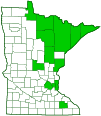
Hemlock Varnish Shelf is a common, large, annual, wood-decaying, bracket fungus. It occurs in the United States and southern Canada east of the Great Plains, but it is mostly absent from the deep south. There is a separate (disjunct) population in northern Arizona and New Mexico.
Hemlock Varnish Shelf is found from May through November, alone, scattered, or in groups but not clustered (gregarious). In eastern North America, it is found almost exclusively on hemlocks, though it may appear, on other conifers. It grows on both living and dead trunks, and on logs and stumps. It sometimes appears terrestrial when it grows on surface roots or attached to buried roots near the surface. It is both saprobic (feeding on dead wood) and parasitic (attacking living wood), causing a white rot in the heartwood. When growing on a trunk, it is typically near the base, causing butt rot, which weakens the foundation and may cause the trunk to snap off during a windstorm
When the fruiting body first appears, it looks nothing like a bracket. The shape is elongate and irregular and the color is dark red to orangish or reddish brown. As it ages, it spreads out and flattens, becoming more bracket-like, often with white or bright yellow concentric zones toward the margin. The upper surface is knobby and shiny, appearing varnished. The mature bracket can be 1½″ to 12″ (4 to 30 cm) wide, but it is usually no more than 6″ (16 cm) wide. It is concentrically zoned and more or less fan-shaped or kidney-shaped.
The underside (pore surface) is white at first. There are 4 to 6 minute, nearly invisible, up to ⅜″ (1 cm) deep, pores per millimeter. The surface turns brown when bruised, and it becomes brown as it ages.
There is usually a distinct stalk, but this is sometimes absent. When present, the stalk is 1¼″ to 5½″ (3 to 14 cm) long, and up to 1¼″ (2 cm) wide.
The flesh is whitish and fairly soft when young, but it soon becomes tough, too tough to be edible.
The spore print is brown.
Similar Species
Habitat and Hosts
Hemlock
Ecology
Season
May through November
Distribution
Sources
Biodiversity occurrence data published by: Minnesota Biodiversity Atlas (accessed through the Minnesota Biodiversity Atlas Portal, bellatlas.umn.edu. Accessed 2/24/2026).
Ganoderma tsugae Murrill in GBIF Secretariat (2023). GBIF Backbone Taxonomy. Checklist dataset https://doi.org/10.15468/39omei accessed via GBIF.org. Accessed 2/24/2026.
Mycology Collections Portal (MyCoPortal) https://www.mycoportal.org/portal/collections/index.php). Accessed 2/24/2026.
Occurrence
Common
Taxonomy
Kingdom
Fungi (Fungi)
Subkingdom
Dikarya
Phylum
Basidiomycota (Basidiomycete Fungi)
Subphylum
Agaricomycotina (Higher Basidiomycetes)
Class
Agaricomycetes (Mushrooms, Bracket Fungi, Puffballs, and Allies)
Order
Polyporales (Shelf Fungi)
Family
Polyporaceae (Bracket Fungi)
Genus
Ganoderma (Artist’s Brackets, Reishi, and Allies)
Subgenus
Ganoderma (Reishi)
Family
A recently published molecular phylogenetic analysis of the order Polyporales (Justo et al., 2017) resulted in a revised family-level classification of the order. The revised order moves Ganoderma and other genera formerly placed in the family Ganodermataceae into the family Polyporaceae.
Subordinate Taxa
Synonyms
Fomes tsugae
Polyporus tsugae
Common Names
Cedar Lacquer Polypore
Hemlock Varnish Shelf
