


Southern Red-backed Vole - Species Profile
Conservation • Description • Habitat • Ecology • Distribution • Taxonomy
Conservation Status
IUCN Red List
LC - Least Concern
NatureServe
N5 - Secure
SNR - Unranked
Minnesota
not listed
Description
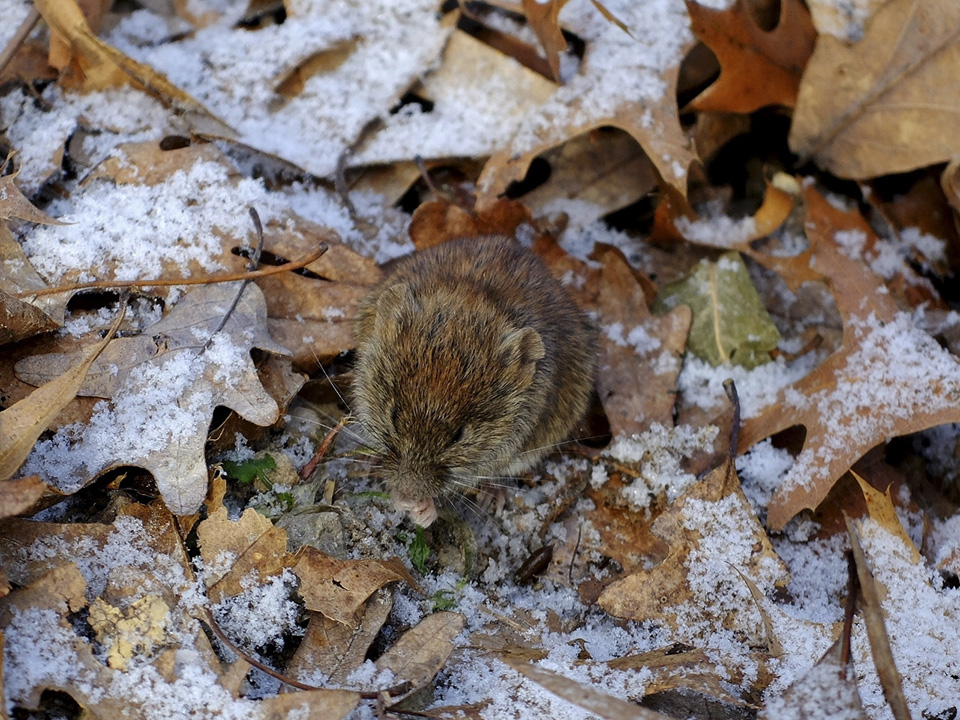
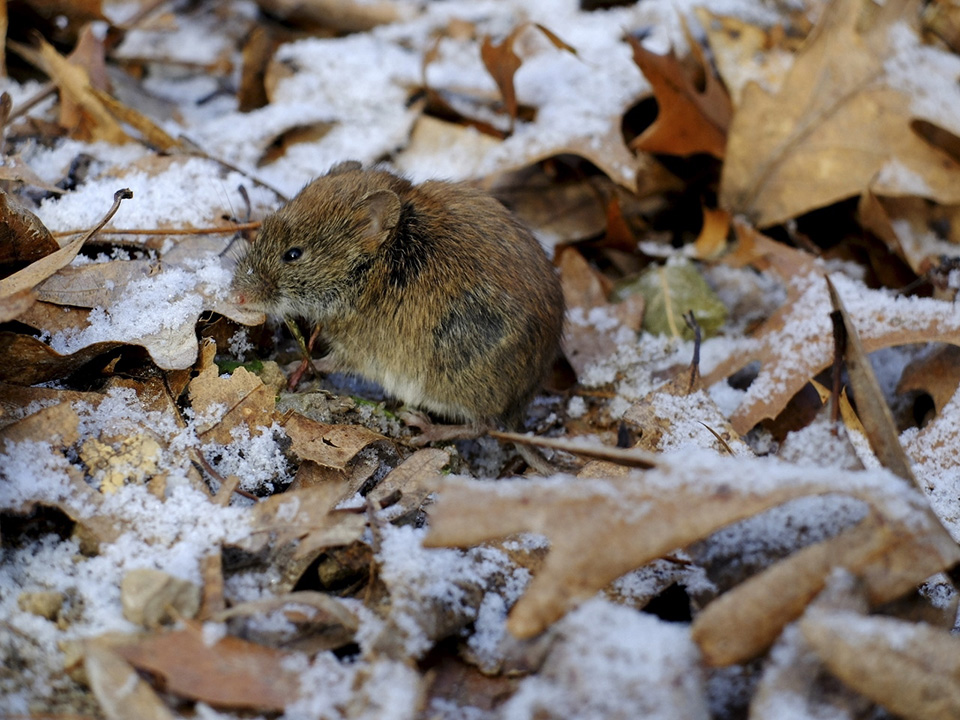
Southern Red-backed Vole is one of the smallest voles found in Minnesota. Adults have a stocky build. They may be 4½″ to 6¾″ long, including the tail, and weigh ¼ to 1½ ounces, but average just 5¼″ long and ⅞ ounce. Males and females are similar in size. Females have 8 mammae.
The coat (pelage) is dark gray above with a broad, chestnut-brown stripe down the middle of the head and back. In the summer it is relatively short and coarse. In the winter it is long, dense, and lighter in color. The belly is gray to creamy white. Juveniles are darker than adults.
The legs are short. The feet are creamy white or buff.
The tail is short, 1″ to 2⅜″ long, slender, and sharply bicolored.
The head is gray on the sides and face. The snout is short. The eyes are small. The ears are brown and short. The mouth has 16 teeth. The upper incisors are not grooved. The molars have high crowns and angular cusps.
Size
Total length: 4½″ to 6¾″
Head and body: 2¾″ to 4⅜″
Tail: 1″ to 2⅜″
Sign
Similar Species
Lemmings are larger and have shorter tails.
On other voles the pelage is not bicolored.
Habitat
Moist deciduous, coniferous and mixed forests with stumps and logs for ground cover; cedar, tamarack, and black spruce swamps, bogs with spruce and fir.
Ecology
Behavior
They are active both during the day and at night, but more often at night. They forage mostly on the ground but also in trees. When on the ground they use runways of shrews, moles, or other small mammals. They usually hop rather than run. They are solitary and do not form colonies or pair bonds.
Lifespan
Usually 10 to 12 months but up to 18 months
Life Cycle
Breeding takes place from May to September. There may be 2 to 6 litters in a year. The nest is located usually under a log, tree root, or other shelter, sometimes in a burrow created by a mole or other small mammal. Gestation lasts 17 to 19 days. The female has 3 to 8, usually 4 to 6 offspring. The young are born naked and blind. They remain in the nest less than three weeks. They reach sexual maturity at 2 to 4 months of age.
Food
They are opportunistic feeders consuming mostly plant matter. Their diet changes with the season. In the spring they eat mostly young shoots and leaf petioles. In the summer they also eat berries. In the fall they also eat nuts and seeds. In the winter they eat seeds, roots, bark of young trees and shrubs, and food stored in their nests. Throughout the year they also eat roots, insects, snails, fungi, and lichens.
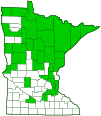
Distribution |
||
|
Sources Biodiversity occurrence data published by: Minnesota Biodiversity Atlas (accessed through the Minnesota Biodiversity Atlas Portal, bellatlas.umn.edu, 12/19/2025). Timm, R. M. 1975. Distribution, natural history, and parasites of mammals of Cook County, Minnesota. Occasional Papers, Bell Museum of Natural History, University of Minnesota 14:1–56. Hazard, Evan B. 1982. The Mammals of Minnesota. University of Minnesota Press, Minneapolis, Minnesota. 280 pp. The counties in light green lack modern records but have historic county or township specimens or records. |
|
| 12/19/2025 | ||
Common Gapper’s Red-backed Vole (C. g. gapperi) is found in north-central and northeast Minnesota. Loring’s Red-backed Vole (C. g. loringi) is found in the remaining forested areas of the state. |
||
Occurrence |
||
Common and widespread |
||
Taxonomy
Class
Subclass
Theria
Infraclass
Placentalia (Placental Mammals)
Magnorder
Boreoeutheria
Superorder
Euarchontoglires (Primates, Rodents, and Allies)
Order
Rodentia (Rodents)
Suborder
Supramyomorpha
Infraorder
Myomorphi
Superfamily
Muroidea
Family
Cricetidae (Hamsters, Voles, Lemmings, and Allies)
Subfamily
Arvicolinae (Voles, Lemmings, and Muskrats)
Tribe
Clethrionomyini (Red-backed Voles and Allies)
Genus
Clethrionomys (Red-backed Voles)
Suborder
The American Society of Mammalogists Mammal Diversity Database (MDD) currently places the species within the Suborder Supramyomorpha. This designation reflects the acceptance of recent large-scale molecular phylogenetic studies that reorganized the Rodentia into three major clades. The necessity for the new suborder arose because genetic analysis showed that the classical Suborder Myomorpha, which housed the mouselike rodents, was paraphyletic—it included the common ancestor but excluded certain descendant groups (like beavers and pocket gophers). Supramyomorpha is the larger, monophyletic group that includes the traditional Myomorpha and all of its descendants. The classification system recognizing Suborder Supramyomorpha was adopted in the paper Flynn et al. (2019), with the name formally proposed by D'Elía et al. (2019). We acknowledge that many regional checklists and traditional resources continue to use the more classical and recognizable Suborder Myomorpha.
Genus
In recent years, two genus names, Clethrionomys and Myodes, have been used interchangeably for Red-backed Voles. A recent article (Kryštufek, Boris et al., 2019) showed that the name Myodes was unavailable because it was already a junior synonym another genus. Following the rules of the International Code of Zoological Nomenclature, the oldest valid name for the genus is Clethrionomys.
The change was controversial in 2019 and it remains so today. Mammal Diversity Database, NatureServe, NCBI, and iNaturalist use the name Clethrionomys. Mammal Species of the World, GBIF, ITIS, and Catalogue of Life use the name Myodes.
Subordinate Taxa
Arizona Red-backed Vole (Clethrionomys gapperi arizonensis)
Black Hills Red-backed Vole (Clethrionomys gapperi brevicaudus)
Boreal Red-backed Vole (Clethrionomys gapperi athabascae)
British Columbia Red-backed Vole (Clethrionomys gapperi saturatus)
Carolina Red-backed Vole (Clethrionomys gapperi carolinensis)
Cascades Red-backed Vole (Clethrionomys gapperi cascadensis)
Common Gapper’s Red-backed Vole (Clethrionomys gapperi gapperi) 
Dark-colored Red-backed Vole (Clethrionomys gapperi phaeus)
Dusky Red-backed Vole (Clethrionomys gapperi obscurus)
Dusky-backed vole (Clethrionomys gapperi fuscodorsalis)
Gaspe Red-backed Vole (Clethrionomys gapperi gaspeanus)
Gaut’s Red-backed Vole (Clethrionomys gapperi gauti)
Hudson Red-backed Vole (Clethrionomys gapperi hudsonius)
Idaho Red-backed Vole (Clethrionomys gapperi idahoensis)
Kentucky Red-backed Vole (Clethrionomys gapperi maurus)
Kittatiny Red-backed Vole (Clethrionomys gapperi rupicola)
Labrador Red-backed Vole (Clethrionomys gapperi proteus)
Loring’s Red-backed Vole (Clethrionomys gapperi loringi)
Mazama Mt Red-backed Vole (Clethrionomys gapperi mazama)
Mogollon Red-backed Vole (Clethrionomys gapperi limitis)
Northeastern Red-backed Vole (Clethrionomys gapperi caurinus)
Olympic Red-backed Vole (Clethrionomys gapperi nivarius)
Pymatuning Red-backed Vole (Clethrionomys gapperi paludicola)
Revillagigedo Island Red-backed Vole (Clethrionomys gapperi solus)
Rhoad’s Red-backed Vole (Clethrionomys gapperi rhoadsii)
Rocky Mountain Southern Red-backed Vole (Clethrionomys gapperi galei)
Southern Red-backed Vole (Clethrionomys gapperi pallescens)
Southern Red-backed Vole (Clethrionomys gapperi pygmaeus)
Southern Red-backed Vole (Clethrionomys gapperi rufescens)
Stikine Red-backed Vole (Clethrionomys gapperi stikinensis)
Uinta Red-backed Vole (Clethrionomys gapperi uintaensis)
Ungava Red-backed Vole (Clethrionomys gapperi ungava)
Western Red-backed Vole (Clethrionomys gapperi occidentalis)
White Mountain Red-backed Vole (Clethrionomys gapperi ochraceus)
Wrangel Red-backed Vole (Clethrionomys gapperi wrangeli)
Synonyms
Myodes gapperi
Clethrionomys gapperi solus
Common Names
Boreal Redback Vole
Gapper’s Red-backed Mouse
Southern Red-backed Vole
Glossary
Pelage
The coat of a mammal, consisting of fur, wool, or hair, and including a soft undercoat and stiff guard hairs.
Petiole
The stalk of a leaf blade or compound leaf that attaches the leaf blade to the stem.