redshank - Species Profile
Conservation • Description • Habitat • Ecology • Use • Distribution • Taxonomy
Conservation Status
IUCN Red List
not listed
NatureServe
NNR - Unranked
SNR - Unranked
Minnesota
not listed
Description
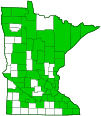
Redshank is a very widespread, very common, mat-forming moss. It occurs worldwide, probably in every country in the northern and southern temperate zones but is replaced in the tropical zone by closely related species. In North America it occurs in every U.S. state and Canadian province, but it is most common east of the Great Plains and west of the Rocky Mountains. It is common in Minnesota. It is found in a wide variety of habitats and is often found on disturbed sites. It grows under full sun or light shade, in moist or moderately moist areas, in sandy, gravelly, or clay soils. It frequently colonizes areas following wildfires or controlled burns. It often occurs in industrial environments because it is able to tolerate high pollution levels. In urban areas it is found growing through sidewalk cracks, on old roofs, and on exposed bare ground.
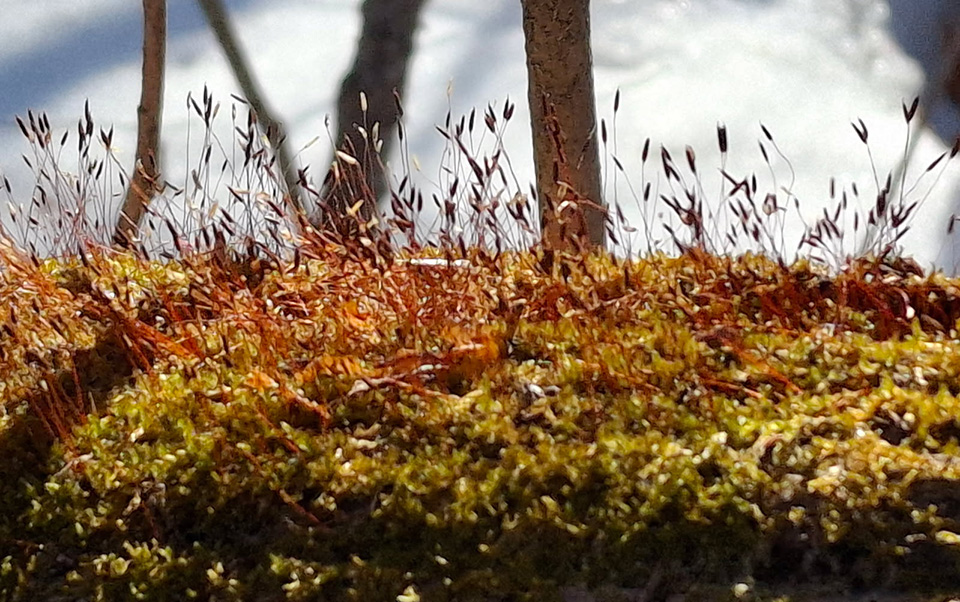
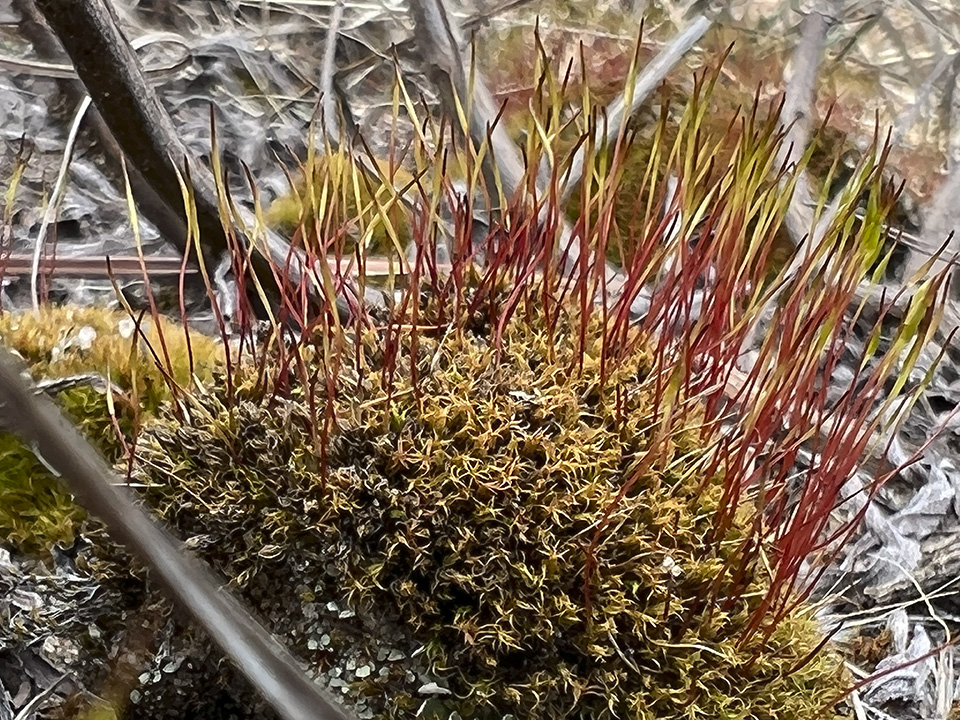
Redshank has an upright growth habit (acrocarp). It usually forms an open or dense tuft, sometimes a cushion, composed of both fertile and non-fertile shoots. The tuft or cushion may be green, dark green, brownish-green, light green, or yellowish-green, and is often tinged with purple or reddish-brown. The stems are erect and usually ⅜″ to 1 3⁄16″ (1 to 3 mm) long. In shaded areas they can be 2¾″ to 3⅛″ (7 to 8 cm) long. They are usually unbranched, sometimes forked at the tip. They are densely leafy and are usually darker at the base. The upper 3⁄16″ (5 mm) is the current year’s growth. Fibrous filaments (rhizoids) at the base adhere the stem to the substrate, usually soil.
The leaves are crowded, stalkless, spreading to ascending, and slightly arched. They are lance-shaped, egg lance-shaped, or triangular lance-shaped, and 1⁄64″ to ⅛″ (0.35 to 2.8 mm) long. When moist they are flat and spread outward in all directions. When they dry out, they become folded or twisted. The leaf blade consists of a wide midrib (costa) with a flat portion (lamina) on each side. The costa is ridged (keeled) on the underside and is more than one third the total width of the blade. The lamina is translucent and folds over the costa on each side almost to the leaf tip. The costa is darker green and more opaque. It sometimes continues beyond the blade as a long smooth awn.
The stem, leaves, and root-like structures (rhizoids), together are the gametophyte phase of the moss life cycle. Male reproductive structures (antheridia) and female reproductive structures (archegonia) are borne on separate plants at the tip of the stem. The fertilized egg produces a spore-producing structure (sporophyte). The sporophyte consists of a foot, which attaches the sporophyte to the gametophyte, a long stalk (seta), and a capsule. At maturity, the seta is stout, ⅜″ to 1 3⁄16″ (1 to 3 cm) long, and variable in color with shades of yellowish-green to deep red. When immature, the capsule is round and green. At maturity the capsule is dark red and 1⁄16″ to 3⁄32″ (2.0 to 2.5 mm) long. There is a slight bulge (struma) on one side at the base of the capsule. At the end of the capsule there is an opening that is covered with a membranous hood (operculum). The operculum is cone-shaped and straight. The entire capsule is covered with a hood (calyptra). The calyptra is hairless and has a long extension (beak) that is usually held at an angle. As it matures, the capsule becomes slightly curved and develops a ring around the opening (annulus). At maturity the calyptra falls off. The annulus forces the operculum to drop off exposing the capsule opening with a ring of 16 teeth. The spores are dispersed by wind.
Growth Form
Acrocarp
Height
¾″ to 2⅜″ (2 to 6 cm) including the sporophyte
Similar Species
Habitat
Moist or moderately moist. Disturbed areas. Full sun or light shade. Sandy, gravelly, or clay soils.
Ecology
Use
Distribution
Sources
Biodiversity occurrence data published by: Minnesota Biodiversity Atlas (accessed through the Minnesota Biodiversity Atlas Portal, bellatlas.umn.edu. Accessed 2/23/2026).
Midwest Herbaria Portal. 2026. https://midwestherbaria.org/portal/index.php. Accessed 2/23/2026.
Biodiversity occurrence data published by: Bryophyte Portal (accessed through the Bryophyte Portal Portal, https://bryophyteportal.org/portal). Accessed 2/23/2026.
Ceratodon purpureus (Hedw.) Brid. in GBIF Secretariat (2023). GBIF Backbone Taxonomy. Checklist dataset https://doi.org/10.15468/39omei accessed via GBIF.org. Accessed 2/23/2026.
Janssens, Joannes A., and The Minnesota County Biological Survey, Minnesota Department of Natural Resources, State of Minnesota. County Atlas of Minnesota Mosses. May, 2000. www.dnr.state.mn.us/plants/flm/mossatlas/index.html.
Nativity
Native
Occurrence
Very widespread and very common
Taxonomy
Kingdom
Subkingdom
Bryobiotina (Non-vascular Plants)
Phylum
Class
Bryopsida (Joint-toothed Mosses)
Subclass
Dicranidae
Order
Dicranales
Family
Ditrichaceae
Genus
Ceratodon
Family
The genus Ceratodon has traditionally been placed in the family Ditrichaceae. A recent phylogenetic study of members of the subclass Dicranidae (Fedosov et al., 2021) showed that Ceratodon and a few other genera (including Cheilothela, Pseudaongstroemia, and Trichodon) actually formed their own distinct branch separate from the “true” Ditrichaceae. Consequently, the authors proposed reinstating the family Ceratodontaceae to accommodate these genera.
This proposal remains a point of taxonomic debate. While major global authorities like World Flora Online and the Bryophyte Nomenclator have adopted the change, many other regional and traditional databases continue to maintain the genus within Ditrichaceae.
Subordinate Taxa
redshank (Ceratodon purpureus ssp. convolutus)
redshank (Ceratodon purpureus ssp. purpureus)
redshank (Ceratodon purpureus ssp. stenocarpus)
Synonyms
Barbula helvetica
Barbula saussuriana
Barbula validinervia
Bryum bipartitum
Bryum celsii
Bryum longicaule
Bryum papillosum
Bryum purpureum
Bryum strictum
Bryum tenue
Ceratodon antarcticus
Ceratodon arcticus
Ceratodon columbiae
Ceratodon conicus var. acicularis
Ceratodon crassinervis
Ceratodon flavisetus
Ceratodon grossiretis
Ceratodon grossiretis var. validus
Ceratodon microcarpus
Ceratodon microphyllus
Ceratodon minutifolius
Ceratodon mollis
Ceratodon moravicus
Ceratodon perplexans
Ceratodon pupureus
Ceratodon purpurascens
Ceratodon purpureus
Ceratodon purpureus ssp. arcticus
Ceratodon purpureus ssp. brevidens
Ceratodon purpureus ssp. brevifolius
Ceratodon purpureus ssp. purpurascens
Ceratodon purpureus ssp. xanthopus
Ceratodon purpureus var. alpestris
Ceratodon purpureus var. alpinus
Ceratodon purpureus var. arcticus
Ceratodon purpureus var. aristatus
Ceratodon purpureus var. asper
Ceratodon purpureus var. bipartitum
Ceratodon purpureus var. brevicaulis
Ceratodon purpureus var. brevifolius
Ceratodon purpureus var. brevisetus
Ceratodon purpureus var. carinatus
Ceratodon purpureus var. celsii
Ceratodon purpureus var. cordatus
Ceratodon purpureus var. crassinervis
Ceratodon purpureus var. crispus
Ceratodon purpureus var. cristatus
Ceratodon purpureus var. cuspidatus
Ceratodon purpureus var. densus
Ceratodon purpureus var. erythropus
Ceratodon purpureus var. fastigiatus
Ceratodon purpureus var. filiformis
Ceratodon purpureus var. flavisetus
Ceratodon purpureus var. gracilis
Ceratodon purpureus var. graefii
Ceratodon purpureus var. himalayanus
Ceratodon purpureus var. intermedius
Ceratodon purpureus var. julaceus
Ceratodon purpureus var. latifolius
Ceratodon purpureus var. litoralis
Ceratodon purpureus var. longicaulis
Ceratodon purpureus var. longifolius
Ceratodon purpureus var. microphyllus
Ceratodon purpureus var. minor
Ceratodon purpureus var. mollis
Ceratodon purpureus var. moravicus
Ceratodon purpureus var. pallidisetus
Ceratodon purpureus var. pallidus
Ceratodon purpureus var. paludosus
Ceratodon purpureus var. palustris
Ceratodon purpureus var. papillosus
Ceratodon purpureus var. pehrii
Ceratodon purpureus var. planifolius
Ceratodon purpureus var. purpurascens
Ceratodon purpureus var. purpureus
Ceratodon purpureus var. pusillus
Ceratodon purpureus var. robustus
Ceratodon purpureus var. rufescens
Ceratodon purpureus var. saussurianus
Ceratodon purpureus var. stellatus
Ceratodon purpureus var. subplanifolius
Ceratodon purpureus var. tenuis
Ceratodon purpureus var. tripartitus
Ceratodon purpureus var. turfosus
Ceratodon purpureus var. typicus
Ceratodon purpureus var. viridissimus
Ceratodon purpureus var. wallyanus
Ceratodon purpureus var. xanthopus
Ceratodon semilunaris
Ceratodon sinensis
Ceratodon validus
Ceratodon vialis
Ceratodon wallyanus
Dicranum bipartitum
Dicranum celsii
Dicranum erythropum
Dicranum intermedium
Dicranum longisetum
Dicranum palustre
Dicranum purpurascens
Dicranum purpureum
Dicranum purpureum var. bipartitum
Dicranum purpureum var. intermedium
Dicranum purpureum var. palustre
Dicranum purpureum var. stellatum
Dicranum purpureum var. tenue
Dicranum strictum
Dicranum viridissimum
Didymodon papillosus
Didymodon purpureus
Didymodon purpureus var. subacaulis
Grimmia halophila
Hypnum recurvulum
Leskeella cuspidata
Meesia kenyae
Mielichhoferia recurvifolia
Mnium purpureum
Tortula saussuriana
Trichostomum basiflorum
Trichostomum papillosum
Trichostomum purpureum
Trichostomum tortum
Common Names
ceratodon moss
fire moss
purple forkmoss
purple horn toothed moss
purple horn-toothed moss
purple moss
red roof moss
redshank