Guatemala long-jawed spider - Species Profile
Conservation • Description • Habitat • Ecology • Distribution • Taxonomy
Conservation Status
IUCN Red List
not listed
NatureServe
NNR - Unranked
Minnesota
not listed
Description
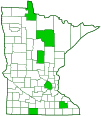
Guatemala long-jawed spider is a small to medium-sized orbweaver. It occurs in the United States from Maine to Florida, west to Minnesota and Texas, and across the southwest to California. It also occurs in southern Canada from Nova Scotia to Ontario, in Mexico, and in Central America.
Adults are active from April to October in Minnesota. They are found in trees and other vegetation in marshes, along lake shores and stream sides, and in gardens, always not far from water.
The female is 3⁄16″ to 7⁄16″ (5.4 to 11.5 mm) in length.
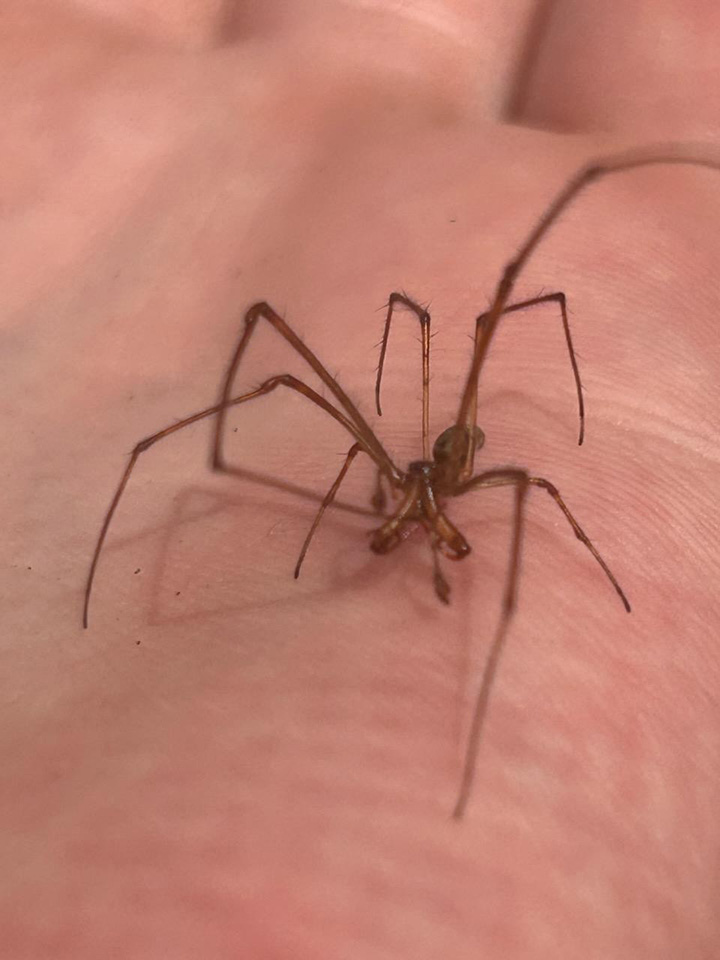
The front part of the body (cephalothorax) is longer than wide. The upper side (carapace) is yellowish brown. The front part of the carapace is slightly elevated, and on the rear part there is a distinct longitudinal furrow in the middle.
There are eight eyes arranged in two rows of four eyes each. The lateral eyes are closer together than the median eyes. All of the eyes are on black spots and are the same size. The jaws (chelicerae) are very large and about half as long as carapace.
The abdomen is elongated oval and much longer than wide. The base color is a deep, dark charcoal or blackish-brown. However, the dorsal (upper) surface is heavily overlaid with a layer of white to pale beige guanine crystals. These crystals create a shimmering, silvery wash that partially obscures the dark skin beneath, often leaving a distinct, leaf-like pattern (the folium) where the dark underlying surface remains visible. The folium varies in intensity, from a pair of continuous, bold, wavy lines, to a series of dark arcs or spots, to almost entirely obscured.
The legs are slender. The first and second pair are very long and they extend forward. The third pair are much shorter and extend straight out to the side. The fourth pair are long and extend backward.
The male is 3⁄16″ to ⅜″ (5.2 to 10.2 mm) in length. The chelicerae are almost as long as the carapace. The abdomen is completely covered with guanine crystals and appears entirely yellowish brown with no dark markings.
Size
Female total length: 3⁄16″ to 7⁄16″ (5.4 to 11.5 mm)
Male total length: 3⁄16″ to ⅜″ (5.2 to 10.2 mm)
Web
A large, circular web (orb) is built in a shady area, often in woods, over or near water. The web is on a single plane and may be horizontal, slanted, or vertical. After the web is built the center is cut out, leaving an open hub. There are 4 or 5 spirals near the center, an open space, then 30 to 40 more spirals to complete the orb.
Under certain conditions, such as a mass emergence of midges, this species exhibits “social flexibility” and will build massive communal webs. A notable occurrence at Lake Tawakoni, Texas, in 2007 involved millions of individuals—predominantly T. guatemalensis—constructing a continuous silk shroud that draped over 200 yards of shoreline vegetation and reached heights of 40 feet. In these rare events, the spiders suppress their natural territoriality to exploit an extreme abundance of prey.
Similar Species
Silver long-jawed spider (Tetragnatha laboriosa) usually has more distinct silvery lateral stripes and is more commonly found in open meadows/grasslands away from water.
Habitat
Near water: marshes, lake shores, stream sides, wooded edges, and gardens
Ecology
Foraging
Web builder (Passive Hunter)
Prey
Small flying insects, primarily midges (Chironomidae), but also including mayflies, mosquitoes, and other aquatic insects that emerge from nearby water sources.
Behavior
The extra long chelicerae on the male are used to lock the female's fangs into place and keep her from biting him while they mate.
Life Cycle
Season
April to October
Distribution
Sources
Tetragnatha guatemalensis O.Pickard-Cambridge, 1889 in GBIF Secretariat (2023). GBIF Backbone Taxonomy. Checklist dataset https://doi.org/10.15468/39omei accessed via GBIF.org. Accessed 4/6/2026.
Levi, Herbert Walter. (1981). The American orb-weaver genera Dolichognatha and Tetragnatha north of Mexico (Araneae: Araneidae, Tetragnathinae). Bulletin of the Museum of Comparative Zoology at Harvard College, 149, 271--318. https://www.biodiversitylibrary.org/part/33808
Occurrence
Taxonomy
Class
Order
Suborder
Araneomorphae (Typical Spiders)
Infraorder
Entelegynae
Superfamily
Araneoidea (Orbweavers and Allies)
Family
Tetragnathidae (Long-jawed Orbweavers)
Subfamily
Tetragnathinae
Genus
Subordinate Taxa
Synonyms
Eocryphoeca parva
Tetragnatha banksi
Tetragnatha fraterna
Tetragnatha intermedia
Tetragnatha laudativa
Tetragnatha parva
Tetragnatha seneca
Common Names
Guatemala long-jawed spider
Guatemalan long-jawed spider