Wheeler's thick-legged jumping spider - Species Profile
Conservation • Description • Habitat • Ecology • Distribution • Taxonomy
Conservation Status
IUCN Red List
not listed
NatureServe
NNR - Unranked
Minnesota
not listed
Description
Wheeler's thick-legged jumping spider is a small, uncommon, typical jumping spider. It occurs in the United States from Maine to New York, west to North Dakota and South Dakota, and there are isolated records in Kansas, Oklahoma, and Arkansas. It occurs across southern Canada from Quebec to Saskatchewan.
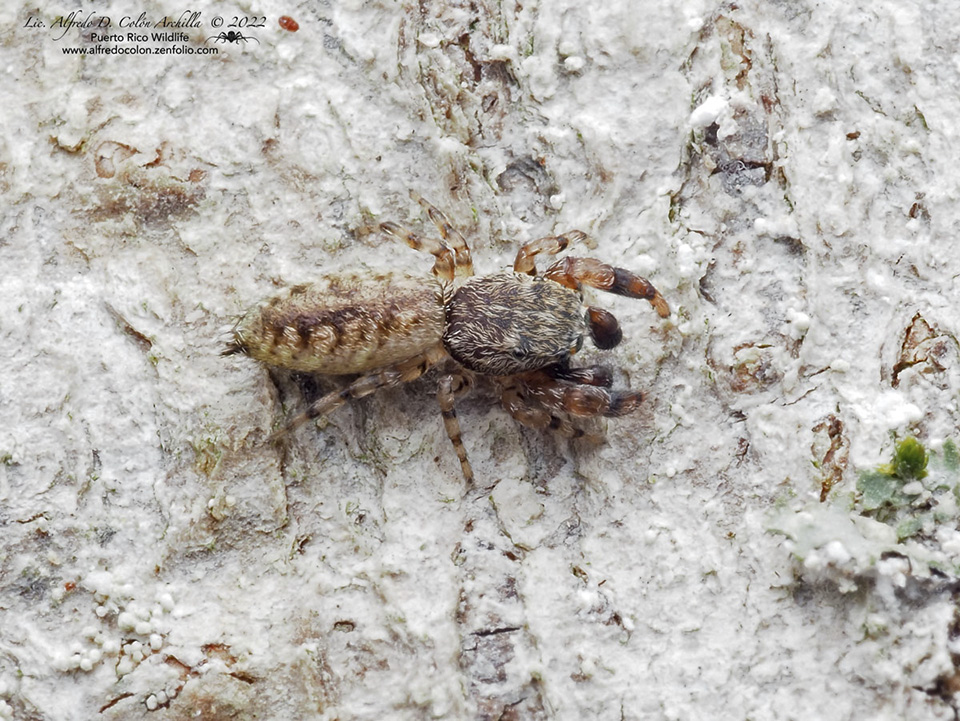
Adult females are ⅛″ (4.3 mm) in length and males are ⅛″ (3.3 to 3.7 mm) in length. Both sexes feature a high-contrast pattern of dark brown to black (dark) and white to off-white (pale) regions, with a dark cephalothorax and a predominantly pale abdomen.
The front part of the body (cephalothorax) is low, flat, and less than twice as long as wide. It is widest near the middle of the rear (thoracic) region and tapers more sharply toward the front than the back. The sides are vertical in front, rounded in back. The upper side (carapace) is dark, but it appears lighter due to a uniform covering of pale hairs (setae). There are eight eyes arranged in three rows. In the first row, the anterior median eyes (AME) are very close together, almost touching, and they are twice as large as the anterior lateral eyes (ALE). In the second row, the posterior median eyes (PME) are small and are closer to the first row than the third. In the third row, the posterior lateral eyes (PLE) are as far apart as the width of the carapace at that point.
The abdomen is narrow and long, longer than the cephalothorax. It is pale with a dark median stripe that is broken on the sides into six lateral branches.
The legs are almost translucent with a dark band near each joint. The first pair of legs is the stoutest, and this is the feature that gives the species its common name.
Size
Female total length: ⅛″ (4.3 mm)
Male total length: ⅛″ (3.3 to 3.7 mm)
Web
No web
Similar Species
Habitat
Ecology
Foraging
Active hunter (Cursorial Hunter)
Prey
Behavior
Life Cycle
Season
May to October
Distribution
Sources
Admestina wheeleri G. W. Peckham & E. G. Peckham, 1888 in Bánki, O., Roskov, Y., Döring, M., Ower, G., Hernández Robles, D. R., Plata Corredor, C. A., Stjernegaard Jeppesen, T., Örn, A., Pape, T., Hobern, D., Garnett, S., Little, H., DeWalt, R. E., Miller, J., Orrell, T., Aalbu, R., Abbott, J., Abreu, C., Acero P, A., et al. (2026). Catalogue of Life (2026-06-19 XR). Catalogue of Life Foundation, Amsterdam, Netherlands. https://doi.org/10.48580/dgy8b
Occurrence
Uncommon
Taxonomy
Class
Order
Suborder
Araneomorphae (Typical Spiders)
Infraorder
Entelegynae
Superfamily
Salticoidea
Family
Subfamily
Salticinae (Typical Jumping Spiders)
Tribe
Dendryphantini
Subtribe
Synagelina
Genus
Admestina
Subordinate Taxa
Synonyms
Common Names
thick-legged jumping spider
Wheeler's thick-legged jumping spider
