featherlegged orbweaver - Species Profile
Conservation • Description • Habitat • Ecology • Distribution • Taxonomy
Conservation Status
IUCN Red List
not listed
NatureServe
NNR - Unranked
SNR - Unranked
Minnesota
not listed
Description
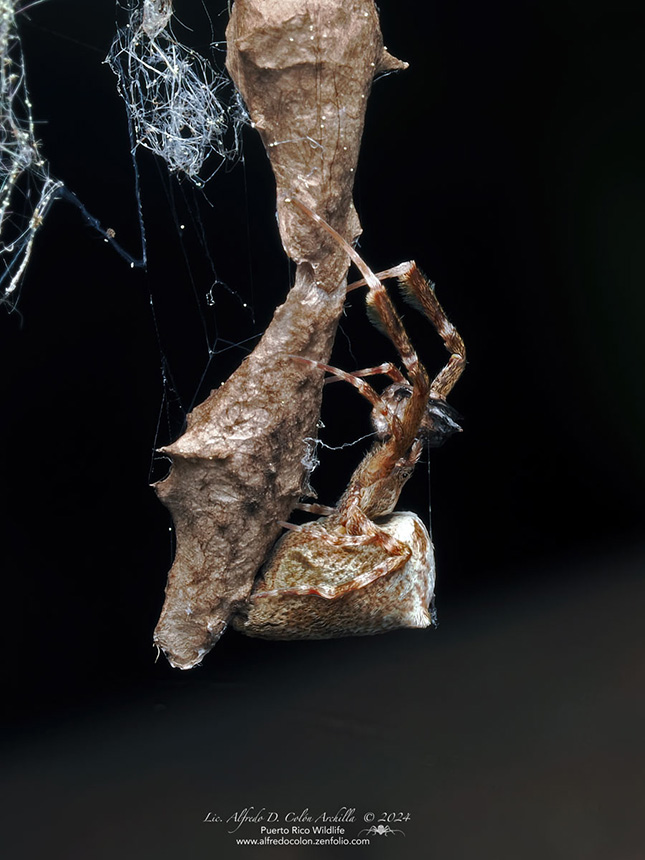
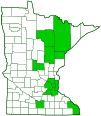
Featherlegged orbweaver is a common, small, non-venomous spider. It occurs in the United States and southern Canada east of the Great Plains, and in Mexico.
Adults are active from March to November. They are commonly found in heavily shaded woodlands in the lower branches of trees, in bushes, among rocks, and sometimes in the rain gutters of houses.
The female is ⅛″ to 3⁄16″ (3.5 to 4.4 mm) in length and has a ¼″ to ⅜″ (6 to 10 mm) legspan. The coloration is variable, from brownish yellow or brownish red to brown, and from pale to dark.
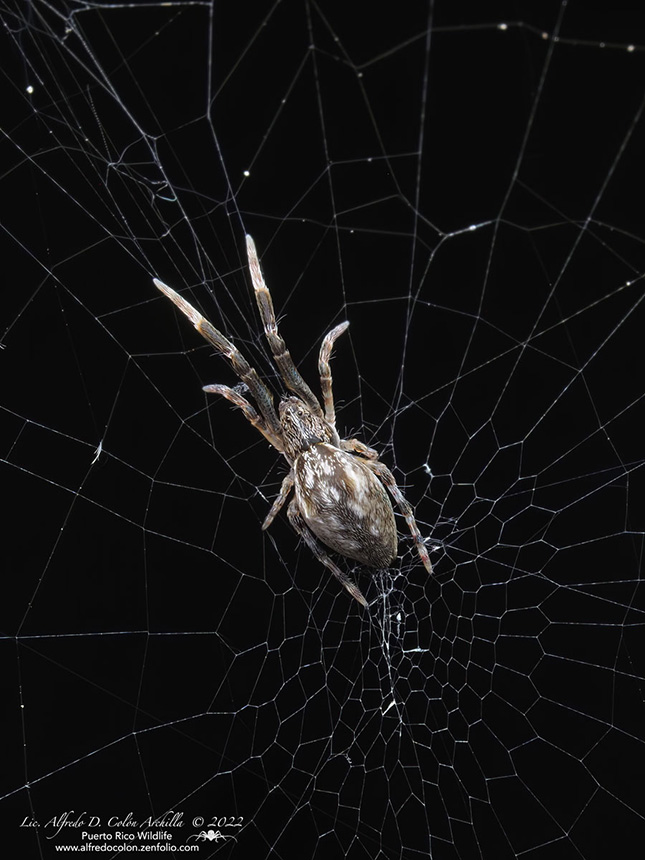
The front part of the body (cephalothorax) is much smaller than the abdomen, oval when viewed from above, convex when viewed from the side. It is not humped. The upper side (carapace) is brownish with pale margins and sometimes a narrow pale stripe in the middle from front to back. There are eight eyes in two rows of four. The rear eye row is distinctly recurved, meaning the outer eyes sit further back than the middle pair. All of the eyes are dark, and the anterior lateral eyes (ALE) are smaller than the others.
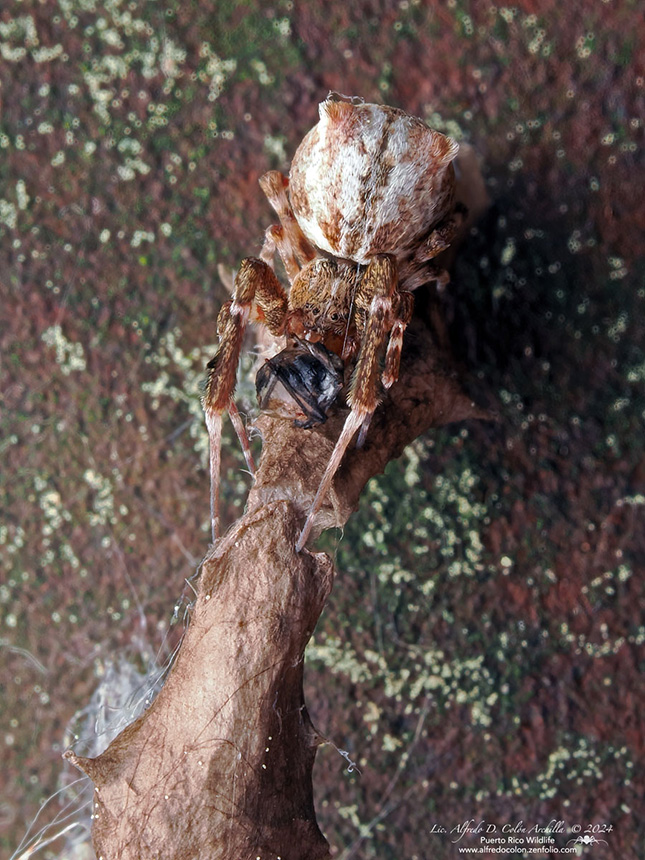
The abdomen is broadly oval when viewed from above, though its width varies depending on how recently the spider has fed. When viewed from the side, the abdomen appears distinctly triangular, due in part to a pair of humps (“shoulders”) near the front at the highest point. The abdomen is densely hairy and pale with dark markings, often including a series of dark, chevron-like lines leading backward from the pair of dorsal humps toward the rear. The humps are covered with dark hairs.
The legs are relatively long and slender. The first pair of legs is much stouter and much longer than the other legs, up to four times the length of the abdomen, and it has many specialized sensing hairs (trichobothria). The fifth segment (tibia) has a brush-like cluster of stiff, stout hairs (macrosetae) at the outer (distal) end. This is the feature that gives the species its common name.
Males are slightly smaller, 3⁄32″ to ⅛″ (2.6 to 2.9 mm) in length. The abdomen is flat.
Size
Female total length: ⅛″ to 3⁄16″ (3.5 to 4.4 mm)
Male total length: 3⁄32″ to ⅛″ (2.6 to 2.9 mm)
Legspan: ¼″ to ⅜″ (6 to 10 mm)
Web
Like all species in the family Uloboridae, the featherlegged orbweaver produces only non-sticky silk. The capture portion of the web (the spiral) is made of cribellate (or hackled) silk. This specialized silk is produced by an organ called a cribellum and is teased by the hind legs into a fuzzy, woolly band. These extremely thin strands attach to prey using a mechanical, Velcro-like bond at a molecular level.
The web itself is a typically vertical orb. The frame and the “spokes” (radii) are constructed with smooth structural silk, while the inner capture spiral consists of the cribellate silk. Because this spider lacks venom glands, it must work quickly once an insect is snagged, rushing from the hub to wrap the prey in a dense silk shroud to immobilize it. To feed, the spider regurgitates digestive enzymes onto the prey and ingests the liquefied remains.
The center of the web (the hub) is often “sheeted” over with silk and may feature a linear decoration (stabilimentum). This structure helps conceal the spider’s silhouette and, in the case of females, is often used to camouflage a string of lumpy, papery egg sacs.
Similar Species
Habitat
Heavily shaded woodlands in the lower branches of trees, in bushes, among rocks, and sometimes in the rain gutters of houses
Ecology
Foraging
Web builder (Passive Hunter)
Prey
Small flying insects
Behavior
When an insect is snagged, the spider quickly wraps the prey in a silk shroud to immobilize it, regurgitates digestive enzymes onto the prey, and ingests the liquefied remains.
Life Cycle
Immature individuals overwinter
Season
March to November
Distribution
Occurrence
Taxonomy
Class
Order
Suborder
Araneomorphae (Typical Spiders)
Infraorder
Entelegynae
Family
Uloboridae (Hackled Orbweavers)
Subfamily
Uloborinae
Genus
Uloborus (Feather-legged Spiders)
Subordinate Taxa
Synonyms
Uloborus mammeata
Uloborus riparia
Common Names
featherlegged orbweaver