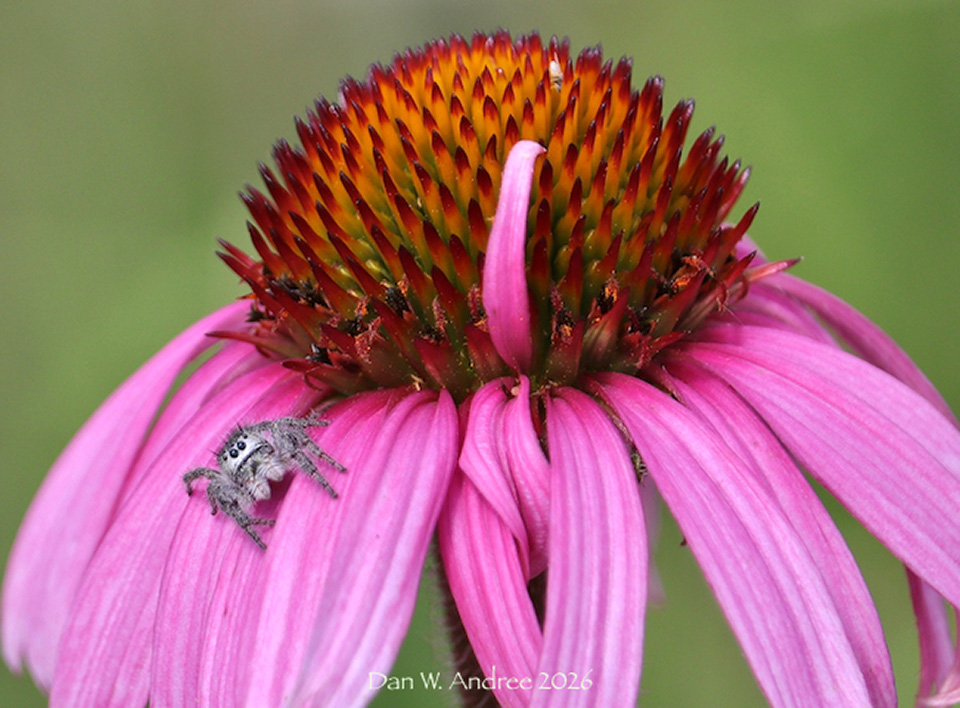
grayish jumping spider - Species Profile
Conservation • Description • Habitat • Ecology • Distribution • Taxonomy

Conservation Status
IUCN Red List
not listed
NatureServe
NNR - Unranked
SNR - Unranked
Minnesota
not listed
Description
Grayish jumping spider is a common, medium-sized spider. It occurs in the United States and southern Canada east of the Great Plains. It is common in Minnesota. It is found in meadows, old fields, the understory of hardwood forests, and woodland edges. It has also been found in the nests of mud dauber wasps. Adults are most commonly seen in spring and in late summer to fall.
Grayish jumping spider is small to medium-sized for a jumping spider, but it is one of the largest jumping spiders in our area. Females are ¼″ to ½″ (6.00 to 11.46 mm) in length. Males are much smaller, 3⁄16″ to 5⁄16″ (4.36 to 8.54 mm) in length. Adults have a ⅜″ to ⅝″ (10 to 15 mm) legspan. The body is heavy and very hairy.
The front part of the body (cephalothorax) is robust. The plate covering the cephalothorax (carapace) is longer than wide, high, and convex, not flat. On the male it is very dark brown, on the female it is lighter. On the male, the area defined by the eyes (ocular quadrangle) is iridescent. The rear part of the ocular quadrangle is sparse.
There are four pairs of eyes arranged in what appears to be three rows. The first row of four eyes is curved backward. The middle and forward-most pair of these is by far the largest of all of the eyes and can be moved. The second row of two eyes is closer to the first row than it is to the third row, which is set far back on the head. The second and third rows form a square. The jaws (chelicerae) are small. On the female, the chelicerae have a white band and a white fringe. There are two sensory appendages (palps) associated with the mouthparts. On the male, each palp has a conspicuous white stripe on top (dorsally).
The rear part of the body (abdomen) is egg shaped, widest in the middle, and tapered to the end. The abdomen of the male in the north, including Minnesota, is entirely tan except for a row of black spots on each side near the middle (median spots). In the south, the abdomen of the male may be tan or orange. On the female, the abdomen is entirely brown or tan, usually without any spots.
The legs are short and hairy. On the male, the fringe on the front legs has an alternating black and white fringe. The fringe is short to medium except on the fifth leg segment (tibia), where it is long.
Size
Female Body Length: ¼″ to ½″ (6.00 to 11.46 mm)
Male Body Length: 3⁄16″ to 5⁄16″ (4.36 to 8.54 mm)
Legspan: ⅜″ to ⅝″ (10 to 15 mm)
Web
No web
Similar Species
Habitat
Meadows, old fields, the understory of hardwood forests, and woodland edges
Ecology
Foraging
Active hunter (Cursorial Hunter)
Prey
Behavior
Grayish jumping spider hunts by chasing prey on vegetation.
Life Cycle
Early stage spiderlings overwinter. Adults reach maturity in the spring.
Season
Spring and late summer to fall
Distribution

Sources
Biodiversity occurrence data published by: Minnesota Biodiversity Atlas (accessed through the Minnesota Biodiversity Atlas Portal, bellatlas.umn.edu. Accessed 7/8/2026).
Phidippus princeps (G. W. Peckham & E. G. Peckham, 1883) in Bánki, O., Roskov, Y., Döring, M., Ower, G., Hernández Robles, D. R., Plata Corredor, C. A., Stjernegaard Jeppesen, T., Örn, A., Pape, T., Hobern, D., Garnett, S., Little, H., DeWalt, R. E., Miller, J., Orrell, T., Aalbu, R., Abbott, J., Abreu, C., Acero P, A., et al. (2026). Catalogue of Life (2026-05-15 XR). Catalogue of Life Foundation, Amsterdam, Netherlands. https://doi.org/10.48580/dgxsq
Edwards, G. B. (2004). Revision of the jumping spiders of the genus Phidippus (Araneae: Salticidae). Occasional Papers of the Florida State Collection of Arthropods 11: 1-156.
Occurrence
Common
Taxonomy
Class
Order
Suborder
Araneomorphae (Typical Spiders)
Infraorder
Entelegynae
Superfamily
Salticoidea
Family
Subfamily
Salticinae (Typical Jumping Spiders)
Tribe
Dendryphantini
Subtribe
Dendryphantina
Genus
Complex
Phidippus audax complex
Subordinate Taxa
grayish jumping spider (Phidippus princeps ssp. princeps) 
grayish jumping spider (Phidippus princeps ssp. pulcherrimus)
Synonyms
Attus insolens
Phidippus castrensis
Phidippus insolens
Common Names
grayish jumper
grayish jumping spider
prince jumping spider
sinuous tufted jumping spider