lyric cobweaver - Species Profile
Conservation • Description • Habitat • Ecology • Distribution • Taxonomy
Conservation Status
IUCN Red List
not listed
NatureServe
NNR - Unranked
Minnesota
not listed
Description
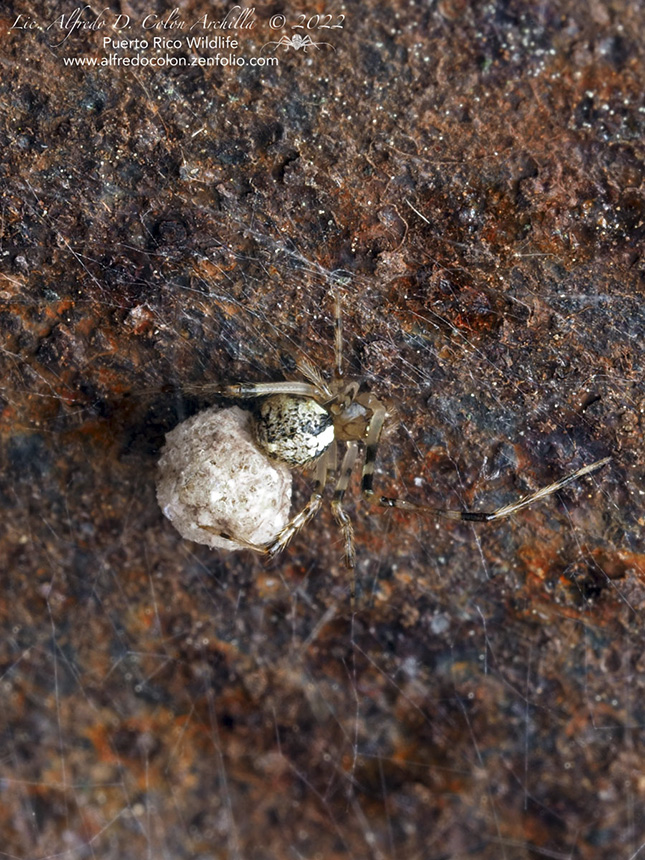
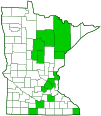
Lyric cobweaver is a common, small, cobweb spider. It occurs in the United States east of the Great Plains, in Japan, and in Korea. It is typically found in forest understories and at forest edges, on the underside of the leaves of trees and shrubs.
Females are 1⁄16″to ⅛″ (2.5 to 3.5 mm) in length and have a ¼″ to 5⁄16″ (6 to 8 mm) legspan.
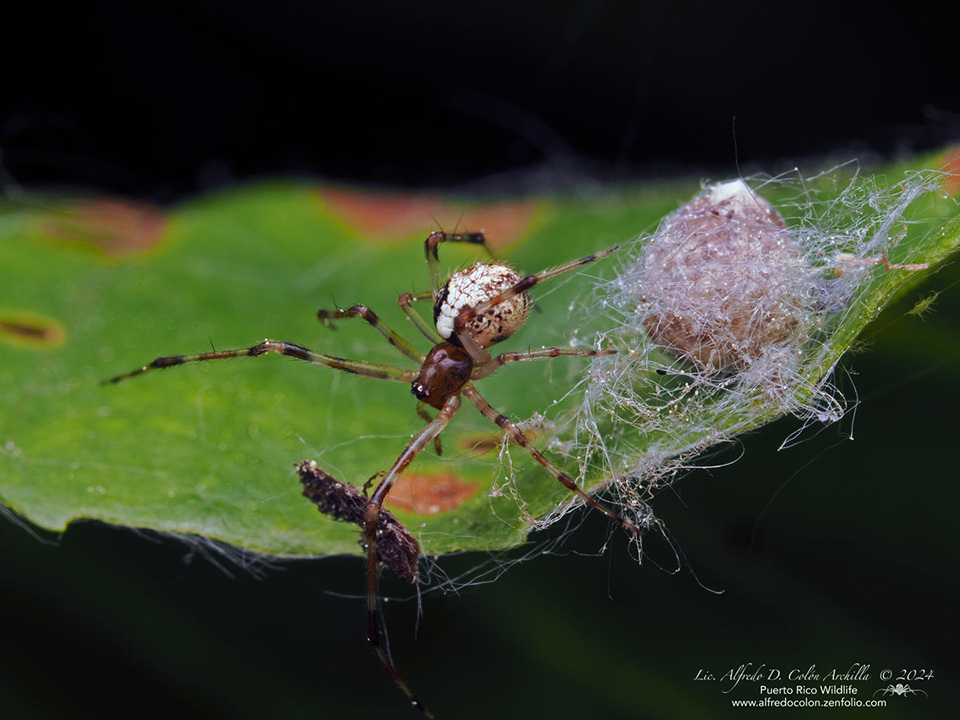
The front part of the body (cephalothorax) is slightly longer than wide. The upper side (carapace) is flat. The color varies from light brown to medium-dark brown. The sides and the eye region are darker. The thoracic groove is indistinct. On the underside of the cephalothorax (sternum), there is a dark U-shaped or V-shaped mark that is said to resemble a lyre. This is the feature that gives the spider its common name and the species epithet lyrica. Unfortunately, it is nearly impossible to see the mark on this small spider unless it is under a microscope or the lighting is “just right.”
There are eight eyes arranged in two rows of four. The front row, consisting of the anterior median eyes (AME) and anterior lateral eyes (ALE), is curved backward. The rear row, consisting of the posterior median eyes (PME) and posterior lateral eyes (PLE), is straight. On each side the AME and ALE are almost touching.
The abdomen is broadly oval to almost spherical. When viewed from the side, it is rounded in the front and distinctly flattened in the rear. The upper surface is covered with fine, inconspicuous hairs. There are two color forms. The typical form has a broad, white or pale, longitudinal stripe in the middle bordered by dark brown or black mottling. On the inverted form, the colors are reversed: a broad, dark brown or black, longitudinal stripe in the middle bordered by white with little dark brown or black mottling. Regardless of the color phase, the margins of these markings are often irregular or “toothed,” and the overall amount of dark mottling can vary significantly between individuals.
The legs are stout, moderately long, and brown or light brown with darker brown rings. They are not spiny but are densely covered with hairs. The first pair of legs is the longest, the third pair is the shortest, and the fourth pair is only slightly shorter than the first pair. There is a row of 6 to 10 slightly curved bristles (“comb”) on the last segment (tarsus) of each hind leg. This is the feature that gives the family one of its common names “comb-footed spiders.” There are three claws at the end of each tarsus, but these are not visible to the naked eye.
The legs are ringed with alternating pale and dark bands.
Males are smaller, 1⁄16″to ⅛″ (2.1 to 2.8 mm) in length. The second pair of legs are longer than the fourth pair.
Size
Female total length: 1⁄16″to ⅛″ (2.5 to 3.5 mm)
Male total length: 1⁄16″to ⅛″ (2.1 to 2.8 mm)
Legspan: ¼″ to 5⁄16″ (6 to 8 mm)
Web
The web is a three-dimensional scaffold of non-sticky silk. Within this scaffold, the spider suspends several vertical “gumfoot” lines. These lines are under tension and are coated with sticky droplets near the bottom where they attach to a substrate (usually a leaf or twig).
When a crawling insect hits a gumfoot line, the line snaps, pulling the prey upward into the air where it dangles, unable to escape, until the spider descends to wrap it.
Similar Species
Habitat
Forest understories and at forest edges
Ecology
Foraging
Web builder (Passive Hunter)
Prey
Ants, small beetles, and small flying insects.
Behavior
Life Cycle
Season
March to October in Minnesota
Distribution
Occurrence
Taxonomy
Class
Order
Suborder
Araneomorphae (Typical Spiders)
Infraorder
Entelegynae
Superfamily
Araneoidea (Orbweavers and Allies)
Family
Subfamily
Theridiinae
Genus
Yunohamella
Subordinate Taxa
Synonyms
Allotheridion lyricum
Takayus lyricus
Theridion kentuckyense
Theridion lyra
Theridion lyricum
Common Names
lyric cobweaver