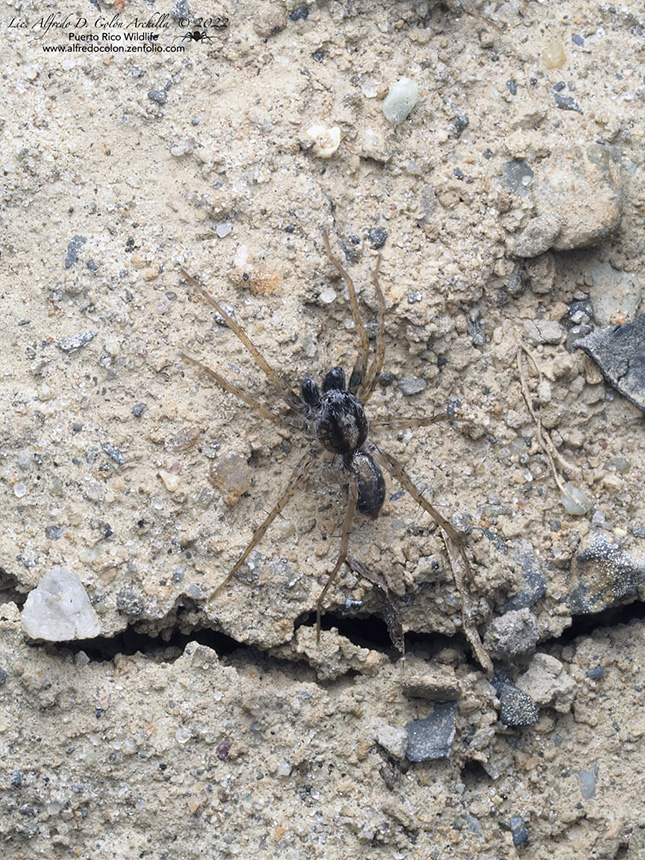
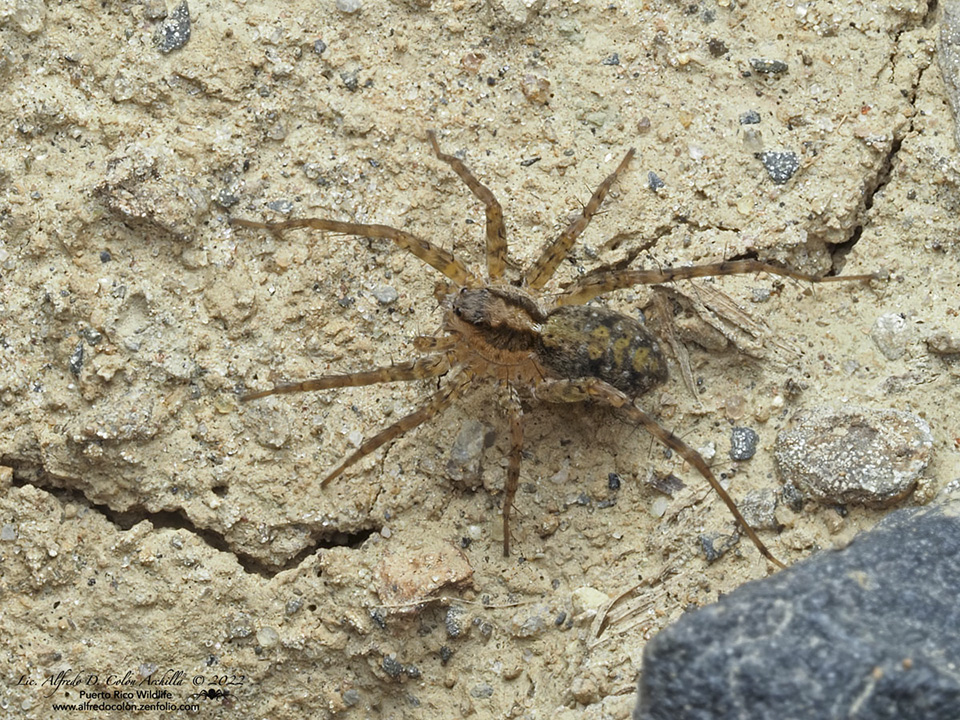
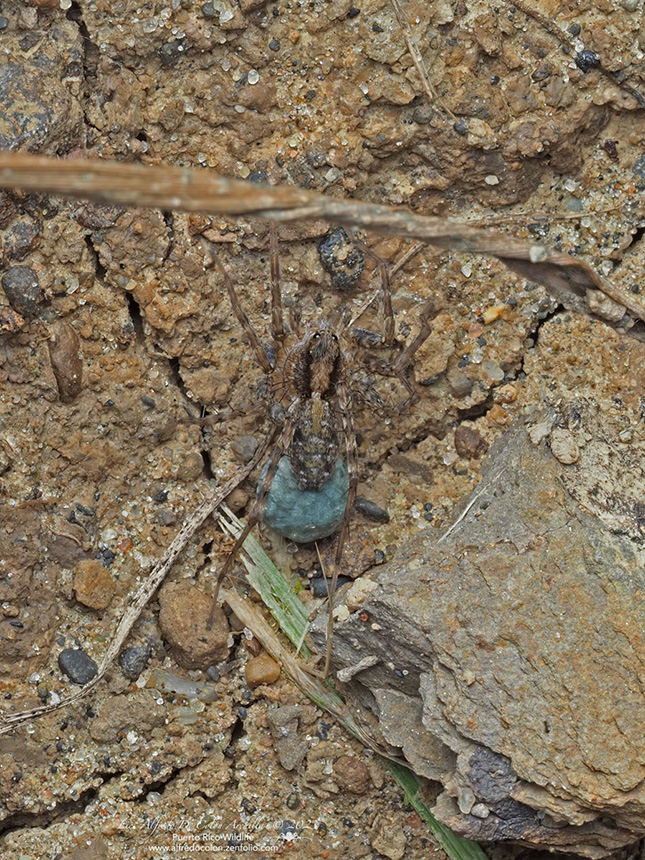
shore spider - Species Profile
Conservation • Description • Habitat • Ecology • Distribution • Taxonomy
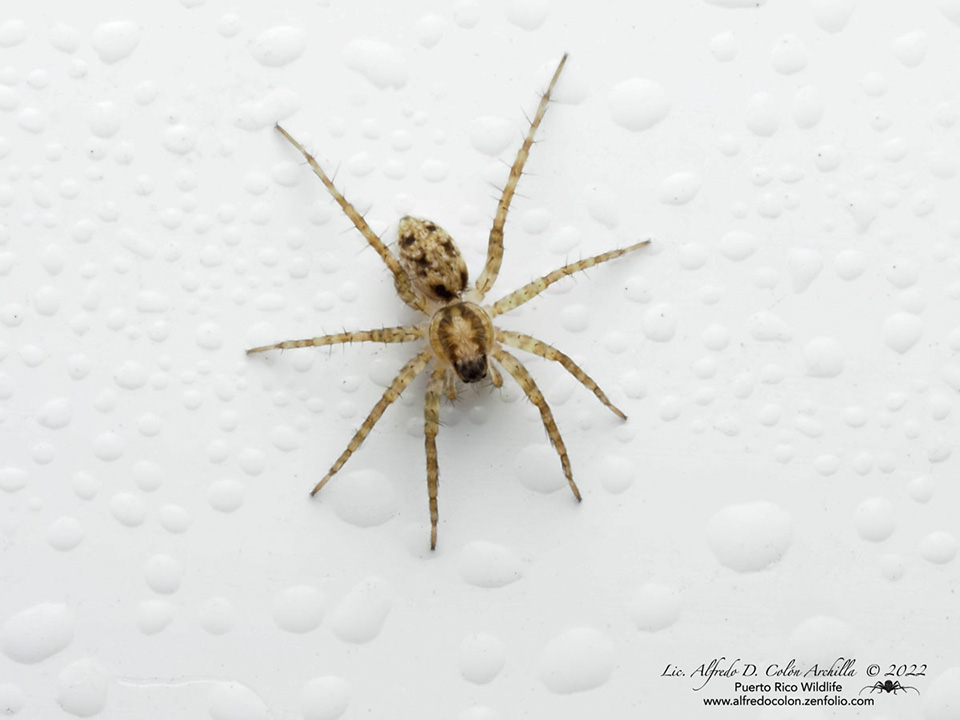
Conservation Status
IUCN Red List
not listed
NatureServe
NNR - Unranked
Minnesota
not listed
Description
Shore spider is a common, small, thin-legged, wolf spider. It occurs in the United States and southern Canada east of the Great Plains. It is one of the most common and widespread species in the genus Pardosa in North America. It is found in a wide range of dry and moist environments, including in open woodlands and marshes, at the margins of ponds, along stream sides, on gravel roads, and in lawns.
Females are 3⁄16″ to ¼″ (5.2 to 6.2 mm) in length with a legspan of 11⁄16″ to 1″ (18 to 25 mm). The body is brownish yellow (pale) with dark brown (dark) markings.
The front part of the body (cephalothorax) is longer than wide and the sides are steep. The upper side (carapace) of the cephalothorax is high, highest in the head region, and there is a long, distinct, longitudinal groove in the middle. The lateral margins are smoothly convex, and the rear margin is concave. There is a broad pale stripe in the middle (median stripe) bordered by a broad dark stripe (sublateral stripe), and there is a broad pale stripe on each margin (lateral stripe). The median stripe is widest in the middle and narrowed at the rear. The eye region is dark brown to black.
There are eight eyes in two rows of four. The front (anterior) row has four small eyes and is straight or slightly curved forward. The rear (posterior) row has two very large posterior median eyes (PME) and two large posterior lateral eyes (PLE). The PLE are set behind the PME, and some authors describe this arrangement as three rows of eyes. The front row is shorter than the middle row. The PME are closer to the PLE than to each other. The PME and PLE have a layer of reflective tissue internally. This allows the spider to see in relative darkness. It also causes their eyes to shine when hit by the beam of a flashlight. The jaws (chelicerae) are relatively small. They are yellow or brown with a short, black mark at the base. The upper margin has two teeth, while the lower margin has three teeth, but the last tooth is usually very small. On the area below the eyes (clypeus), there is a small black triangular spot below each anterior lateral eye.
The abdomen is egg-shaped and is densely covered with short hairs. The base color is dark but the hairs make it appear mostly pale. There is a pale, spear-shaped mark at the base pointing toward the rear and ending before the middle. It is flanked by a pair of dark spots. In the middle, there is a pair of large, pale “bullseye” spots with dark spots in the center. Toward the rear, on each side, there is a series of dark chevrons that more or less merge together into a single dark spot.
The legs are relatively long and thin with dark rings and very long spines on all segments except the last section (tarsus), corresponding to the foot. The sixth segment (metatarsus) and the tarsus are exceptionally thin. On the hind legs, the fifth segment has three pairs of spines below. The first and second (basal and median) pairs are very long, much longer than the diameter of the tibia. The third pair is much smaller.
Males are smaller, ⅛″ to 3⁄16″ (4.0 to 4.7 mm) in length. The body color is darker. The cephalothorax is often almost entirely black, especially toward the front, obscuring the side stripes. The patella (“knee”) of each pedipalp is covered in a dense, brush-like tuft of white hairs (scopula) that contrasts sharply with his dark body. The abdomen is also often entirely black above with faint or no pale markings. The leg-like feelers (pedipalps) are solid black. The legs are not banded or are only obscurely banded.
Size
Female total length: 3⁄16″ to ¼″ (5.2 to 6.2 mm)
Male total length: ⅛″ to 3⁄16″ (4.0 to 4.7 mm)
Legspan: 11⁄16″ to 1″ (18 to 25 mm)
Web
No web
Similar Species
Habitat
Open woodlands, marshes, margins of ponds, stream sides, gravel roads, and lawns,
Ecology
Foraging
Active hunter (Cursorial Hunter)
Prey
Small insects, other tiny arthropods, and occasionally other spiders.
Behavior
Unlike many wolf spiders, they hunt during the day.
Life Cycle
The egg sac is a sphere, greenish at first but eventually turning brown, that the female carries with her.
Season
Year round
Distribution
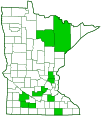
Occurrence
Common and widespread
Taxonomy
Class
Order
Suborder
Araneomorphae (Typical Spiders)
Infraorder
Entelegynae
Superfamily
Lycosoidea (Wolf Spiders and Allies)
Family
Subfamily
Pardosinae
Genus
Pardosa (Thin-legged Wolf Spiders)
Subordinate Taxa
Synonyms
Pardosa nigropalpis
Common Names
shore spider
wetland thin-legged wolf spider