slow running crab spider - Species Profile
Conservation • Description • Habitat • Ecology • Distribution • Taxonomy

Conservation Status
IUCN Red List
not listed
NatureServe
NNR - Unranked
Minnesota
not listed
Description
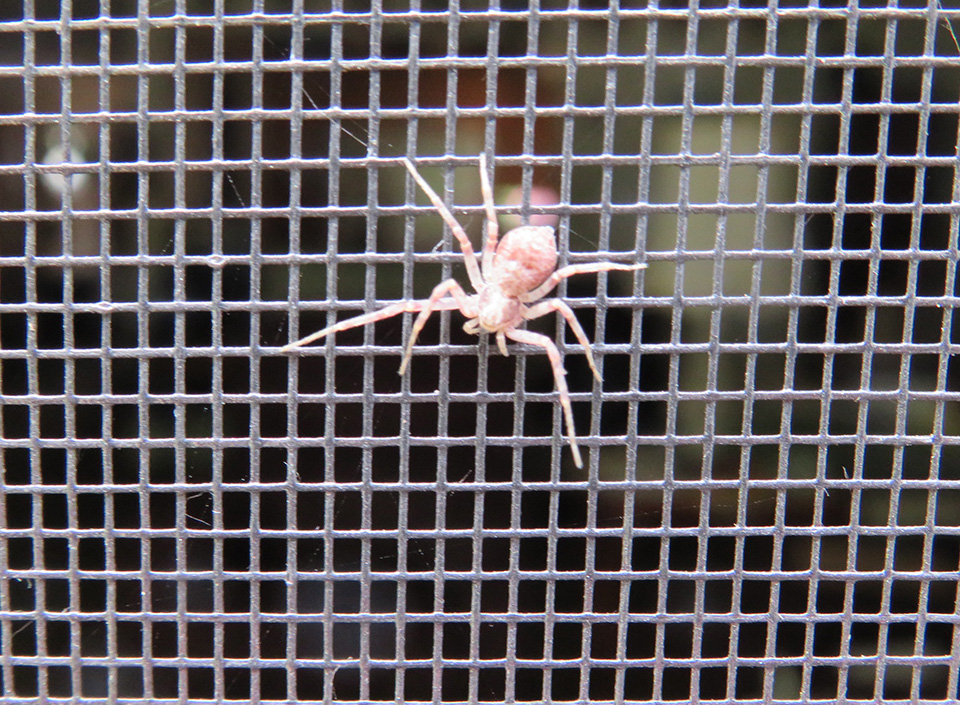
Slow running crab spider is a small spider. It is difficult to see due to its small size and mottled brown coloration that blends into the background. It occurs in the United States from Maine to Virginia west to Oregon and Colorado, and in Alaska and Canada. It is widespread but not common. It is found mostly in the foliage of conifers but also on other trees.
The adult female is ⅛″ to 3⁄16″ (3.5 to 5.0 mm) in length, not including the legs. The male is only slightly smaller, ⅛″ (3.0 to 3.5 mm) in length. The body is soft and flattened.
The covering (carapace) of the front part of the body (cephalothorax) is somewhat flattened, as wide as long or wider than long, and smoothly rounded on the sides. It is creamy white with some brown spots in the middle and brown mottling on the sides. On the male the upper side is coated with shiny scales. There are eight eyes arranged in two rows of four. None of the eyes are on raised projections, (tubercles), and all of the eyes are small. The four eyes in the back row are all the same size. The posterior median eyes (PME) are closer to the posterior lateral eyes (PLE) than they are to each other.
The abdomen is somewhat flattened, longer than wide, and a little pointed at the rear. It is creamy white above and brown on the sides. The upper side is sprinkled with small brown spots. There is a dark brown dash on each side about two-thirds of the way back that extends into the creamy white area. The male is darker than the female, usually much darker. The the upper side is coated with shiny scales, and there is less contrast between the dark and light areas
The legs are long and slender. They are longer and thinner on the male than on the female. They first, third, and fourth pairs of legs are nearly the same length and thickness, the second pair is only slightly longer. The front two pairs project outward rather than forward (laterigrade), allowing the spider to move quickly sideways, like a crab. This is the feature that gives the superfamily its common name. The legs are mostly pale but have a dark area at the end of each segment and a dark area in the middle of the third segment (femur). The first four segments of each leg are armed with long, stiff, spine-like hairs. The last leg segment (tarsus) has a two claws, a dense, brush-like tuft of microscopic hairs below (scopula), and a dense, brush-like tuft of microscopic hairs at the end (claw tuft). The claws, scopulae, and claw tufts are not visible to the naked eye.
Size
Female Body Length: ⅛″ to 3⁄16″ (3.5 to 5.0 mm)
Male Body Length: ⅛″ (3.0 to 3.5 mm)
Web
Running crab spiders do not build snares, retreats, or nests.
Similar Species
Habitat
Foliage of mostly coniferous trees but also other trees
Ecology
Foraging
Active hunter (Cursorial Hunter)
Prey
Behavior
The adult is able to move very fast. Its movements are rapid and erratic. While it may wait in ambush, it often hunts by running after prey. This is the feature that gives the family its common name.
Life Cycle
Season
May through August
Distribution

Sources
Biodiversity occurrence data published by: Minnesota Biodiversity Atlas (accessed through the Minnesota Biodiversity Atlas Portal, bellatlas.umn.edu. Accessed 8/18/2026).
Philodromus placidus Banks, 1892 in Bánki, O., Roskov, Y., Döring, M., Ower, G., Hernández Robles, D. R., Plata Corredor, C. A., Stjernegaard Jeppesen, T., Örn, A., Pape, T., Hobern, D., Garnett, S., Little, H., DeWalt, R. E., Miller, J., Orrell, T., Aalbu, R., Abbott, J., Abreu, C., Acero P, A., et al. (2026). Catalogue of Life (2026-07-17 XR). Catalogue of Life Foundation, Amsterdam, Netherlands. https://doi.org/10.48580/dgykv
Occurrence
Widely scattered but not common
Taxonomy
Class
Order
Suborder
Araneomorphae (Typical Spiders)
Infraorder
Entelegynae
Zoosection
Rta clade (RTA Clade Spiders)
Zoosubsection
Dionycha (Dionycha Clade Spiders)
Family
Philodromidae (Running Crab Spiders)
Subfamily
Philodrominae
Genus
Subordinate Taxa
Synonyms
Common Names
slow running crab spider