Woodland giant wolf spider
(Tigrosa aspersa)
Conservation • Description • Habitat • Ecology • Distribution • Taxonomy
Conservation Status
IUCN Red List
not listed
NatureServe
NNR - Unranked
Minnesota
not listed
Description
Woodland giant wolf spider is a large burrowing spider. It occurs in the United States and southern Canada east of the Great Plains. It is found in woodlands and woodland edges.
Adults are active from May to mid-October. They build burrows, 5″ to 8″ deep, often hidden with straw and twigs. They mostly hunt at night, but occasionally during the day. They are sometimes found in silk-lined depressions under rocks.
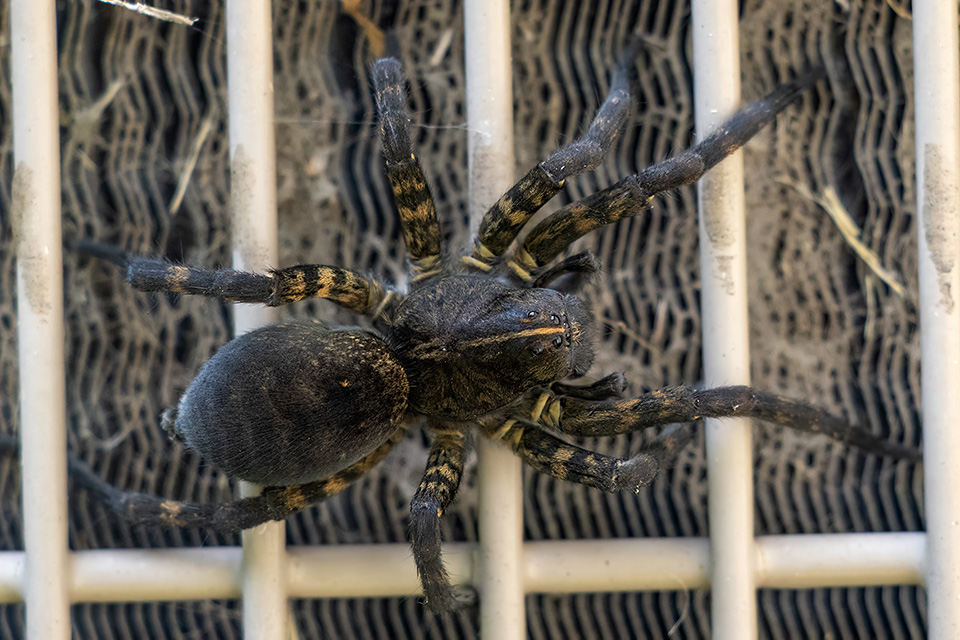
Females are 1″ to 1¼″ (25.0 to 30.5 mm) in length and have a 3″ to 4″ (75 to 100 mm) legspan. The body is entirely covered with short hairs. The overall coloration is usually consistently dark, though some individuals have a pale background color.
The front part of the body (cephalothorax) is longer than wide. The upper side (carapace) is dark reddish brown (mahogany). A furrow (dorsal groove) extends from the middle toward the rear of the carapace. Numerous slender black lines radiate from the dorsal groove toward the margins. There is a slender, pale, longitudinal stripe on the front half of the carapace that extends from the eye region to the dorsal groove, and there is usually a pale stripe on each lateral margin.
The eye region and the face are dark. There are eight eyes in two rows of four. The front (anterior) row has four small, equally spaced eyes, and it is slightly curved forward. The median eyes (AME) are larger than the lateral eyes (ALE). The rear (posterior) row has two very large posterior median eyes (PME) and two large posterior lateral eyes (PLE). The PLE are set well behind the PME, and some authors describe this arrangement as three rows of eyes. The rear row is about equal in width to the middle row. The PME are closer to the PLE than to each other. The PME and PLE have a layer of reflective tissue internally. This allows the spider to see in relative darkness. It also causes their eyes to shine when hit by the beam of a flashlight. The basal segments of the jaws (chelicerae) are large, powerful, and dark brown to black. The front and rear margins each have three teeth.
The abdomen is egg-shaped and brown. The middle front part (cardiac region) is slightly darker, and there is sometimes a pair of small light spots along the rear of the cardiac region. On the rear third of the abdomen there are four or five slightly darker chevrons.
The legs are long and stout. Leg banding is variable, ranging from uniform dark brown to faintly or distinctly banded, especially on the rear legs.
Males are smaller, ¾″ to ⅞″ (18.5 to 21.3 mm) in length. The lateral stripes on the carapace are broken into series of dashes. The legs are pale without dark bands except on the rear leg, where there are often dusky dark bands at the end of the segments.
Size
Female total length: 1″ to 1¼″ (25.0 to 30.5 mm)
Male total length: ¾″ to ⅞″ (18.5 to 21.3 mm)
Legspan: 3″ to 4″ (75 to 100 mm)
Web
No web
Similar Species
Habitat
Woodlands and woodland edges.
Ecology
Foraging
Active hunter (Cursorial Hunter)
Prey
Behavior
Adults are mostly nocturnal
Life Cycle
Season
May to mid-October
Distribution
Sources
Tigrosa aspersa (Hentz, 1844) in Bánki, O., Roskov, Y., Döring, M., Ower, G., Hernández Robles, D. R., Plata Corredor, C. A., Stjernegaard Jeppesen, T., Örn, A., Pape, T., Hobern, D., Garnett, S., Little, H., DeWalt, R. E., Miller, J., Orrell, T., Aalbu, R., Abbott, J., Abreu, C., Acero P, A., et al. (2026). Catalogue of Life (2026-08-26 XR). Catalogue of Life Foundation, Amsterdam, Netherlands. https://doi.org/10.48580/dgyy9
Occurrence
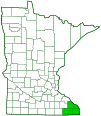
Fairly common in the eastern United States, uncommon in Minnesota
Taxonomy
Class
Order
Suborder
Araneomorphae (Typical Spiders)
Infraorder
Entelegynae
Zoosection
Rta clade (RTA Clade Spiders)
Zoosubsection
Oval calamistrum clade (Oval Calamistrum Clade Spiders)
Superfamily
Lycosoidea (Wolf Spiders and Allies)
Family
Subfamily
Lycosinae
Genus
Tigrosa
Genus
Until recently, this species was named Hogna aspersa. In a systemic study of the Nearctic Lycosidae formerly in the genus Lycosa (Brady, Allen R., 2012), Hogna aspersa, along with three other species in the genus Hogna and one in the genus Allocosa, were transferred to the new genus Tigrosa.
Subordinate Taxa
Synonyms
Hogna aspersa
Hygrolycosa aspersa
Lycosa exitiosa
Lycosa immaculata
Lycosa inhonesta
Lycosa oblonga
Lycosa vulpina
Tarentula inhonesta
Tarentula tigrina
Common Names
woodland giant wolf spider
Photos
Visitor Photos
Share your photo of this arachnid.
This button not working for you?
Simply email us at info@MinnesotaSeasons.com.
Attach one or more photos and, if you like, a caption.
Tigrosa aspersa
I photographed this Woodland Giant Wolf Spider, Tigrosa aspersa, on my air conditioner in La Crescent.
Minnesota Seasons Photos
Slideshows
Slideshows
Tigrosa aspersa (Tiger Wolf Spider)
Andrew Hoffman
Videos
Visitor Videos
Share your video of this arachnid.
This button not working for you?
Simply email us at info@MinnesotaSeasons.com.
Attach a video, a YouTube link, or a cloud storage link.
Other Videos
Tiger Wolf Spider (Tigrosa Aspersa) Female
David Thompson
Sightings
Visitor Sightings
Report a sighting of this arachnid.
This button not working for you?
Simply email us at info@MinnesotaSeasons.com.
Be sure to include a location.
Greg Watson
9/2/2026

Location: La Crescent, MN
I photographed this Woodland Giant Wolf Spider, Tigrosa aspersa, on my air conditioner in La Crescent.
Minnesota Seasons Sightings