Ruby-throated Hummingbird - Species Profile
Conservation • Description • Habitat • Ecology • Distribution • Taxonomy
Conservation Status
IUCN Red List
N5 - Secure
SNR - Unranked
NatureServe
N5 - Secure
SNR - Unranked
Minnesota
not listed
Description
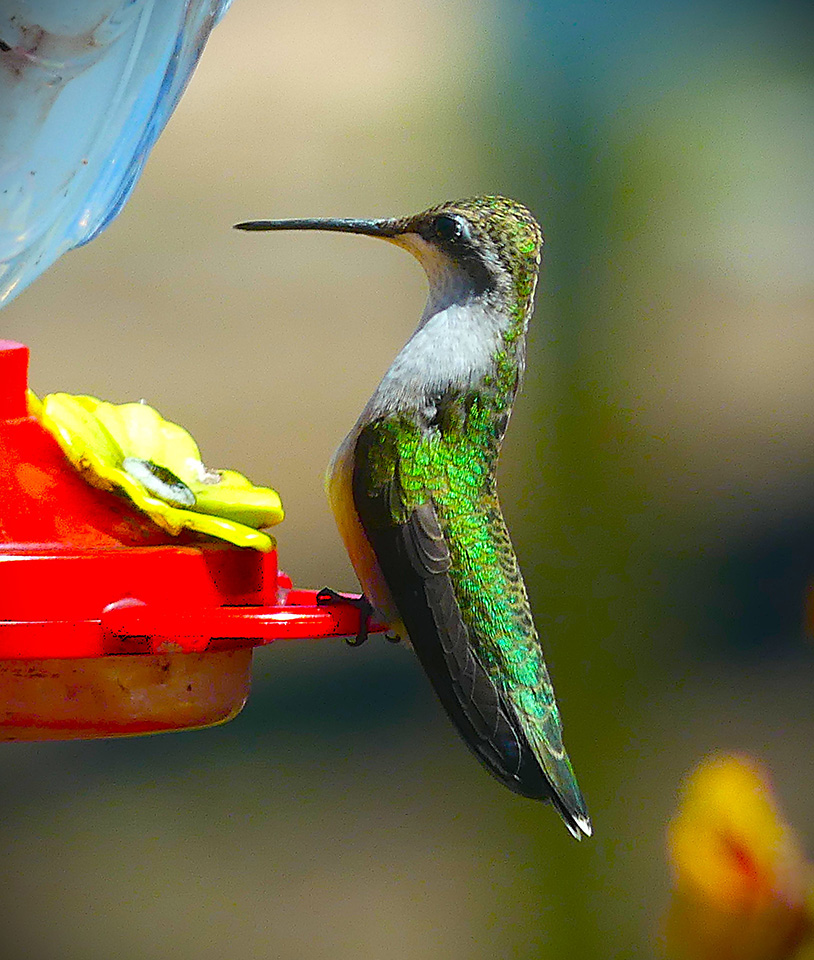
Ruby-throated Hummingbird is the smallest Breeding bird in the eastern United States and southeastern Canada. It is seldom seen but easily recognized because it is the only hummingbird that breeds in or migrates through Minnesota. It is 3″ to 3½″ in length and has a 3⅛″to 4¼″ wingspan. The male weighs about 3 grams, the female about 3.5 grams.
The adult male has an iridescent green back and forehead, whitish underparts, gray or grayish-green sides and flanks, an iridescent ruby-red throat (gorget), and a black face and chin. The bill is slender, straight, and about ¾″ long. The tail is entirely dark and forked. The wings are nearly black.
The adult female is larger. It has a grayish-white throat; a longer bill; a rounded to squared, shallowly forked tail; and white tips on the outer tail feathers. Juveniles resemble adult females. Young males and some older females have a few red feathers on the throat.
Size
Total length: 3″ to 3½″
Wingspan: 3⅛″to 4¼″
Voice
A soft buzzing of the wings. A loud "chick" or squeak.
Similar Species
Rufous Hummingbird (Selasphorus rufus) is the only other hummingbird found in Minnesota. It is a rare, accidental visitor, not a resident. The back of the male is entirely brownish-red (rufous), occasionally with some green markings, but rarely entirely green. The female has a white throat with red spots.
Habitat
Dense or open, mixed or deciduous woodlands; wetlands, savannas, orchards, gardens, wooded back yards.
Ecology
Migration
In the spring, males arrive in late April or early May and establish a territory. Females arrive in early to mid-May.
In the fall, adults males begin migrating in early August. Females follow soon afterward. They fly across the Gulf of Mexico or along the western coast of Mexico and spend the winter in Central or South America.
Nesting
The male performs a diving courtship display for any female that alights in its territory in the spring. After mating, the male has nothing more to do with the female or its offspring.
The female selects a nest site usually near the end of a down-sloping branch. She builds an open, cup-shaped nest on top of the branch out of bud scales, binding it together with spider silk or pine resin, lining it with thistle or dandelion down, and decorating it with lichens or moss. The nest takes 6 to 10 days to build and is about 2″ in diameter when done. When the nest is completed the female lays 1 to 3 white, ½″ to 9 ⁄16″ long eggs.
The eggs hatch in 12 to 14 days. The young leave the nest 18 to 22 days after hatching.
Diet
Flower nectar, small insects and spiders, sweetened water from backyard feeders. Where available, they also feed from Yellow-bellied Sapsucker wells. Early spring migrating males are heavily dependent on sapsucker wells because there are few or no blooming flowers when they arrive.
Distribution
Occurrence
Common migrant and breeder
Maps
The Minnesota Ornithologists’ Union All Seasons Species Occurrence Map
Taxonomy
Class
Aves (Birds)
Order
Apodiformes (Swifts and Hummingbirds)
Family
Trochilidae (Hummingbirds)
Subfamily
Trochilinae (Bee Hummingbirds, Emeralds, Mountain-gems, and Allies)
Tribe
Mellisugini (Bee Hummingbirds and Allies)
Genus
Archilochus (Ruby-throated and Black-chinned Hummingbirds)
Subordinate Taxa
In 1990, evolutionists Charles Sibley and Jon Ahlquist proposed a new taxonomy of birds based on DNA studies done in the 1970s and 1980s. In the Sibley-Ahlquist taxonomy the order Apodiformes is raised to a superorder and hummingbirds are separated as the order Trochiliformes. Some of the proposed changes have been accepted by the American Ornithologists’ Union (AOU), but not all. Some taxonomists have placed hummingbirds into their own order Trochiliformes. The National Center for Biotechnology Information (NCBI) has adopted this classification. Few other sources have.
Synonyms
Trochilus colubris





