brown centipede - Species Profile
Conservation • Description • Habitat • Ecology • Distribution • Taxonomy

Conservation Status
IUCN Red List
not listed
NatureServe
not listed
Minnesota
not listed
Description
Brown centipede is an exotic, widespread, very common, typical stone centipede. It is native to Europe and has been introduced into North America and New Zealand. The time and place of its introduction into North America is unknown, but it is thought to have been during colonial times in the 15th century. It probably arrived in plants brought to or shipped to America by early European settlers. Since then, it has been reintroduced many times. It is now found throughout the United States and southern Canada. It is the most common centipede in the northern U.S. Though rarely found far from places of human activity, it is considered “exceedingly abundant” throughout its range.
Brown centipede is a habitat generalist, but it is highly susceptible to desiccation, which restricts it to damp or moist places. It is found in forests, grasslands, and in places with scarce vegetation; on soil, bark, and fallen tree trunks; in leaf litter, moss, and crevices; under mulch, rocks, and stones; and in greenhouses, nurseries, and households. It feeds on small insects, spiders, earthworms, and other arthropods, including sowbugs and millipedes.
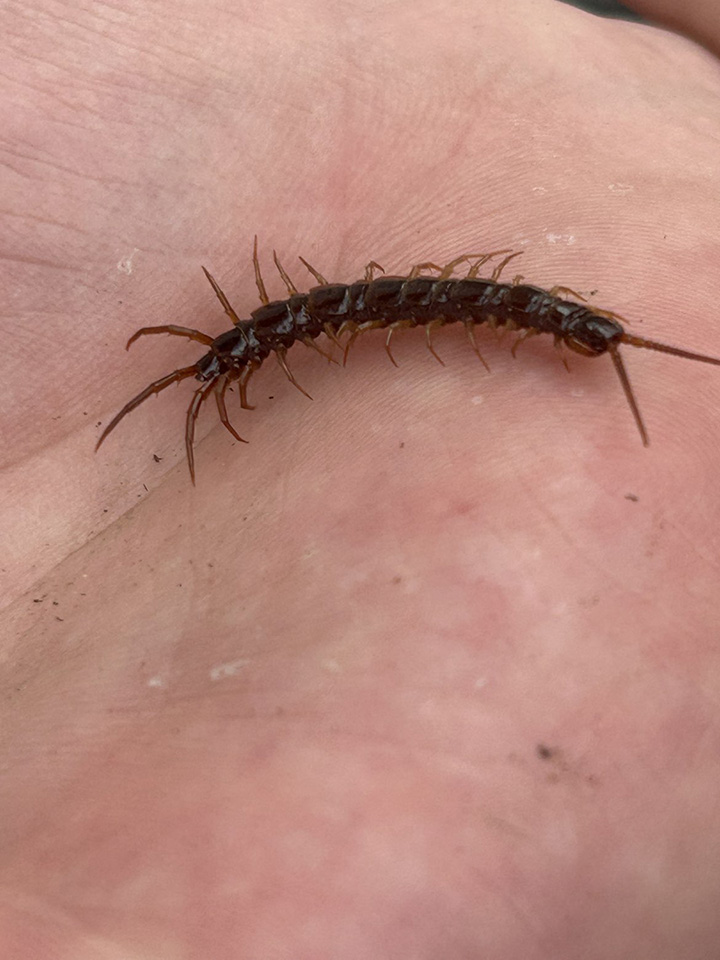
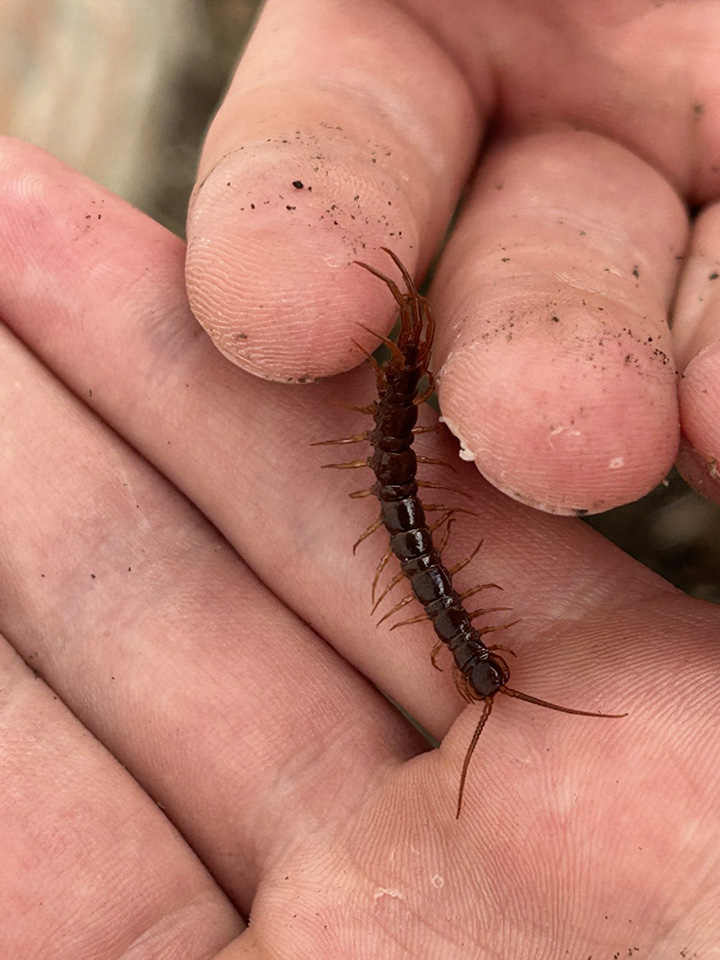
Adults are rich chestnut brown, 11⁄16″to 1¼″ (18 to 32 mm) in length, and ⅛″ (2.8 to 4.0 mm) wide.
The head is sometimes reddish. The antennae are relatively short, -no more than one third the length of the body. They usually have 39 to 43 segments, but they may have as few as 30 or as many as 55. The last segment is twice as long as the preceding one. On each side of the head there is a tight group of 19 to 34 simple eyes (ocelli) in 5 or 6 rows. There is a pair of poison claws under the head.
Recently hatched young have just seven pairs of legs. They gain a body segment and a pair of legs with each molt. The adult body has 18 segments, and it is not constricted behind the head. Fifteen of the segments have an upper skeletal plate (tergite) and a single pair of legs. Each tergite has a well-developed, flattened, plate-like extension (paranotum) on each side. The paranota are mostly, or at least in part, the same color as the legs. The tergites on segments 1, 3, 5, 7, 8, 10, 12, and 14 are much longer than those on the remaining segments. The tergites on segments 9, 11, and 13 have a large triangular projection at each rear corner. The plate on the underside of the first segment of the thorax (prosternum) has 5 teeth on each side.
The legs are often pale. The rear legs extend backward and are long, resembling a second pair of antennae.
Size
Total length: 11⁄16″ to 1¼″ (18 to 32 mm)
Similar Species
Habitat
Forests, grasslands, and urban areas
Ecology
Season
Behavior
Like most centipedes, brown centipedes are fast runners.
Life Cycle
Food
Small insects, spiders, earthworms, and other arthropods
Distribution

Occurrence
Exceedingly abundant
Taxonomy
Subphylum
Myriapoda (Myriapods)
Class
Chilopoda (Centipedes)
Order
Lithobiomorpha (Stone Centipedes)
Family
Lithobiidae
Genus
Lithobius (Typical Stone Centipedes)
Subgenus
Lithobius
Subordinate Taxa
Lithobius forficatus forficatus
Lithobius forficatus pulcher
Synonyms
Lithobius ameles
Lithobius americanus
Lithobius argus
Lithobius biunguiculatus
Lithobius biunguis
Lithobius biungulatus
Lithobius bonensis
Lithobius brevicalcaratus
Lithobius brevicornis
Lithobius britannicorum
Lithobius cheruscus
Lithobius convenicus
Lithobius coriaceus
Lithobius curtirostris
Lithobius degener
Lithobius diampolisi
Lithobius forcipata
Lithobius forficatus ssp. biunguis
Lithobius forficatus ssp. biungulatus
Lithobius forficatus ssp. brevicalcaratus
Lithobius forficatus ssp. britannicorum
Lithobius forficatus ssp. cheruscus
Lithobius forficatus ssp. convenicus
Lithobius forficatus ssp. degener
Lithobius forficatus ssp. sorrentinus
Lithobius forficatus ssp. villosus
Lithobius golemanskyi
Lithobius hardwickei
Lithobius hortensis
Lithobius interrupta
Lithobius laevilabrum
Lithobius leachii
Lithobius muscorum
Lithobius parisiensis
Lithobius parvolus
Lithobius pulcher
Lithobius quadridentatus
Lithobius rapitus
Lithobius sorrentinus
Lithobius trilineatus
Lithobius vesuvianus
Lithobius villosus
Lithobius vulgaris
Scolopendra forcipata
Scolopendra forficata
Stenomera interrupta
Common Names
brown centipede
common centipede
garden centipede
stone centipede