virile crayfish - Species Profile
Conservation • Description • Habitat • Ecology • Distribution • Taxonomy
Conservation Status
IUCN Red List
LC - Least Concern
NatureServe
N5 - Secure
SNR - Unranked
Minnesota
not listed
Description
Virile crayfish, also called northern crayfish, is a medium- to large-sized freshwater crustacean. It is widespread and abundant across North America. It is native to central United States and Canada from Quebec to Tennessee in the east to Alberta and Colorado in the west. It is introduced and considered invasive outside of its native range from coast to coast.
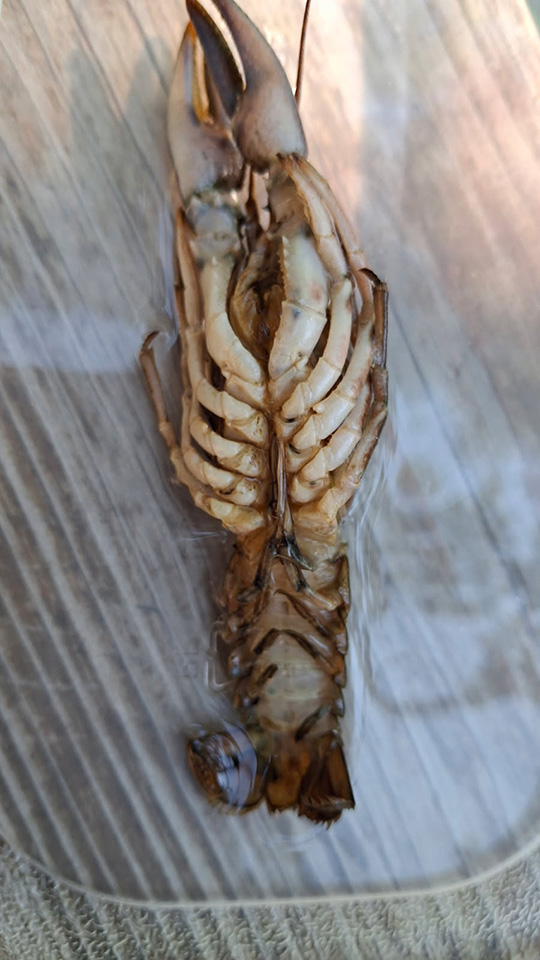
Adults are 1¾″ to 5″ long and smooth. Males are usually larger than females. Occasionally, an individual will be entirely bluish.
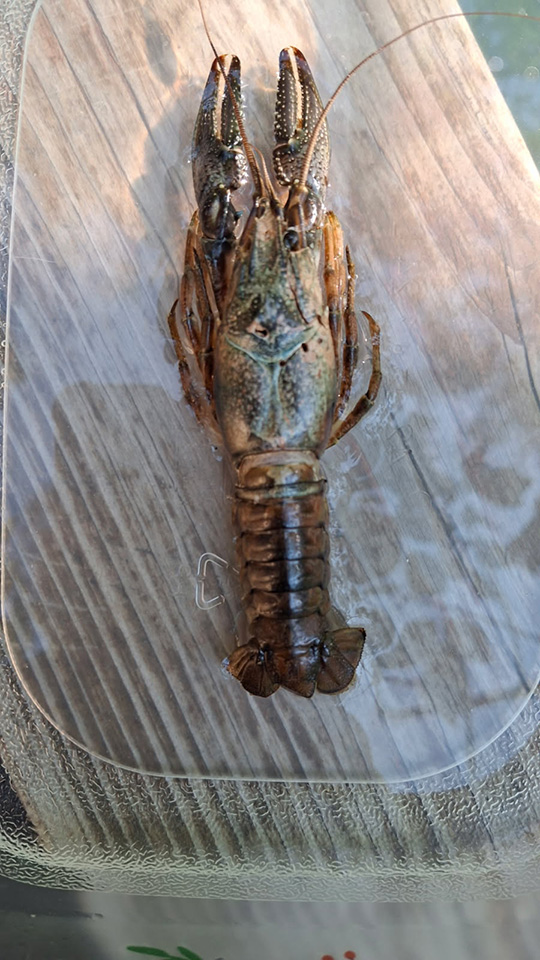
The abdomen and the shield (carapace) covering the front part of the body (cephalothorax) are olive-brown dappled with dark brown. The long spike-like extension of the carapace that projects forward between the eyes (rostrum) has straight, more or less parallel sides. There is a pair of dark brown splotches on the upper (dorsal) side of abdominal segments 1 through 5.
The claws (chelae) are broadly flattened and usually bluish with numerous yellow bumps (tubercles). They do not have black bands at the tip. The movable finger (dactylus) on the claw has a straight margin. The legs are usually bluish with yellow tubercles.
Size
Total length: 1¾″ to 5″
Similar Species
Habitat
A variety of lakes, streams, and wetlands
Ecology
Season
Most active May to September
Behavior
They prefer streams with rocky bottoms, moderate flow and turbidity, abundant cover, and stable water levels. They often use rocks, logs, or other organic debris as cover. They occasionally dig burrows into muddy banks, especially when water levels are low.
To survive the winter, they migrate to deeper water that does not completely freeze and they become inactive.
Lifespan
3 to 4 years
Life Cycle
Breeding takes place in the fall or early spring. The female stores the sperm, sometimes for months, and fertilizes the eggs in the spring. The fertilized eggs are attached is raspberry-like bunches to the abdominal appendages (swimmerets). They hatch in one to two months. They moult several times and reach maturity in their second year.
Juvenile Diet
Adult Diet
Mostly dead animals, but also living snails, insects, fish, tadpoles, and plant material.
Distribution

Sources
Biodiversity occurrence data published by: Minnesota Biodiversity Atlas (accessed through the Minnesota Biodiversity Atlas Portal, bellatlas.umn.edu. Accessed 7/11/2026).
Faxonius virilis (Hagen, 1870) in Bánki, O., Roskov, Y., Döring, M., Ower, G., Hernández Robles, D. R., Plata Corredor, C. A., Stjernegaard Jeppesen, T., Örn, A., Pape, T., Hobern, D., Garnett, S., Little, H., DeWalt, R. E., Miller, J., Orrell, T., Aalbu, R., Abbott, J., Abreu, C., Acero P, A., et al. (2026). Catalogue of Life (2026-06-19 XR). Catalogue of Life Foundation, Amsterdam, Netherlands. https://doi.org/10.48580/dgy8b
Helgen, J.C. 1990. The distribution of crayfishes (Decapoda, Cambaridae) in Minnesota. Final report submitted to the Nongame Wildlife Program, Minnesota Department of Natural Resources. 96 pp.
Occurrence
Widespread and abundant
Taxonomy
Subphylum
Crustacea (Crustaceans)
Superclass
Multicrustacea (Typical Crustaceans)
Class
Malacostraca (Malacostracans)
Subclass
Eumalacostraca (Decapods, Isopods, and Allies)
Superorder
Eucarida (Crabs, Crayfish, Shrimp, etc.)
Order
Decapoda (Crabs, Crayfishes, Lobsters, Prawns, and Shrimp)
Suborder
Pleocyemata (Crabs, Lobsters, Shrimp, and Allies)
Infraorder
Astacidea (Crayfishes and Lobsters)
Superfamily
Astacoidea (Northern Hemisphere Crayfishes)
Family
Cambaridae
Genus
Faxonius
Subordinate Taxa
Synonyms
Cambarus couesi
Cambarus debilis
Cambarus viridis
Cambarus virilis
Cambarus wisconsinensis
Orconectes virilis
Common Names
northern crayfish
virile crayfish