Graham’s rockcress - Species Profile
Conservation • Wetland • Description • Habitat • Ecology • Use • Distribution • Taxonomy
Conservation Status
IUCN Red List
not listed
NatureServe
N5 - Secure
SNR - Unranked
Minnesota
not listed
Wetland Indicator Status
Great Plains
FACU - Facultative upland
Midwest
FACU - Facultative upland
Northcentral & Northeast
FACU - Facultative upland
Description
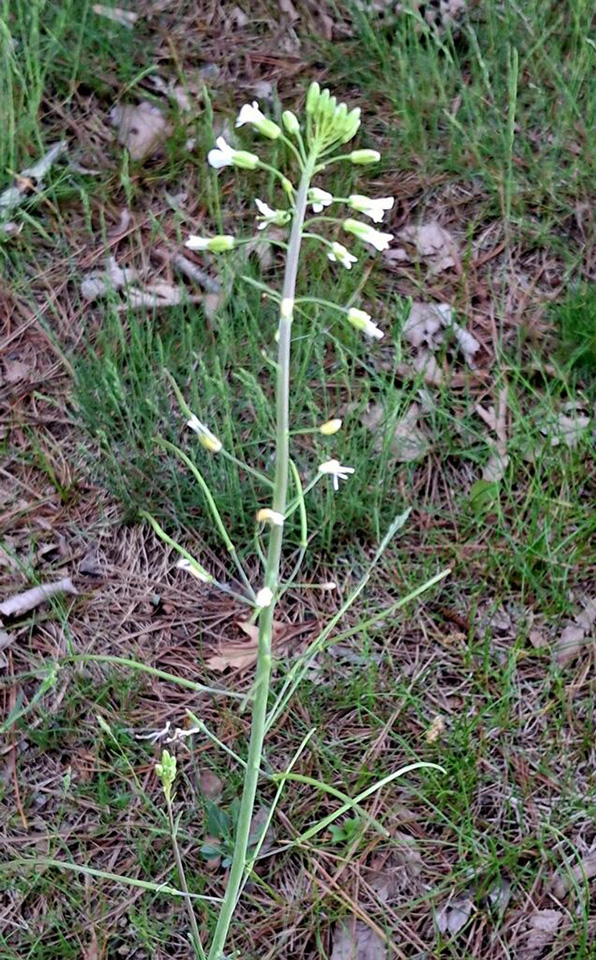
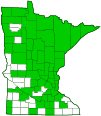
Graham’s rockcress is a common and widespread forb. It has the second largest geographic range of any member of its genus, exceeded only by Drummond’s rockcress (Boechera stricta). It occurs in the United States across three main regions: the northeast (Vermont, New Hampshire, and northern New York); the upper Midwest (Michigan, Wisconsin, and Minnesota); and the west (from Idaho, south to Utah and Colorado, and east to North Dakota); and there are several occurrences around major cities outside of these areas. It occurs across southern Canada and north in the west into Alaska. It is common in Minnesota.
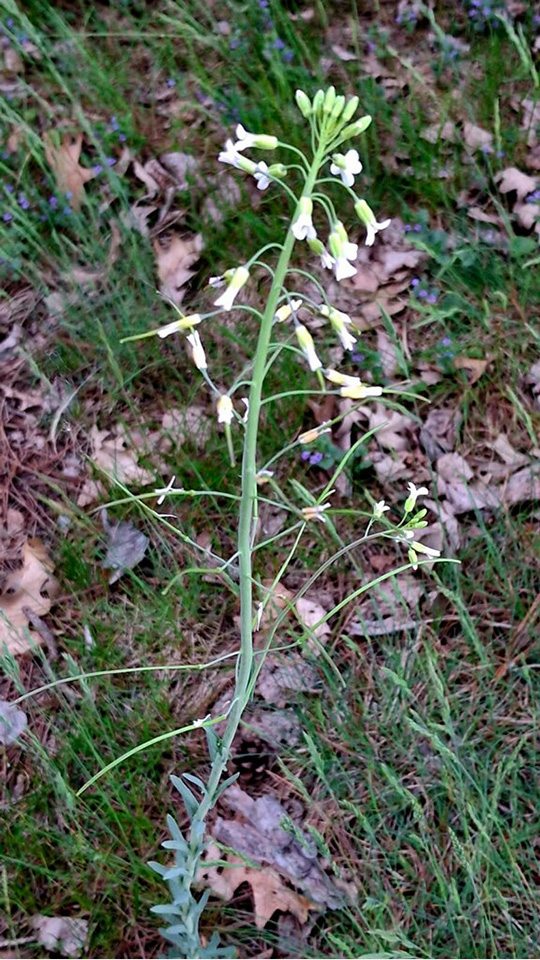
Graham’s rockcress is a biennial or short-lived perennial herb. It rises on a rosette of basal leaves and either a single stalk or usually one stalk from each branch of a persistent, underground, enlarged part of the stem base (caudex). It grows under full or partial sun, on sandy soil in prairies and open woodlands, and on rocky slopes.
The stem is 8″ to 47″ (20 to 120 cm) long and very leafy. It may be entirely hairless or have branched hairs just near the base. The hairs are up to 1⁄32″ (1 mm) long and have usually 2 or 3 branches.
The basal leaves are inversely lance-shaped and 1⁄16″ to ⅜″ (1.5 to 10 mm) wide or wider. The margins may be toothed or untoothed. The upper and lower surfaces are sparsely to densely covered with minute hairs. The hairs are 1⁄64″ to 1⁄32″ (0.5 to 1.0 mm) long and usually have 2 to 4 branches.
There are 13 to 52 stem leaves and those near the base are often crowded, hiding the stem itself. Stem leaves are similar to basal leaves, but they become smaller as they ascend the stem. The blades have a pair of 1⁄32″ to 1⁄16″ (1 to 5 mm) long, lobe-like extensions (auricles) at the base. Upper stem leaves are untoothed and hairless.
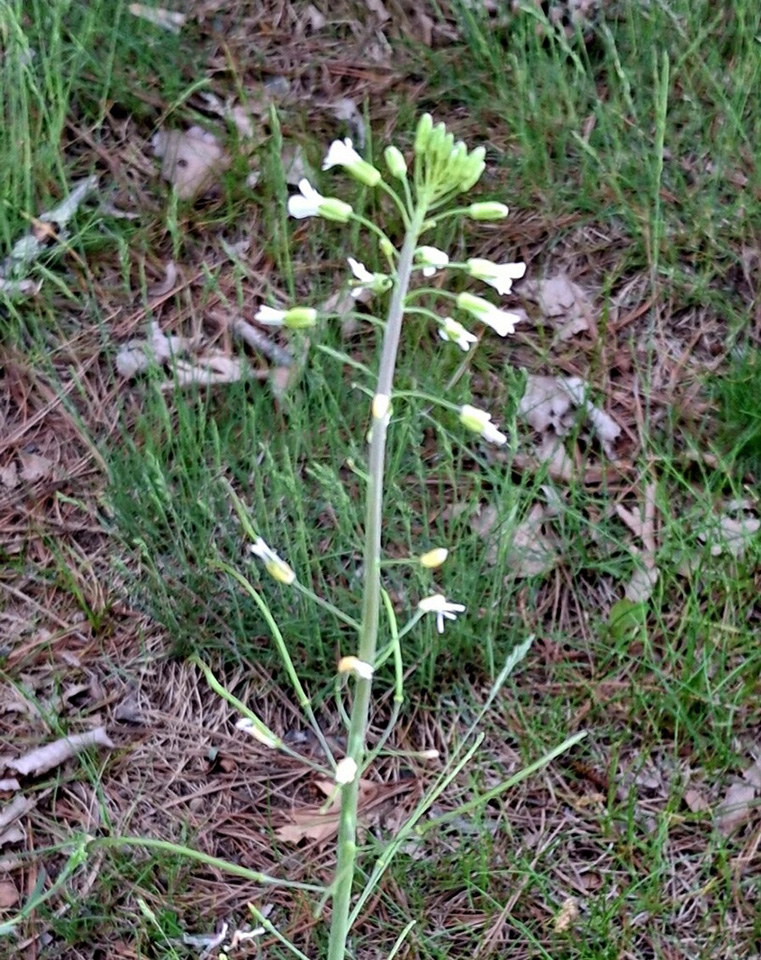
The inflorescence is a usually unbranched cluster (raceme) of 16 to 88 stalked, widely spreading flowers at the end of the stem.
The flowers are about ¼″ to ⅜″ (7 to 10 mm) wide. There are 4 outer floral leaves (sepals), 4 petals, 6 stamens, and 1 style. The sepals are green and they may be hairy or hairless. The petals are white, rarely lavender, 3 ⁄16″ to 5⁄16″ (5.5 to 8.0 mm) long, 1⁄32″ to 1⁄16″ (1 to 2 mm) wide, and hairless. The two outermost stamens are shorter than the others. The raceme becomes greatly elongated in fruit.
The fruit is a long, thin, flat, seed capsule (silique) with 84 to 146 seeds. Each silique is on a 3 ⁄16″ to ⅞″ (5 to 22 mm) long, widely spreading stalk (pedicel). The pedicel is usually slightly downward curved, sometimes slightly upward curved, rarely straight. The silique is 1⅜″ to 3½″ (3.5 to 9 cm) long, 1⁄32″ to 1⁄16″ (1.0 to 1.8 mm) wide, and straight or slightly curved.
The Biological Engine: An Apomictic Triploid
Boechera grahamii is an apomictic triploid. In plain terms, it is a sterile hybrid that bypasses normal pollination to clone itself via its seeds. It formed from a cross between two sexual diploid species (plants with normal pairs of chromosomes):
- Drummond’s rockcress (Boechera stricta)
- Collins’ rockcress (Boechera collinsii)
Because it is a hybrid of these two, its physical traits sit right in the middle, looking like a blend of both parents.
In standard botany, when two different species cross-pollinate, the resulting hybrid has three sets of chromosomes (a triploid), which almost always leaves it sterile. While this form of asexual reproduction is incredibly rare among plants, it is common to the genus Boechera, which uses it to bypass sterility. By utilizing asexual reproduction (apomixis), Graham’s rockcress clones itself through its seeds, making exact genetic copies of the mother plant, capable of reproducing themselves.
Height
8″ to 47″ (20 to 120 cm)
Flower Color
White
Similar Species
Habitat
Full or partial sun. Sandy soil in prairies and open woodlands, and rocky slopes.
Ecology
Flowering
May to July
Pests and Diseases
Use
Distribution
Sources
Biodiversity occurrence data published by: Minnesota Biodiversity Atlas (accessed through the Minnesota Biodiversity Atlas Portal, bellatlas.umn.edu. Accessed 7/19/2026).
Midwest Herbaria Portal. 2026. https://midwestherbaria.org/portal/index.php. Accessed 7/19/2026.
Boechera grahamii (Lehm.) Windham & Al-Shehbaz in Bánki, O., Roskov, Y., Döring, M., Ower, G., Hernández Robles, D. R., Plata Corredor, C. A., Stjernegaard Jeppesen, T., Örn, A., Pape, T., Hobern, D., Garnett, S., Little, H., DeWalt, R. E., Miller, J., Orrell, T., Aalbu, R., Abbott, J., Abreu, C., Acero P, A., et al. (2026). Catalogue of Life (2026-06-19 XR). Catalogue of Life Foundation, Amsterdam, Netherlands. https://doi.org/10.48580/dgy8b
Nativity
Native
Occurrence
Common and widespread
Taxonomy
Kingdom
Subkingdom
Pteridobiotina
Phylum
Tracheophyta (Vascular Plants)
Class
Order
Brassicales (Mustards, Capers, and Allies)
Family
Brassicaceae (Mustard)
Subfamily
Brassicoideae
Supertribe
Camelinodae
Tribe
Boechereae
Genus
Boechera (Rockcresses)
The Taxonomy Story: Unraveling the Mess
For a long time, what we now call Graham’s rockcress (Boechera grahamii) was a botanical dumping ground. It was lumped in with several different species and varieties under the old genus name Arabis.
The breakthrough came in 2007 when researchers Windham and Al-Shehbaz untangled the mess. They discovered that what people used to call Arabis divaricarpa (hybrid rockcress) was actually two completely distinct plants with different parentage:
- The True Western Hybrid: A narrow-sense Boechera divaricarpa found only in the western US.
- The Widespread Hybrid: Boechera grahamii, which dominates everywhere else, especially east of the Rocky Mountains.
The Parentage: How it Formed
Boechera grahamii is an apomictic triploid. In plain terms, it is a sterile hybrid that bypasses normal pollination to clone itself via its seeds. It formed from a cross between two sexual diploid species (plants with normal pairs of chromosomes):
- Drummond’s rockcress (Boechera stricta)
- Collins’ rockcress (Boechera collinsii)
Because it is a hybrid of these two, its physical traits sit right in the middle, looking like a blend of both parents.
The Synonym Cleanup
Because it looks like a blend of its parents and clones itself over a vast geographic range, past botanists gave it dozens of different names depending on where they found it. The 2007 reclassification officially absorbed a long list of old names into Boechera grahamii, including:
- Arabis confinis (mostly)
- Arabis boivinii
- Arabis bourgovii
- Arabis divaricarpa var. dacotica
- Arabis divaricarpa var. stenocarpa
- Boechera brachycarpa
Range
It has the second-largest geographic range of any member of its genus, exceeded only by Drummond’s rockcress (Arabis drummondii).
Subordinate Taxa
Synonyms
Arabis boivinii
Arabis bourgovii
Arabis brachycarpa
Arabis confinis
Arabis confinis var. brachycarpa
Arabis confinis var. confinis
Arabis dacotica
Arabis divaricarpa var. dacotica
Arabis divaricarpa var. hemicylindrica
Arabis divaricarpa var. stenocarpa
Arabis drummondii var. brachycarpa
Arabis holboelii var. brachycarpa
Arabis holboellii var. patula
Arabis patula
Arabis patula var. stenocarpa
Boechera brachycarpa
Boechera divaricarpa var. dacotica
Turritis brachycarpa
Turritis drummondii var. brachycarpa
Turritis grahamii
Turritis patula
Common Names
Graham’s rockcress
spreading-pod rock cress