lowland brittle fern - Species Profile
Conservation • Wetland • Description • Habitat • Ecology • Use • Distribution • Taxonomy
Conservation Status
IUCN Red List
not listed
NatureServe
N5 - Secure
SNR - Unranked
Minnesota
not listed
Wetland Indicator Status
Great Plains
FACW - Facultative wetland
Midwest
FACW - Facultative wetland
Northcentral & Northeast
FACU - Facultative upland
Description
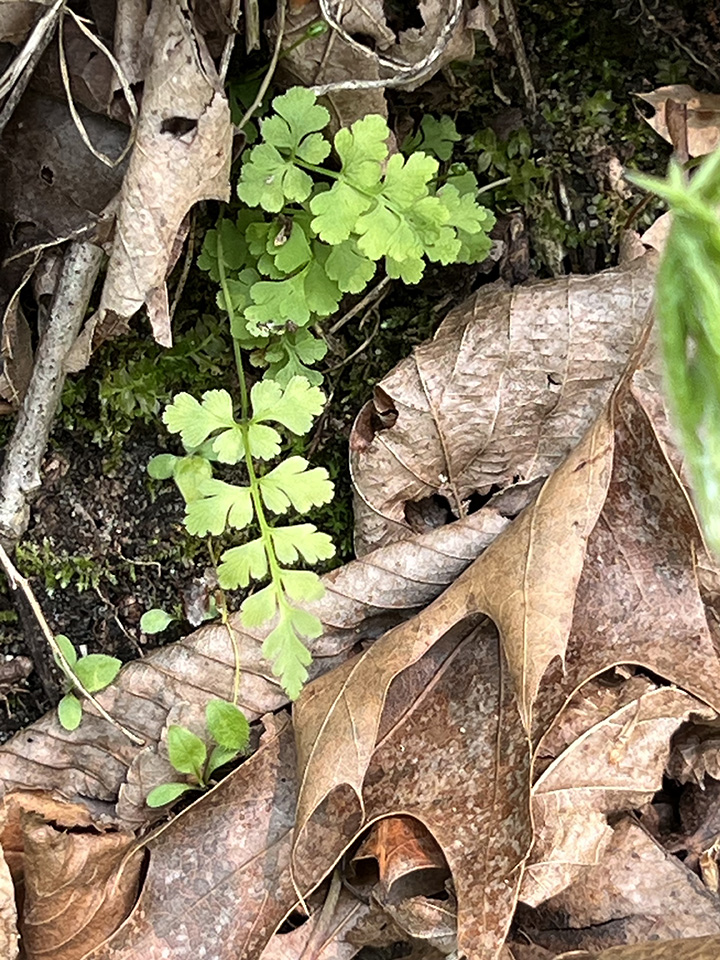
Lowland brittle fern, also called lowland bladderfern, is a small to medium-sized, terrestrial fern. It occurs in the United States east of the Great Plains and in southern Ontario, Canada. It is common in the eastern U.S., uncommon in Minnesota where it reaches the western extent of its range.
Lowland brittle fern is found in moist, deciduous forests on hillsides and in wooded areas along streams. It does not grow on rocks. It appears in early spring and may survive until winter if conditions remain moist. In dry years it may die back (senesce) early to conserve moisture. If moisture returns, it may produce a second flush of new fronds.
Lowland brittle fern rises from a long-creeping, underground, up to 8″ (20 cm) long stem (rhizome). The rhizome is covered with tan to light brown scales and sparse yellow hairs, especially toward the tip. One to several leaves (fronds) are produced in loose intervals near the end of the rhizome beyond the persistent bases of the prior year’s leaf stalks (stipes). However, the rhizome is fast-growing and it extends (“protrudes”) 1″ to 1½″ (25 to 38 mm) beyond the current year’s fronds. This is the feature responsible for the species epithet protrusa.
The fronds are erect, arched, or prostrate, and they may be 3″ to 17¾″ (8 to 45 cm) long, and 1½″ to 4″ (4 to 10 cm) wide, but they are usually no more than 13¾″ (35 cm) long. The stipes are reddish at first, turning green or straw-colored at maturity, and they are shorter than to almost equal to the length of the blade. The blades are egg-shaped or lance-shaped to triangular in outline, one or two times pinnately divided, widest at the second or third primary divisions of the frond (pinnae) from the base, and long-tapered to a bluntly pointed tip. Early season leaves are sterile, smaller, and more coarsely divided, and the margins have rounded teeth. Later leaves are fertile, larger, and more finely divided, and the margins have sharply pointed teeth. The central axes (rachises) are hairless and they lack bulblets.
The pinnae are mostly at right angles to the rachis, and they do not curve forward toward the blade tip. They are triangular to lance-shaped or linear in outline, 3⁄16″ to 2⅜″ (5 to 60 mm) long. The lower pinnae are closely spaced, are oppositely attached or nearly so, and are usually cut into smaller leaflets (pinnules). The outline is more or less equilateral, meaning the downward-pointing (basiscopic) pinnules are roughly equal in size to the upward-pointing ones, not greatly enlarged. The midribs of the pinnae are hairless and they lack bulblets.
The pinnules are usually deeply pinnately lobed, sometimes only toothed. The lowest pinnules on the lowest pinnae have small, 1⁄16″ (1.5 mm) long or longer stalks. The margins are toothed, and the veins mostly end in the points of the teeth.
The reproductive structures are borne on the underside of the pinnules near the base. Small clusters (sori) of spore-bearing cases (sporangia) are arranged in a single row on each side of the midrib halfway between the midrib and the margin. The sorus is circular or nearly so. A hood-like protective veil (indusium) attached to one side arches over the sporangia, but this withers at maturity and becomes difficult to see. The indusium is egg-shaped to cup-shaped and it lacks glandular hairs.
There are 28 to 35 brownish spores per sporangium.
Height
3″ to 17¾″ (8 to 45 cm)
Similar Species
Habitat
Moist, deciduous forests, partial sun, loamy soil
Ecology
Sporulation
June
Pests and Diseases
Use
Distribution
Sources
Biodiversity occurrence data published by: Minnesota Biodiversity Atlas (accessed through the Minnesota Biodiversity Atlas Portal, bellatlas.umn.edu. Accessed 5/12/2026).
Midwest Herbaria Portal. 2026. https://midwestherbaria.org/portal/index.php. Accessed 5/12/2026.
Cystopteris protrusa (Weath.) Blasdell in GBIF Secretariat (2023). GBIF Backbone Taxonomy. Checklist dataset https://doi.org/10.15468/39omei accessed via GBIF.org. Accessed 5/12/2026.
Tryon, R. M. (1980). Ferns of Minnesota (2nd ed., revised). University of Minnesota Press.
Smith, W. R. (2023). Ferns and lycophytes of Minnesota: The complete guide to species identification (R. W. Haug, Photogr.). University of Minnesota Press.
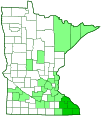
Light green counties on the map indicate misidentified reports or unverified observations.
Misidentified: According to Minnesota State Botanist Welby R. Smith (Ferns and Lycophytes of Minnesota, 2023),
Reports of C. Protrusa growing farther northwest in Minnesota than is indicated on the accompanying map are based on misidentified herbarium records.
Unverified observations: Many community observations on iNaturalist remain unverified, and may be misidentifications of Mackay’s fragile fern (Cystopteris tenuis). It can also inhabit soil in Minnesota, and its range extends much further into central Minnesota.
Nativity
Native
Occurrence
Uncommon in Minnesota
Taxonomy
Kingdom
Subkingdom
Pteridobiotina
Phylum
Tracheophyta (Vascular Plants)
Class
Polypodiopsida (Ferns)
Subclass
Polypodiidae (Leptosporangiate Ferns)
Order
Polypodiales
Suborder
Aspleniinae (Eupolypods II)
Family
Cystopteridaceae
Genus
Cystopteris (Fragile Ferns)
Species
This species was formerly classified as Cystopteris fragilis var. protrusa. It was raised to full species status in 1991 based on a biosystematic revision of the genus Cystopteris (Haufler & Windham, 1991).
Subordinate Taxa
Synonyms
Cystopteris fragilis var. protrusa
Common Names
creeping fragile fern
lowland bladder fern
lowland bladderfern
lowland brittle fern
southern fragile fern
