Toothed plagiomnium moss
(Plagiomnium cuspidatum)
Conservation • Description • Habitat • Ecology • Use • Distribution • Taxonomy
Conservation Status
IUCN Red List
LC - Least Concern
NatureServe
NNR - Unranked
SNR - Unranked
Minnesota
not listed
Description
Toothed plagiomnium moss, also called baby tooth moss and woodsy thyme-moss, is a common, tuft-forming (acrocarpous) moss. It occurs in Europe, Asia, and North America. It occurs throughout the United States and southern Canada, but it is uncommon from the West Coast through the Great Plains and in the south. It is one of the most common and widespread woodland mosses in Minnesota and the northeastern U.S. In Minnesota, it is common in the forested eastern regions, uncommon in the western prairie region except along wooded river corridors.
Toothed plagiomnium moss is found in deciduous and mixed forests, forested peatlands, shrubby areas, savannas, fens, cattail marshes, and river shores. It grows on the ground on soil and on woody debris, and occasionally on tree bases, tree stumps, and soil-covered rocks. It can form a dense mat or an open, often widely spreading tuft.
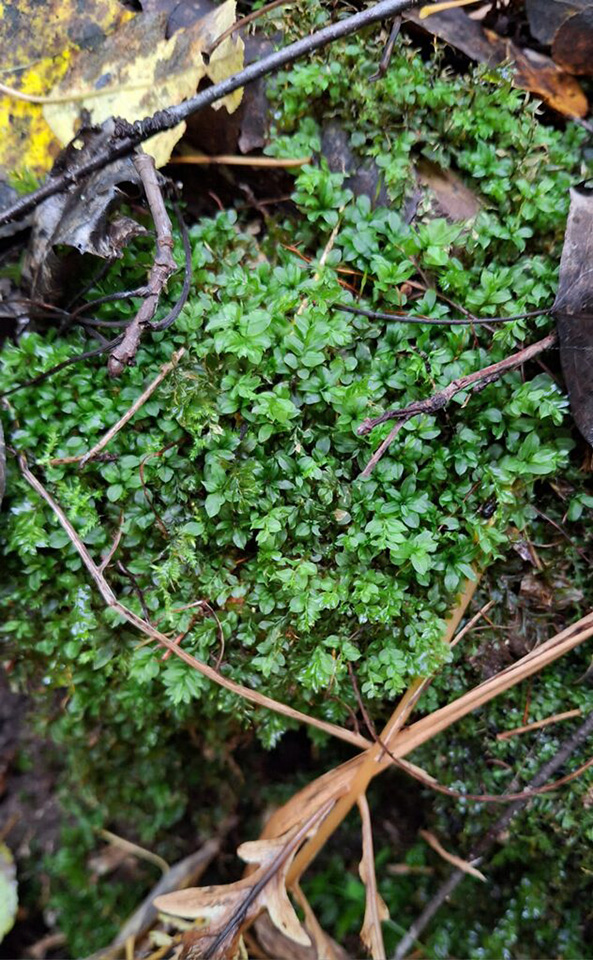
The stems are green or yellowish green when young, and they usually turn brownish as they age. The main, dominant, stem is a vegetative (sterile), creeping, stolon-like, “plagiotropic shoot”. It is unbranched, it lies flat on the ground (prostrate) and it can be up to 2¾″ (7 cm) long. The leaves are arranged on two sides of the stem, not whorled, and they are oriented in a flat plane (complanate). The leaves are smaller at the tip of the stem. There are sometimes numerous, brown, root-like filaments (rhizoids) on the bottom of the stem. The fertile stems are erect, unbranched, and ⅜″ to 1⅜″ (10 to 35 mm) tall, and the leaves are crowded at the top of the stem. The leaves appear to be connected to the stem at the same level, but they are not.
The leaves are ⅛″ to 3⁄16″ (3 to 5 mm) long, 1⁄32″ to 1⁄16″ (1 to 2 mm) wide, and usually egg shaped or more or less diamond shaped, occasionally elliptic. They are dark green or yellowish green, somewhat translucent, and spreading when wet, shriveled and contorted when dry. Dry leaves will return to their previous state when moisture is provided. The base of the leaf blade runs far down the stem. There is one midrib (costa), and it is prominent. The tip of the blade is gradually tapered to a long, sharp, flexible point (cusp). The costa extends into the cusp. The cusp is sometimes toothed. Under magnification, the leaf cells can be seen to be short and elongated. They are sometimes arranged in longitudinal rows, rarely in diagonal rows. The cells in the 2 to 4 marginal rows are smaller, linear, and lighter in color. The leaf margin is toothed only on the upper half, the lower half is smooth. The teeth are sharp and prominent.
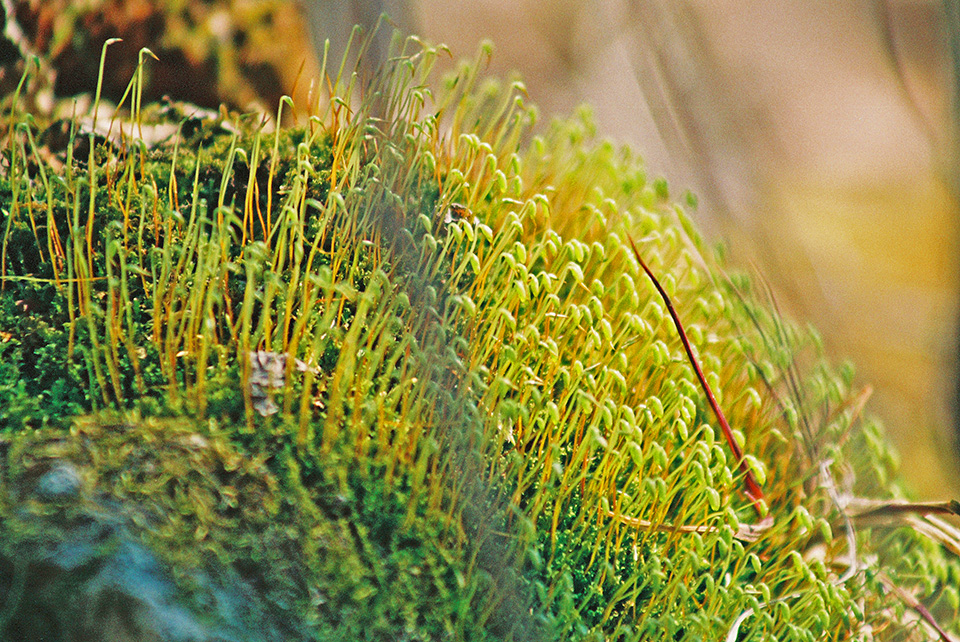
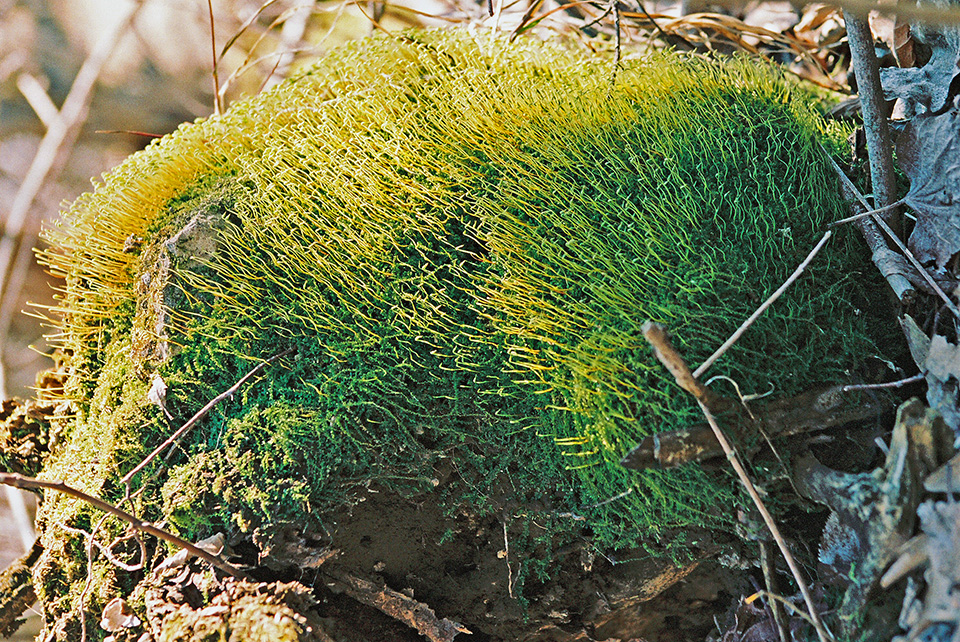
Male and female parts are produced together (synoicous) on each fertile stem. A single spore-bearing reproductive structure (sporophyte) rises from near the tip of each fertile stem. The sporophyte is a small capsule at the end of a long stalk (seta). The seta is ¾″ to 1 3⁄16″ (2 to 3 cm) long, slender, smooth, and yellow, brown, or sometimes reddish. The capsule is egg shaped or cylinder shaped, drooping (pendant), and 1⁄16″to ⅛″ (2 to 3.5 mm) long. It is green at first, soon becoming yellow or yellowish brown.
Growth Form
Acrocarp
Height
⅜″ to 1⅜″ (10 to 35 mm)
Similar Species
Habitat
Deciduous and mixed forests, forested peatlands, shrubby areas, savannas, fens, cattail marshes, and river shores
Ecology
Phenology
The fruit ripens in late spring.
Use
Distribution

Sources
Biodiversity occurrence data published by: Minnesota Biodiversity Atlas (accessed through the Minnesota Biodiversity Atlas Portal, bellatlas.umn.edu. Accessed 9/29/2026).
Midwest Herbaria Portal. 2026. https://midwestherbaria.org/portal/index.php. Accessed 9/29/2026.
Biodiversity occurrence data published by: Bryophyte Portal (accessed through the Bryophyte Portal Portal, https://bryophyteportal.org/portal). Accessed 9/29/2026.
Plagiomnium cuspidatum (Hedw.) T.J. Kop. in Bánki, O., Roskov, Y., Döring, M., Ower, G., Hernández Robles, D. R., Plata Corredor, C. A., Stjernegaard Jeppesen, T., Örn, A., Pape, T., Hobern, D., Garnett, S., Little, H., DeWalt, R. E., Miller, J., Orrell, T., Aalbu, R., Abbott, J., Abreu, C., Acero P, A., et al. (2026). Catalogue of Life (2026-08-26 XR). Catalogue of Life Foundation, Amsterdam, Netherlands. https://doi.org/10.48580/dgyy9
Janssens, Joannes A., and The Minnesota County Biological Survey, Minnesota Department of Natural Resources, State of Minnesota. County Atlas of Minnesota Mosses. May, 2000. www.dnr.state.mn.us/plants/flm/mossatlas/index.html.
Nativity
Native
Occurrence
Wdespread and common to abundant
Taxonomy
Kingdom
Subkingdom
Bryobiotina
Phylum
Subphylum
Bryophytina
Class
Bryopsida (Joint-toothed Mosses)
Subclass
Bryidae
Order
Bryales
Family
Mniaceae
Genus
Plagiomnium (Thyme and Allied Mosses)
Genus
This species was formerly placed in the genus Mnium. It was long known that the genus needed revision. In a generic revision of the family Mniaceae (Koponen, 1968), the author proposed dividing the family into ten genera and the genus Mnium into five genera. Two of those five genera are uncommon, three are widespread and common. Of those three, Plagiomnium leaf margins have single teeth, Mnium leaf margins are double toothed, and Rhizomnium leaf margins have no teeth.
Subordinate Taxa
Synonyms
Astrophyllum silvaticum
Bryum cuspidatum
Hypnum aciphyllum
Hypnum cuspidatum
Mnium affine ssp. humile
Mnium affine var. humile
Mnium cuspidatum
Mnium cuspidatum ssp. eucuspidatum
Mnium cuspidatum ssp. pachyphyllum
Mnium cuspidatum ssp. parvum
Mnium cuspidatum ssp. tenellum
Mnium cuspidatum var. cavifolium
Mnium cuspidatum var. pachyphyllum
Mnium cuspidatum var. tenellum
Mnium serpyllifolium var. cuspidatum
Mnium silvaticum
Mnium silvaticum ssp. cavifolium
Mnium silvaticum var. cavifolium
Mnium sylvaticum
Orthomnion cuspidatum
Polla cuspidata
Common Names
baby tooth moss
common woodsy plagiomnium moss
toothed plagiomnium moss
woodsy leafy moss
woodsy thyme-moss
Visitor Photos
This button not working for you?
Simply email us at info@MinnesotaSeasons.com.
Attach one or more photos and, if you like, a caption.


Minnesota Seasons Photos
Slideshows
Visitor Videos
This button not working for you?
Simply email us at info@MinnesotaSeasons.com.
Attach a video, a YouTube or Instagram link, or a cloud storage link.
Other Videos
Plagiomnium cuspidatum (toothed or “baby-tooth” plagiomnium moss and woodsy thyme-moss)
Rostyslav Yurechko
Plagiomnium cuspidatum, a "baby tooth moss" on a cliff side. Giant city state park.
Mike's thoughts on plants.
Měřík bodlavý | Plagiomnium cuspidatum
Mecheche
Visitor Sightings
This button not working for you?
Simply email us at info@MinnesotaSeasons.com.
Be sure to include a location.
Luciearl
9/27/2026

Location: Pine Song Trail, Fairview Twp.
Nancy Falkum
5/18/2023

Location: Whitewater WMA, Main Branch Unit