wall screw-moss - Species Profile
Conservation • Description • Habitat • Ecology • Use • Distribution • Taxonomy
Conservation Status
IUCN Red List
LC - Least Concern
NatureServe
NNR - Unranked
Minnesota
not listed
Description
Wall screw-moss is a common, small, tuft-forming moss. It is a cosmopolitan species, occurring on every continent except Antarctica. It occurs throughout the United States and southern Canada. It is found in a variety of habitats, including grasslands and forests, and in a variety of light conditions. It grows on calcareous rocks, including limestone and sandstone, and on compacted soil. It is also found on man-made habitats, including concrete, brick and stone walls, roof tiles, and bridges. It is a synanthropic species, very common in urban and industrial areas, but rarely found in natural settings away from human activity.
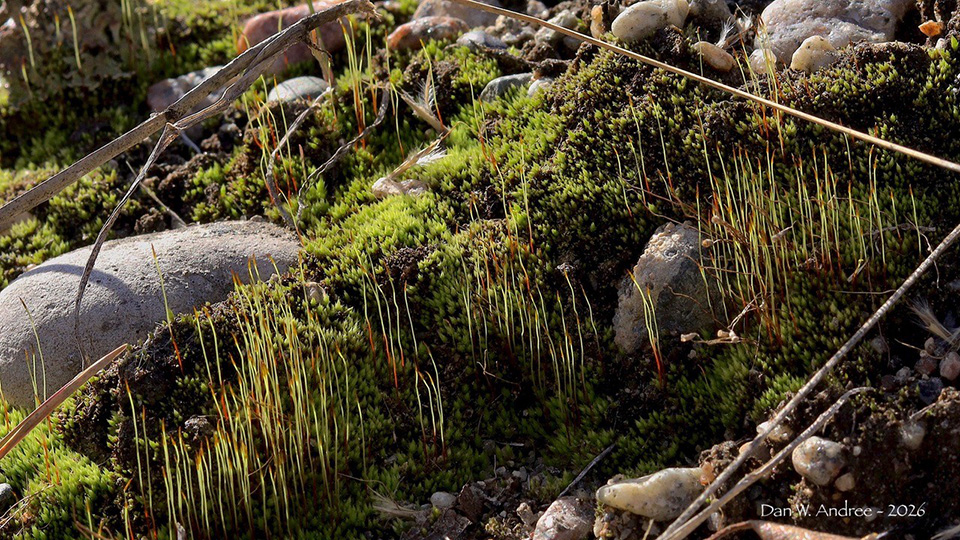
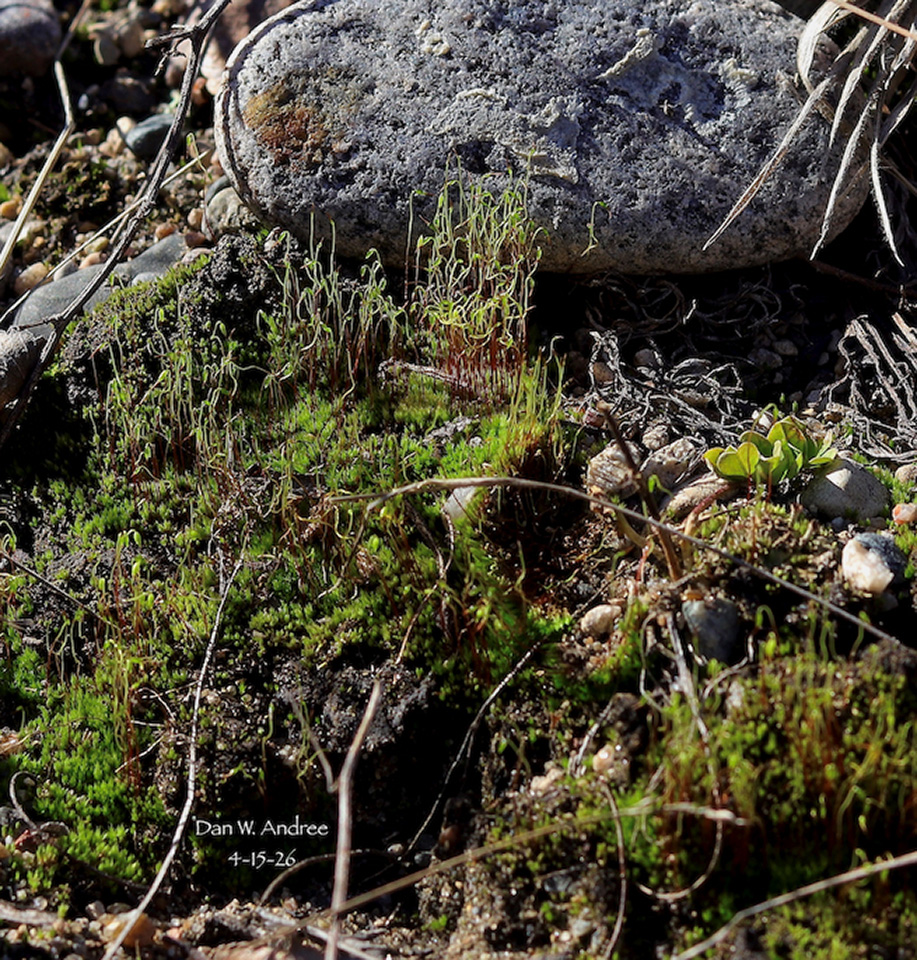
Wall screw-moss has an upright growth form (acrocarpous). It forms dense green cushions often topped with a crowded forest of tall, fruiting stalks (sporophytes).
The stems are of the sexual generation (gametophyte) are unbranched and small, no more than ⅜″ (1 cm) tall. Male and female parts occur on the same plant (autoicous).
The leaves are long, narrow, and egg-shaped or elliptic to inversely egg-shaped. The leaf tips may be bluntly pointed or rounded. The central axis (costa) forms a well developed, short to long, hair-like filament (awn) at the leaf tip. The leaves are green but the tuft may appear grayish green due to the long awns. When it is moist, the leaves are widely spreading. As the plant dries, they fold inward and upward, transforming the star-like stem tip into a sharp, pyramidal point formed by the gathered leaves.
The asexual generation (sporophytes) is a prominent feature of this moss in the spring. Each sporophyte consists of a slender stalk (seta) with an equally slender, spore-bearing capsule at the tip. The seta is straight and commonly ¼″ to ⅝″ (6 to 15 mm) long, though in favorable conditions it can be much longer. It is yellowish at first, becoming reddish as it matures. The capsule is cylindric and erect or nearly erect. The spore-bearing portion (urn) is 1⁄16″ to ⅛″ (1.5 to 3 mm) long and straight or very slightly curved (arcuate). The capsule lid (operculum) has a distinct, long beak, which can be straight, curved, or angled up to 90°.
Growth Form
Acrocarpous
Height
Similar Species
Habitat
A wide variety of natural and man-made habitats
Ecology
Phenology
Capsules mature in spring and summer.
Use
Distribution
Sources
Biodiversity occurrence data published by: Minnesota Biodiversity Atlas (accessed through the Minnesota Biodiversity Atlas Portal, bellatlas.umn.edu. Accessed 4/10/2026).
Midwest Herbaria Portal. 2026. https://midwestherbaria.org/portal/index.php. Accessed 4/10/2026.
Biodiversity occurrence data published by: Bryophyte Portal (accessed through the Bryophyte Portal Portal, https://bryophyteportal.org/portal). Accessed 4/10/2026.
Tortula muralis Hedw. in GBIF Secretariat (2023). GBIF Backbone Taxonomy. Checklist dataset https://doi.org/10.15468/39omei accessed via GBIF.org. Accessed 4/10/2026.
Janssens, Joannes A., and The Minnesota County Biological Survey, Minnesota Department of Natural Resources, State of Minnesota. County Atlas of Minnesota Mosses. May, 2000. www.dnr.state.mn.us/plants/flm/mossatlas/index.html.
Nativity
Native
Occurrence
Common and widespread
Taxonomy
Kingdom
Subkingdom
Bryobiotina (Non-vascular Plants)
Phylum
Class
Bryopsida (Joint-toothed Mosses)
Subclass
Dicranidae
Order
Pottiales
Family
Pottiaceae
Genus
Tortula
Subordinate Taxa
Tortula muralis var. aestiva
Tortula muralis var. madagascariensis
Tortula muralis var. muralis
Tortula muralis var. obcordata
Synonyms
This is a colossal list for Tortula muralis. Because it's a cosmopolitan moss that grows on man-made walls everywhere, botanists from every corner of the globe have given it a unique name over the last 200 years.
Barbula afroinermis
Barbula annulus
Barbula binnsii
Barbula chrysoblasta
Barbula elaphrotricha
Barbula elaphrotricha var. incana
Barbula gulliveri
Barbula melbourneana
Barbula montenegrina
Barbula muralis
Barbula muralis ssp. heribaudii
Barbula muralis ssp. incana
Barbula muralis ssp. ticinensis
Barbula muralis var. capensis
Barbula muralis var. goettingensis
Barbula muralis var. heterophylla
Barbula muralis var. incana
Barbula muralis var. microcarpa
Barbula muralis var. pilosa
Barbula muralis var. rupestris
Barbula muricola
Barbula nano-subulata
Barbula subpulvinata
Barbula ticinensis
Bryum murale
Desmatodon montenegrinus
Desmatodon muralis
Desmatodon muralis var. incanus
Desmatodon muralis var. rupestris
Grimmia crassa
Syntrichia muralis
Tortula aestiva var. ticinensis
Tortula aestiva var. vulcanicola
Tortula annulus
Tortula baetica
Tortula binnsii
Tortula chrysoblasta
Tortula elaphrotricha
Tortula elaphrotricha var. incana
Tortula goettingensis
Tortula gulliveri
Tortula hutchinsonii
Tortula lingulata ssp. montenegrina
Tortula melbourneana
Tortula montenegrina
Tortula muralis ssp. aestiva
Tortula muralis var. albida
Tortula muralis var. baetica
Tortula muralis var. brevipedunculata
Tortula muralis var. calcarea
Tortula muralis var. goettingensis
Tortula muralis var. heribaudii
Tortula muralis var. humilis
Tortula muralis var. incana
Tortula muralis var. longipila
Tortula muralis var. ovata
Tortula muralis var. rupestris
Tortula muralis var. sublaevis
Tortula muralis var. ticinensis
Tortula muralis var. vernalis
Tortula muralis var. vulcanicola
Tortula muricola
Tortula pilosa
Tortula pulvinata
Trichostomum hutchinsonii
Common Names
wall screw moss
wall screw-moss