Red-banded Webcap - Species Profile
Conservation • Description • Habitat • Ecology • Distribution • Taxonomy
Conservation Status
IUCN Red List
not listed
NatureServe
NNR - Unranked
Minnesota
not listed
Description
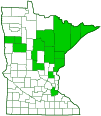
Red-banded Webcap is a common, late season, medium-sized to large, gilled mushroom. It occurs in Europe, Asia, and North America. In the United States it occurs from Maine to New Jersey, west to Minnesota and Illinois, and south along the Appalachian Mountains to northern Georgia, and in Washington State and Alaska. It occurs across southern Canada from Nova Scotia west to British Columbia and north in the west to the Yukon.
Red-banded Webcap is found in late summer and fall in northern mixed coniferous and deciduous forests where birch is present. It is closely associated with birch, though this may not be apparent in a mixed forest. It grows on the ground, sometimes alone but usually scattered, or in groups but not clustered (gregarious). It obtains its nutrients from the rootlets of living trees (mycorrhizal).
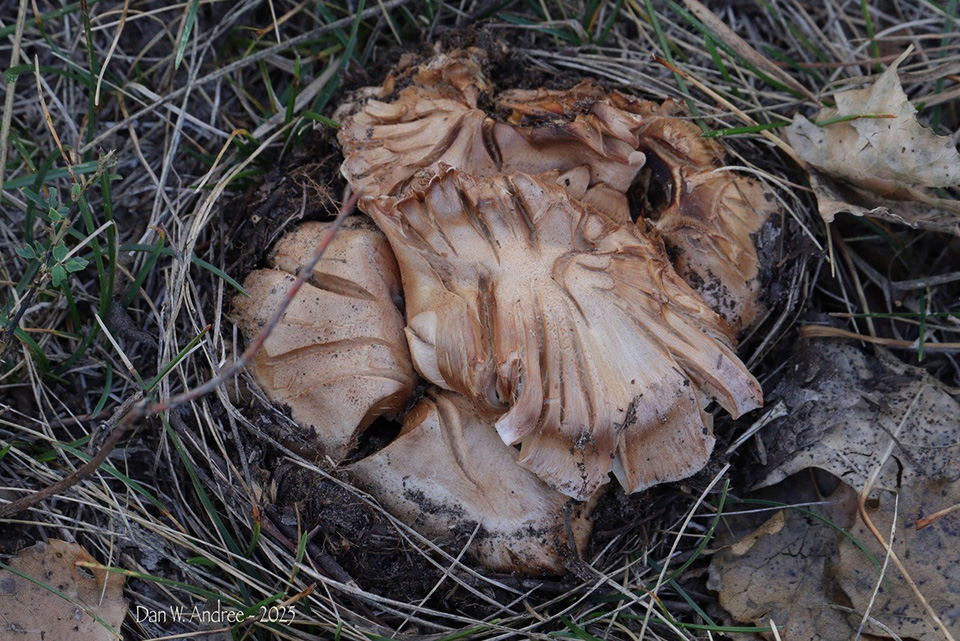
When it first appears, the fruiting body is convex, and the surface is smooth and moist but not slimy or sticky (viscid). It may be hairless or covered with minute silky hairs. It soon becomes bell-shaped with the margins curved inward. The color is variable, yellowish brown, orangish brown, reddish brown, or rusty brown. As it ages the cap expands and the color fades. The mature cap is 2″ to 5″ (5 to 13 cm) in diameter and nearly flat or broadly humped (umbonate). The surface is dry and it sometimes develops small scales. There are sometimes small pieces of tissue, remnants of the universal veil, clinging to the margin.
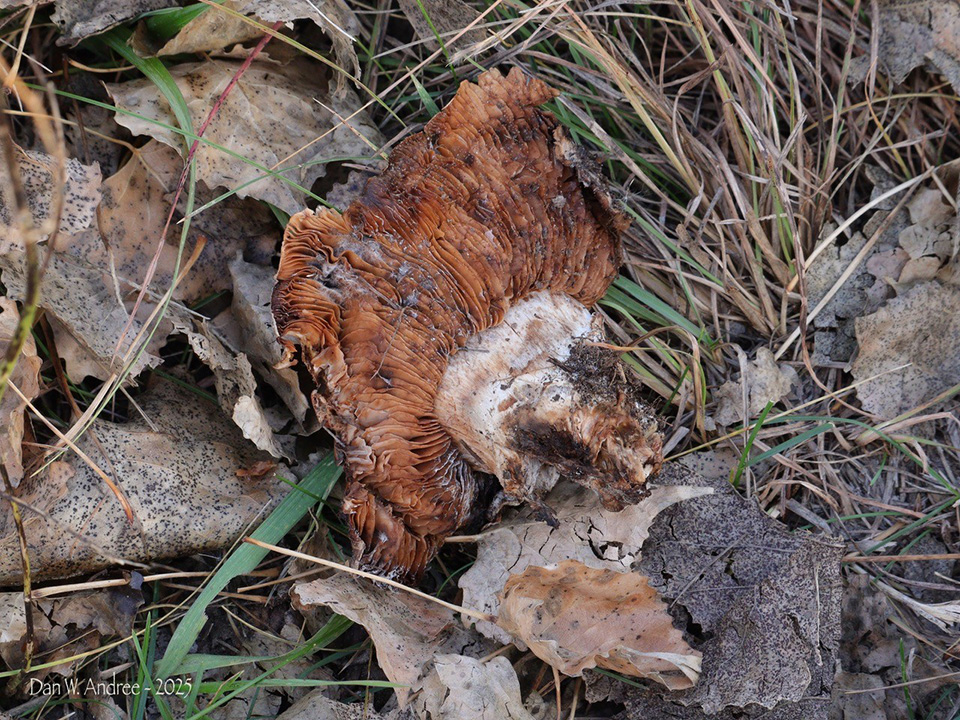
The gills are broad, fairly well spaced, broadly attached to the stalk (adnate), and pale dirty yellowish to pale cinnamon at first. When young, they are covered by a whitish, cobweb-like veil (cortina). As the mushroom ages, the cortina breaks away and the gills become narrowly attached to the stalk (adnexed) or abruptly narrowed at the stalk (notched). The color changes to rusty brown as the spores mature.
The stalk is 2¾″ to 6″ (7 to 15 mm) long, and ⅜″ to 1″ (1.0 to 2.5 cm) thick at the top, and club-shaped, becoming wider at the bottom. The surface is dry, hairless or covered with minute silky hairs, and white to pale brownish. There are one or more rings, “bracelets” of cobwebby fibers, remnants of the cortina. These are whitish at first but soon turn orangish red as they trap falling spores. There are usually 2 or 3 rings, sometimes more.
The flesh is thick and whitish to pale brownish. It was formerly considered edible, though thought to contain the deadly toxin orellanine, like other Cortinarius mushrooms, but at much lower concentrations. Recent research has found that it does not contain orellanine, but it should be avoided due to the risk of confusing it with toxic lookalikes and its tendency to accumulate heavy metals.
The spore print is rusty brown.
Similar Species
Habitat and Hosts
Mixed coniferous and deciduous forests
Birch
Ecology
Season
Late summer and fall
Distribution
Sources
Biodiversity occurrence data published by: Minnesota Biodiversity Atlas (accessed through the Minnesota Biodiversity Atlas Portal, bellatlas.umn.edu. Accessed 2/14/2026).
Cortinarius armillatus (Fr.) Fr. in GBIF Secretariat (2023). GBIF Backbone Taxonomy. Checklist dataset https://doi.org/10.15468/39omei accessed via GBIF.org. Accessed 2/14/2026.
Mycology Collections Portal (MyCoPortal) https://www.mycoportal.org/portal/collections/index.php). Accessed 2/14/2026.
Occurrence
Common
Taxonomy
Kingdom
Fungi (Fungi)
Subkingdom
Dikarya
Phylum
Basidiomycota (Basidiomycete Fungi)
Subphylum
Agaricomycotina (Higher Basidiomycetes)
Class
Agaricomycetes (Mushrooms, Bracket Fungi, Puffballs, and Allies)
Subclass
Agaricomycetidae
Order
Agaricales (Common Gilled Mushrooms and Allies)
Family
Cortinariaceae
Genus
Cortinarius (webcaps)
Subgenus
Telamonia
Section
Armillati
Subordinate Taxa
Synonyms
Agaricus armillatus
Cortinarius armillatus var. miniatus
Cortinarius armillatus var. subcroceofulvus
Cortinarius haematochelis ssp. armillatus
Gomphos armillatus
Hydrocybe armillata
Telamonia armillata
Common Names
Bracelet Cortinarius
Cinnabar Bracelet Webcap
Red banded Cort
Red banded Webcap
Red-banded Webcap