



Lombardy poplar
(Populus nigra var. italica)
Conservation • Description • Habitat • Ecology • Use • Distribution • Taxonomy
Conservation Status |
|
|||||||
| IUCN Red List | LC - Least Concern |
|||||||
| NatureServe | NNA - Not applicable SNA - Not applicable |
|||||||
| Minnesota | not listed |
|||||||
Description |
||
Lombardy poplar is a non-native, cultivated variety. It is a deciduous hardwood tree. It rises on a single stem from a shallow, wide-spreading root system. It is fast growing and short lived, commonly lasting only 30 to 50 years. The short lifespan is due to its susceptibility in humid environments to fungal diseases which cause cankers. It does not escape cultivation but may spread vegetatively. Mature trees are up to 60′ tall. The trunk is slender with many branches. The crown is columnar and very narrow. It begins nearly at the base of the trunk and usually spreads no more than 10′ to 15′. The top of the crown is often dead. The branches are clustered, erect, and held close to the trunk. The bark on young trees is smooth and grayish-green. It does not peel like paper birch. As it ages it becomes thick and gray, with rough, irregular furrows, at least near the base of the tree. The current-season twigs are moderate to stout, swollen at the leaf nodes, yellowish-brown, and shiny. They turn dull gray and rough in the second year. The buds are yellow to yellowish-brown and resinous when squeezed. They are less than ½″ long, cone-shaped, slender, tapering, and pointed. They are covered with 3 or 4 visible bud scales. The lower scales are densely hairy. The upper scales are hairless and shiny. The leaves are deciduous, alternate, 2″ to 4″ long, and not lobed or divided (simple). They are hairy when young, soon becoming hairless. The upper surface is dark green with a definite translucent border. The lower surface is paler green. The margins are finely and shallowly toothed. The teeth are no more than about 1 ⁄32″ deep and are not or only slightly curved inward at the tip (this may be visible only with a hand lens). Leaf blades on short shoots are rhomboid egg-shaped and more or less wedge-shaped at the base. Leaf blades on long shoots are broadly triangular egg-shaped, mostly wider than long, abruptly pointed at the tip, and straight across at the base. The leaf stalk is ⅓″ to ⅔″ as long as the leaf blade and is distinctly flattened perpendicular to the plane of the blade. There are no visible warty glands at the base of the leaf blade where it attaches to the stalk. Male and female flowers are borne on separate plants. However, all individuals of this cultivar trace back to a single male clone, hence all individual plants are male. The flowers appear before the leaves in early spring. They are borne in 2″ to 3″ long, crowded, pendulous, reddish- to yellowish-green catkins on 2nd year branchlets. This cultivar does not produce fruit. |
||
Height |
||
Up to 60′ |
||
Record |
||
There is no state champion of non-native trees. |
||
Flower Color |
||
Reddish or greenish-yellow |
||
Similar Species |
||
Habitat |
||
Dry. Old homesteads. |
||
Ecology |
||
Flowering |
||
Early April to early mid-May |
||
Pests and Diseases |
||
Pemphigus populicaulis (no common name) is an aphid that causes a gall at the junction of leaf blade and petiole. The opening in the gall is a slit running parallel to the direction of the petiole. |
||
Use |
||
|
||
Distribution |
||||
|
Sources |
|||
| 5/7/2023 | ||||
Nativity |
||||
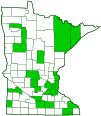
Species native to Europe, Asia, and northern Africa. Cultivar selected in northern Italy, widely cultivated, rarely escaped. |
||||
Occurrence |
||||
Uncommon in Minnesota outside of cultivation. |
||||
Taxonomy |
|||
| Kingdom | Plantae (Plants) | ||
| Phylum | Tracheophyta (Vascular Plants) | ||
| Subdivision | Spermatophytina (Seed Plants) | ||
| Class | Magnoliopsida (Dicots) | ||
Order |
Malpighiales (Nances, Willows, and Allies) | ||
Family |
Salicaceae (Willow) | ||
| Tribe | Saliceae | ||
| Genus | Populus (Poplars, Cottonwoods, and Aspens) | ||
Subordinate Taxa |
|||
Synonyms |
|||
Populus dilatata Populus italica Populus nigra var. italica |
|||
Common Names |
|||
black cottonwood black poplar Lombardy poplar Lombardy’s poplar |
|||
Glossary
Catkin
A slim, cylindrical, drooping cluster of many flowers. The flowers have no petals and are either male or female but not both.
Simple leaf
A leaf that is not divided into leaflets, though it may be deeply lobed or cleft.
Visitor Photos |
|||||
Share your photo of this plant. |
|||||
| This button not working for you? Simply email us at info@MinnesotaSeasons.com. Attach one or more photos and, if you like, a caption. |
|||||
|
|||||
MinnesotaSeasons.com Photos |
|||||
 |
|||||

Slideshows |
||
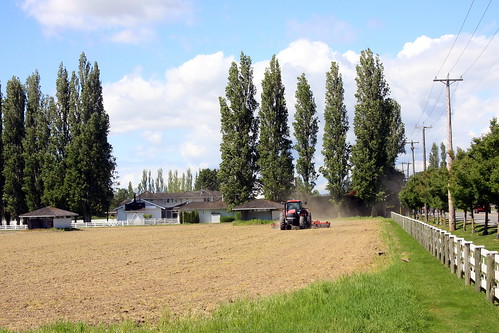
| Populus nigra 'Italica' Blake C. Willson |
||
|
||
About
Lombardi Poplar |
||
Visitor Videos |
|||
Share your video of this plant. |
|||
| This button not working for you? Simply email us at info@MinnesotaSeasons.com. Attach a video, a YouTube link, or a cloud storage link. |
|||
Other Videos |
|||
| Lombardy Poplar Shade Tree Pat Rick |
|||
About
Uploaded on Oct 12, 2010 http://www.tytyga.com/Plant+Tree+Screen The Lombardy Poplar Shade tree is a popular, fast growing tree that can grow into a privacy screen up to 60 feet tall in the U.S, and in Europe some specimens have grown up to 100 feet tall. The Lombardy Poplar tree is a beautiful shaped column that when planted eight feet apart will grow into a solid dense privacy screen that will block noise and toxic fumes from automobiles. Lombardy poplar trees can grow 4 to 6 feet in a year and are cold hardy in most of the United States. Whether the soils are poor and sandy or rich, loamy earth, the Lombardy poplar easily adapts to growing faster in almost any environment requiring a minimum amount of care and attention. The best and fastest tree growth can result in planting the trees in partial or fun sun and heavy watering. The large green leaves of the Lombardy poplar are in constant motion, even from the tiniest breeze and make windy noises like waves crashing against the ocean shore. In the fall the leaves turn into a brilliant yellow fall color. Remember to order a few Lombardy Poplar trees to grow when planted next to form a leafy, dense wall to ensure your privacy block. Some customers claim that their Lombardy Poplar tree have grown into an amazing 12 feet in just one year. Order your trees now Call Ty Ty today!! |
|||
| Lombardy Poplar Tree Shade Tree Pat Rick |
|||
About
Uploaded on Jan 19, 2010 http://www.tytyga.com/product/Lombardy+Poplar+Tree |
|||

Visitor Sightings |
|||||
Report a sighting of this plant. |
|||||
| This button not working for you? Simply email us at info@MinnesotaSeasons.com. Be sure to include a location. |
|||||
|
|||||
MinnesotaSeasons.com Sightings |
|||||
|
Created: Last Updated: © MinnesotaSeasons.com. All rights reserved. |