



Virginia pepper grass
(Lepidium virginicum ssp. virginicum)
Conservation • Wetland • Description • Habitat • Ecology • Use • Distribution • Taxonomy
Conservation Status |
|
|||||||
| IUCN Red List | not listed |
|||||||
| NatureServe | N5 - Secure SNR - Unranked |
|||||||
| Minnesota | not listed |
|||||||
Wetland Indicator Status |
||||||||
| Great Plains | FACU - Facultative upland |
|||||||
| Midwest | FACU - Facultative upland |
|||||||
| Northcentral & Northeast | FACU - Facultative upland |
|||||||
Description |
||
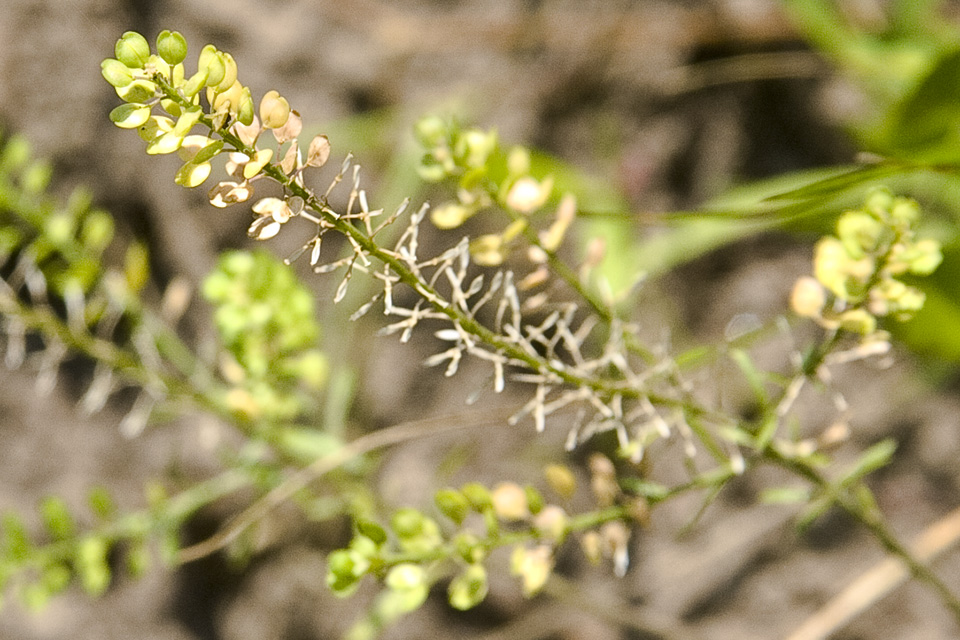
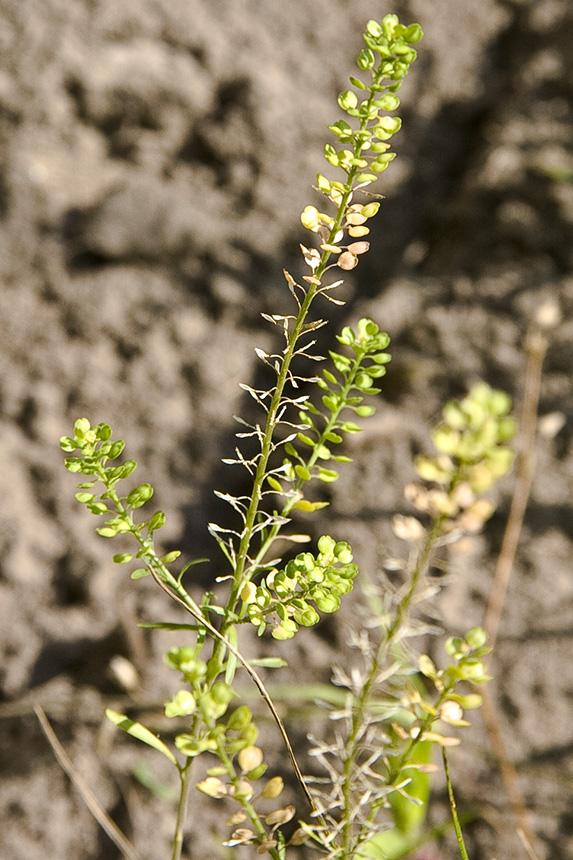
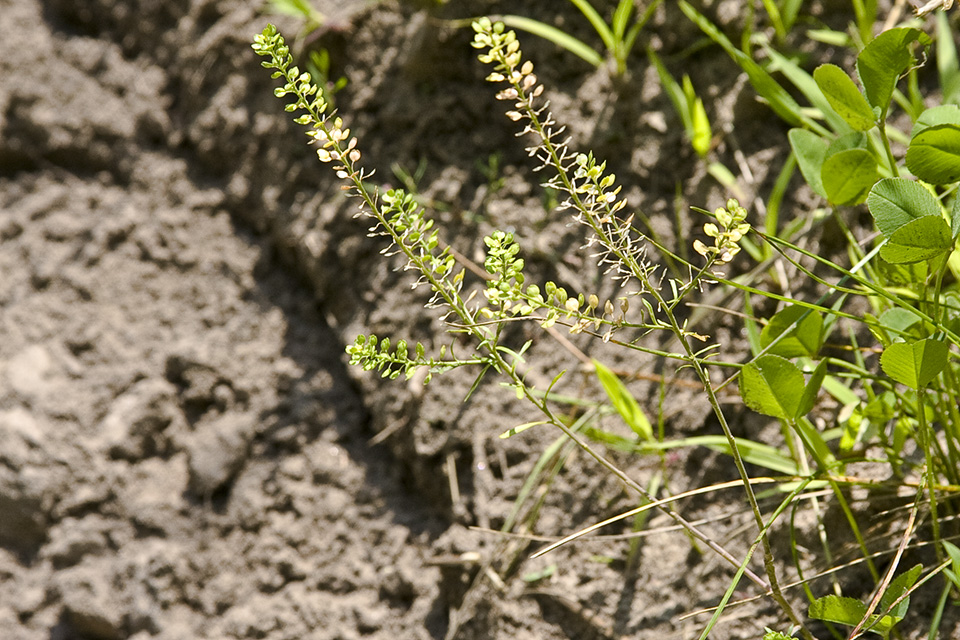
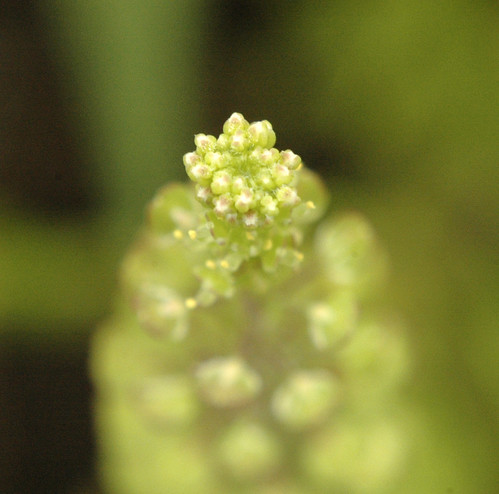
Virginia pepper grass is a 4″ to 20″ tall, erect, annual or biennial forb that rises on usually a single stem from a slender, branching taproot. At first it forms a rosette about 6″ in diameter of basal leaves. The basal leaves are usually once lobed with a large, rounded, terminal lobe. When the plant is a biennial it overwinters in this form. Basal leaves are usually wilted by flowering time. The flowering stems are erect or ascending. They are occasionally branched at the base, often branched in the upper third. They are covered, especially near the top, with minute, curved, mostly ascending hairs. Lower stem leaves are alternate, inversely egg-shaped or linear, 1″ to 4″ long, and 3 ⁄16″ to ⅜″ wide. They are on short leaf stalks and are sometimes lobed. The leaf blades are tapered to almost heart-shaped at the base and taper to a point at the tip with straight sides along the tip. The upper and lower surfaces are usually hairless, sometimes sparsely hairy. The margins are sharply toothed. Upper stem leaves are similar but smaller, linear, and stalkless but not clasping. The margins are usually untoothed. The inflorescence is a dense, unbranched cluster (raceme) at the end of the stems and branches. The racemes are compact when in flower, but quickly elongate as the fruits develop, eventually becoming up to 4″ long. Typically, a few flowers are in bloom crowded at the top of the raceme, with developing and developed fruits below. The individual flowers less than ⅛″ wide. There are 4 green, linear to narrowly elliptic sepals, and 4 white petals. The petals are as long to twice as long as the sepals. There is no floral scent. The fruit is a flattened, 1 ⁄16″ to ⅛″ long, mostly circular, seed pod. It is widest at the middle. The tip is narrowly winged and has a broad, shallow notch. It is initially green, turning brownish when dry. It is on a stalk that is spreading or ascending. |
||
Height |
||
4″ to 20″ |
||
Flower Color |
||
White |
||
Similar Species |
||
Clasping pepper grass (Lepidium perfoliatum) upper stem leaves are broadly egg-shaped to circular and perfoliate or strongly clasping with auricles that surround the stem and overlap. Field pennycress (Thlaspi arvense) fruits are much larger, 5 ⁄16″ to ¾″ long, and are broadly winged all around, not just at the tip. Gardencress pepperweed (Lepidium sativum) fruits are on stalks that are closely ascending or almost erect. The fruits are larger, 3 ⁄16″ to ¼″ wide. Prairie peppergrass (Lepidium densiflorum) is nearly indistinguishable when not in flower. The flowers either have no petals or have petals that are no longer than the sepals. The fruits are broadly inversely egg-shaped, widest above the middle. |
||
Habitat |
||
Dry to moist. Prairies, bluff tops, fields, railroads, roadsides, disturbed sites. Full or partial sun. |
||
Ecology |
||
Flowering |
||
May to July |
||
Pests and Diseases |
||
|
||
Defense Mechanisms |
||
This and other mustards (family Brassicaceae) produce chemical compounds when cells are damaged that are toxic to most animals, fungi, and bacteria. |
||
Use |
||
|
||
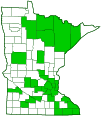
Distribution |
||||
|
Sources |
|||
| 5/28/2023 | ||||
Nativity |
||||
Native |
||||
Occurrence |
||||
|
||||
Taxonomy |
|||
| Kingdom | Plantae (Plants) | ||
| Subkingdom | Pteridobiotina | ||
| Phylum | Tracheophyta (Vascular Plants) | ||
| Class | Magnoliopsida (Dicots) | ||
Order |
Brassicales (Mustards, Capers, and Allies) | ||
Family |
Brassicaceae (Mustard) | ||
| Tribe | Lepidieae | ||
Genus |
Lepidium (Peppergrass) | ||
| Species | Lepidium virginicum (Virginia Pepper Grass) | ||
Subordinate Taxa |
|||
|
|||
Synonyms |
|||
Clypeola caroliniana Crucifera virginica Cynocardamum virginicum Dileptium diffusum Dileptium praecox Dileptium virginicum Iberis virginica Lepidium arcuatum Lepidium danielsii Lepidium diandrum Lepidium exiguiflorum Lepidium iberis Lepidium majus Lepidium micropterum Lepidium praecox Lepidium triandrum Lepidium virginicum var. canescens Lepidium virginicum var. kashmirianum Lepidium virginicum var. kashmiricum Lepidium virginicum var. linearifolium Lepidium virginicum var. macropetalum Lepidium virginicum var. pavonianum Lepidium virginicum var. ramosum Nasturtiastrum virginicum Nasturtium diandrum Nasturtium iberis Nasturtium majus Nasturtium virginicum Semetum ramosum Thlaspi virginianum Thlaspi virginicum |
|||
Common Names |
|||
common peppergrass poor-man's-pepper poorman's-pepperwort Virginia pepper grass Virginia pepper-weed Virginia pepperweed |
|||
Glossary
Auricle
A small, ear-like projection at the base of a leaf or at the junction of a grass blade and stem.
Clasping
Describing a leaf that wholly or partly surrounds the stem but does not fuse at the base.
Linear
Long, straight, and narrow, with more or less parallel sides, like a blade of grass.
Perfoliate
A leaf having margins that entirely surround the stem, giving the appearance that the stem is growing through the leaf.
Pinnate
On a compound leaf, having the leaflets arranged on opposite sides of a common stalk. On a bryophyte, having branches evenly arranged on opposite sides of a stem.
Raceme
An unbranched, elongated inflorescence with stalked flowers. The flowers mature from the bottom up.
Visitor Photos |
|||||
Share your photo of this plant. |
|||||
| This button not working for you? Simply email us at info@MinnesotaSeasons.com. Attach one or more photos and, if you like, a caption. |
|||||
|
|||||
MinnesotaSeasons.com Photos |
|||||
Infructescence |
|||||
 |
 |
||||
 |
|||||

Slideshows |
||
| Lepidium virginicum COMMON PEPPERCRESS Frank Mayfield |
||
|
||
Visitor Videos |
|||
Share your video of this plant. |
|||
| This button not working for you? Simply email us at info@MinnesotaSeasons.com. Attach a video, a YouTube or Instagram link, or a cloud storage link. |
|||
Other Videos |
|||
| EatTheWeeds: Episode 06: Peppergrass, Lepidium Virginicum EatTheWeeds |
|||
About
Uploaded on Feb 11, 2008 http://www.eattheweeds.com/peppergrass-potent-pipsqueak/ Learn how to recognize and use the wild food peppergrass, Lepidium virginicum springtime salad ingredient, pot herb, and spice from www.eattheweeds.com |
|||
| Virginia Pepperweed (Lepidium Virginicum) / Peppergrass - 2012-06-02 W3stlander |
|||
About
Published on Jun 5, 2012 Lepidium virginicum, also known as Virginia pepperweed or peppergrass, is an annual or biennial plant in the Brassicaceae or mustard family. --------------- De Amerikaanse kruidkers (Lepidium virginicum) is een eenjarige plant, die behoort tot de kruisbloemenfamilie (Cruciferae of Brassicaceae). |
|||
| Pepperweed Lepidium Virginicum.avi Sustainability part 1 Moringa |
|||
About
Uploaded on Apr 20, 2011 Foraging foods plant identification |
|||

Visitor Sightings |
|||||
Report a sighting of this plant. |
|||||
| This button not working for you? Simply email us at info@MinnesotaSeasons.com. Be sure to include a location. |
|||||
|
|||||
MinnesotaSeasons.com Sightings |
|||||
|
Created: Last Updated: © MinnesotaSeasons.com. All rights reserved. |