



green milkweed
(Asclepias viridiflora)
Conservation • Description • Habitat • Ecology • Use • Distribution • Taxonomy
|
|
|||||||||||||
Description |
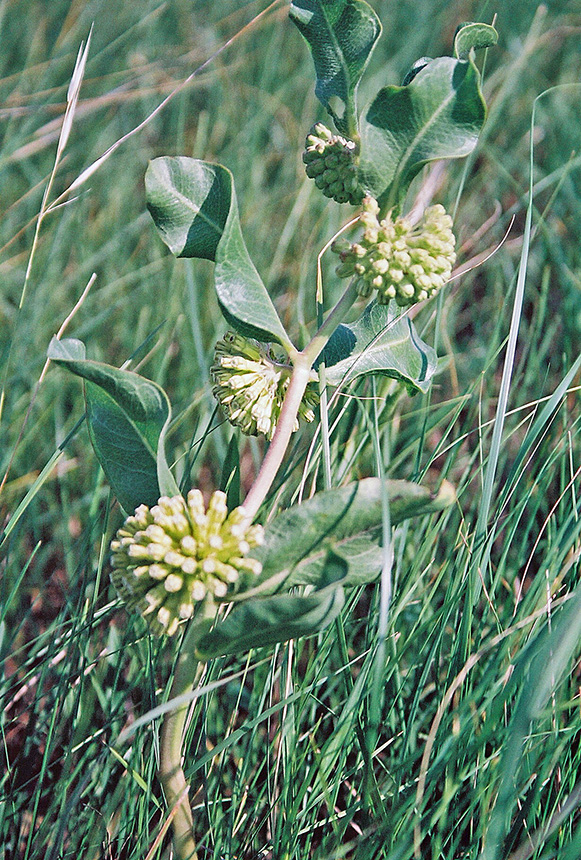
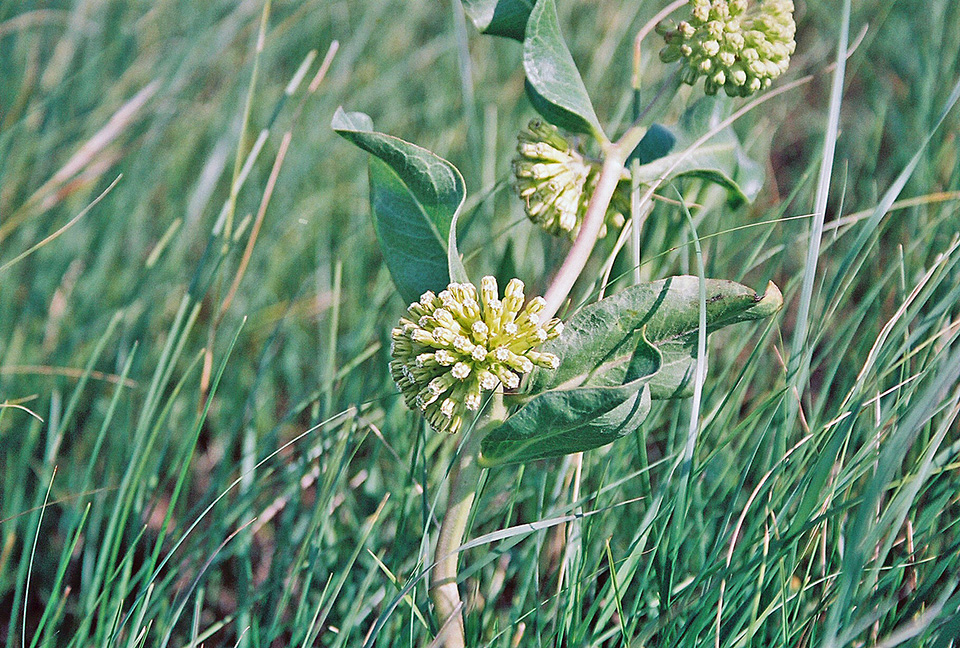
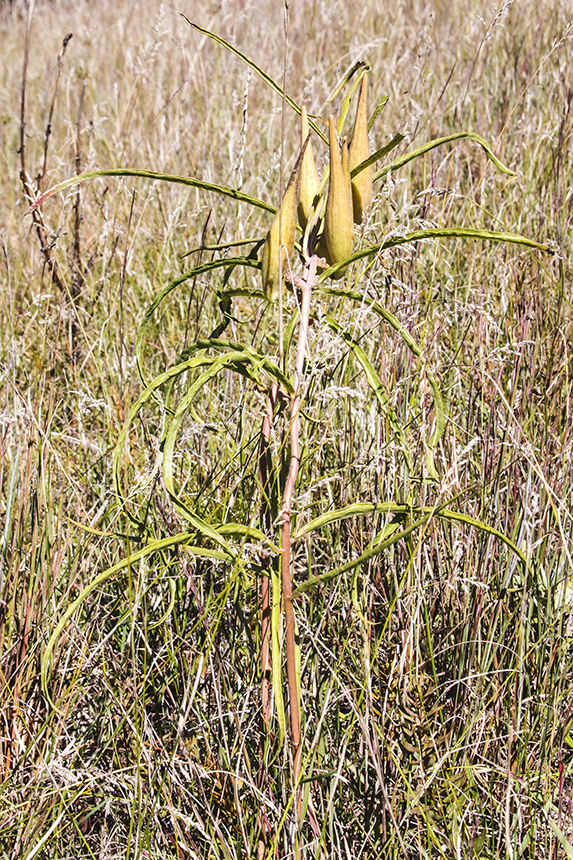
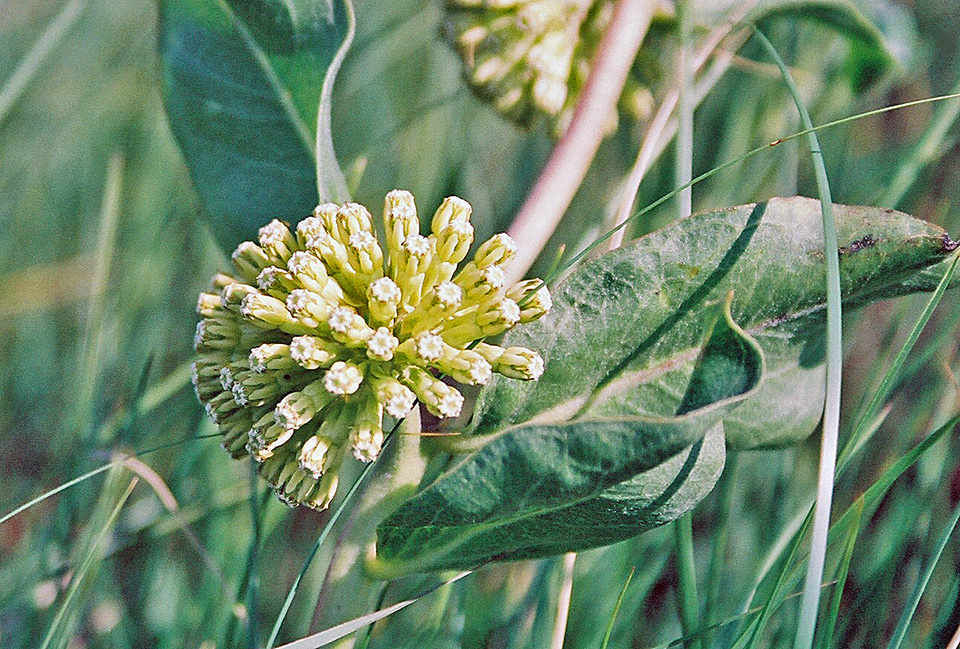
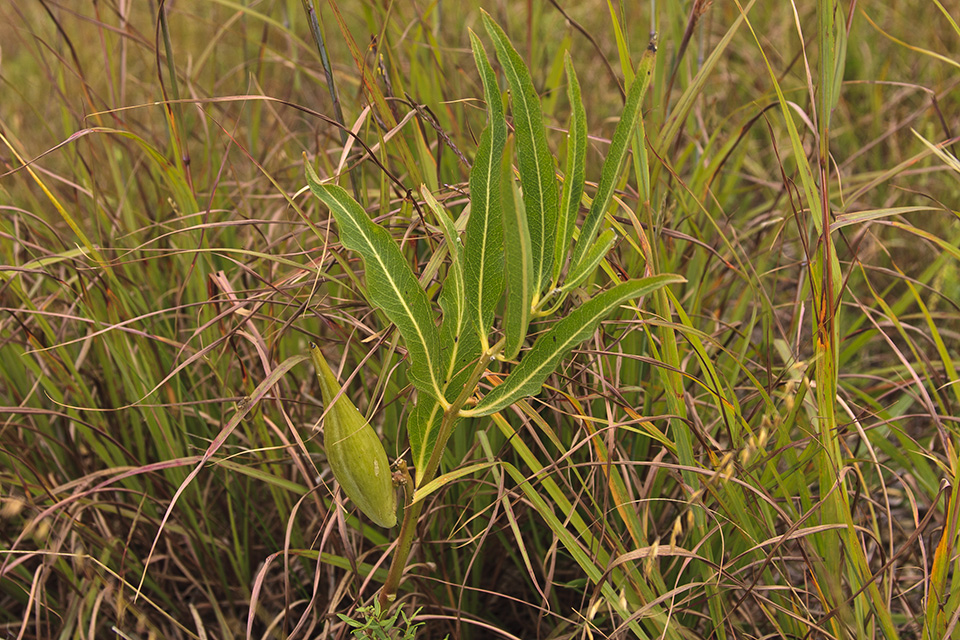
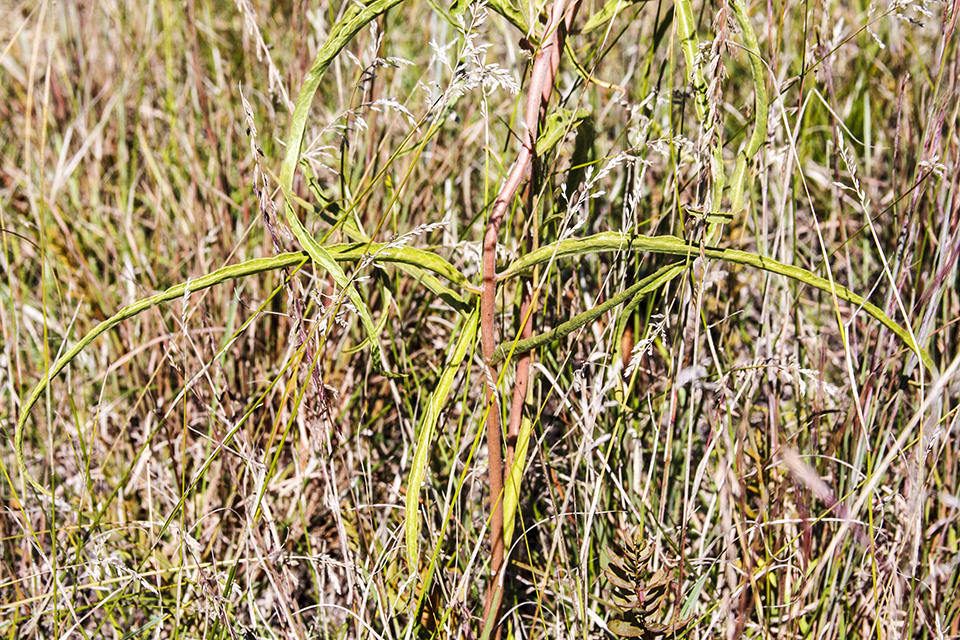
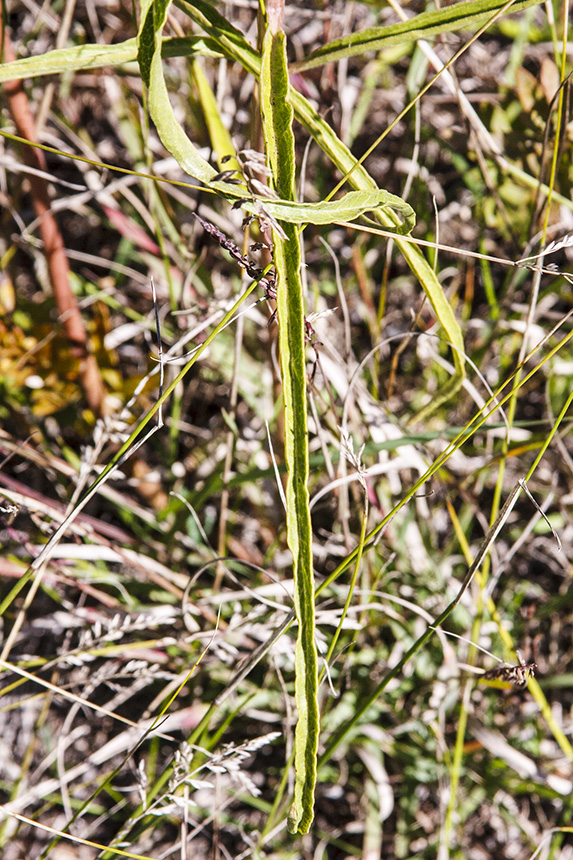
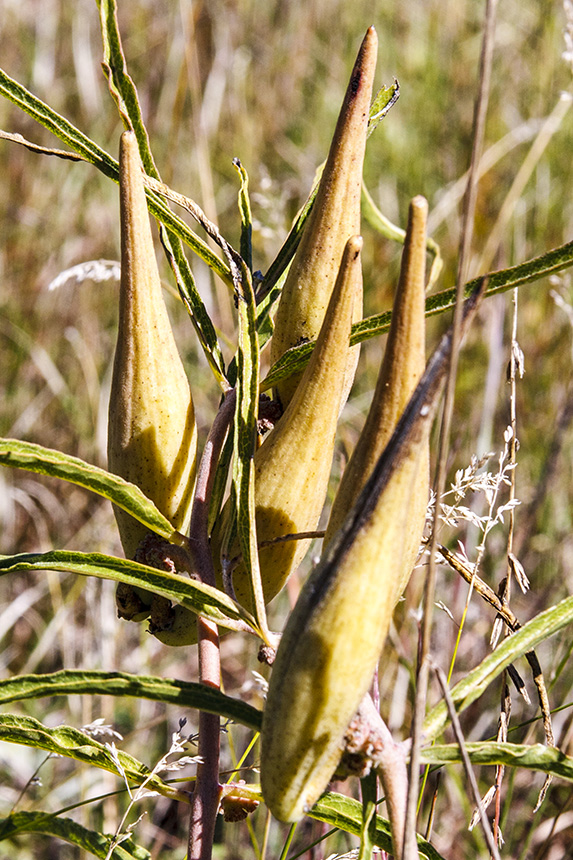
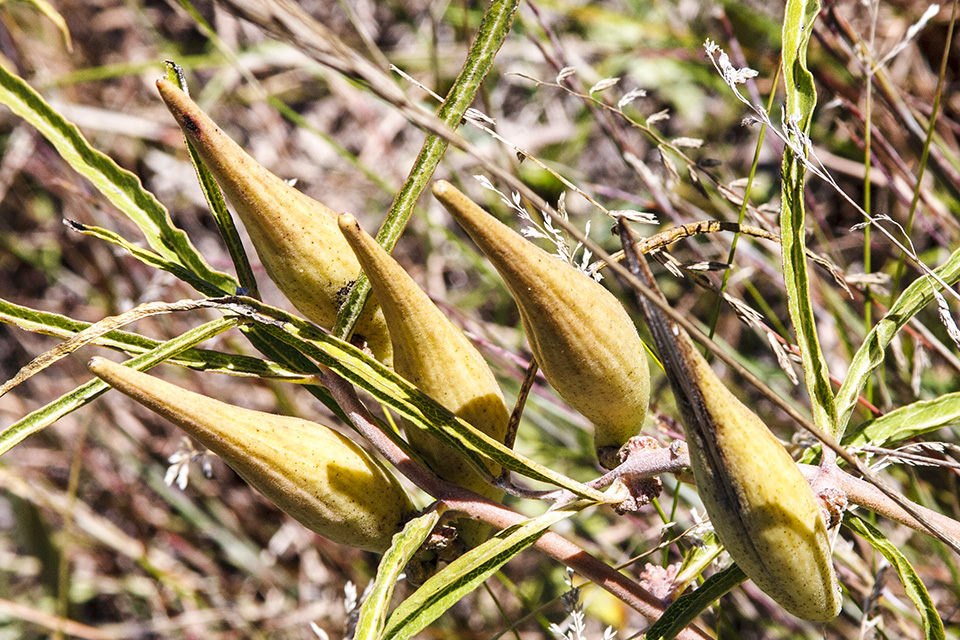
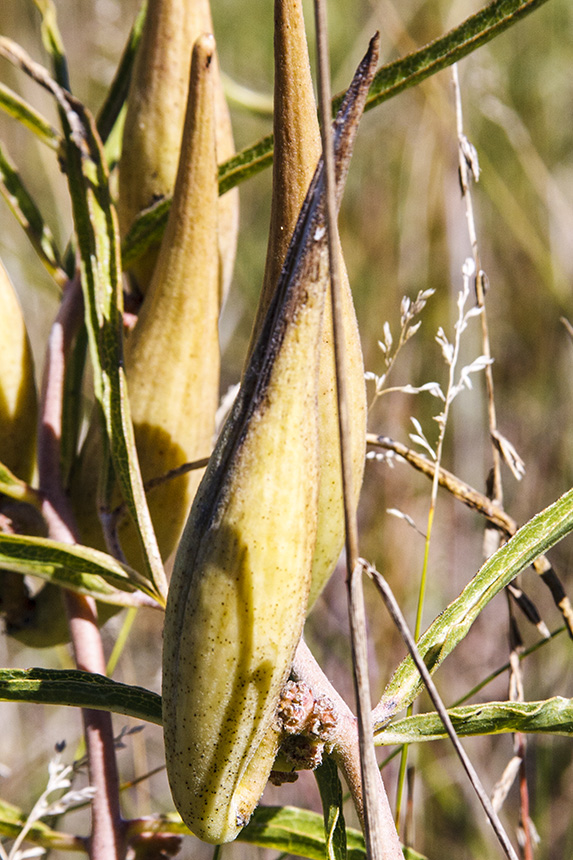
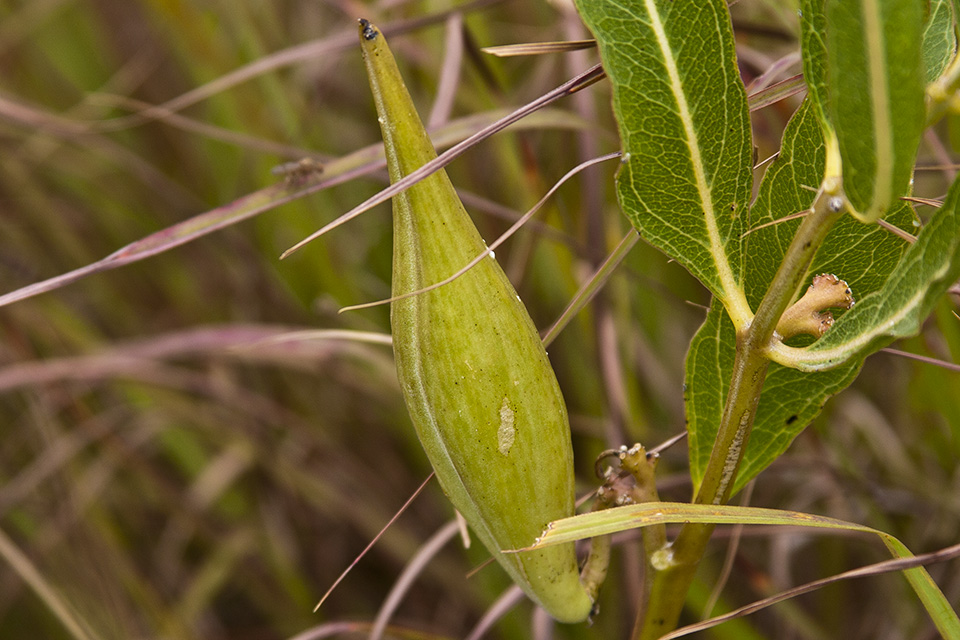
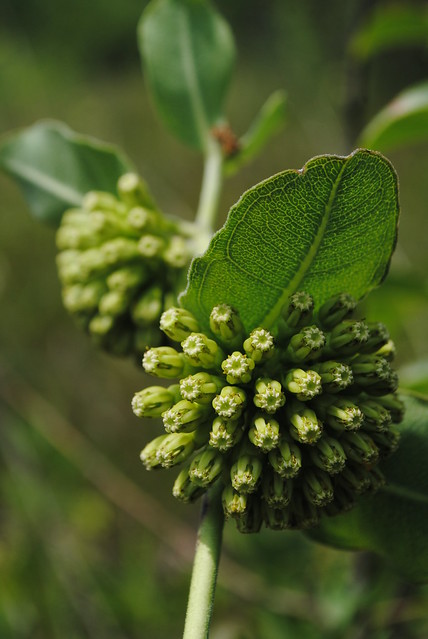
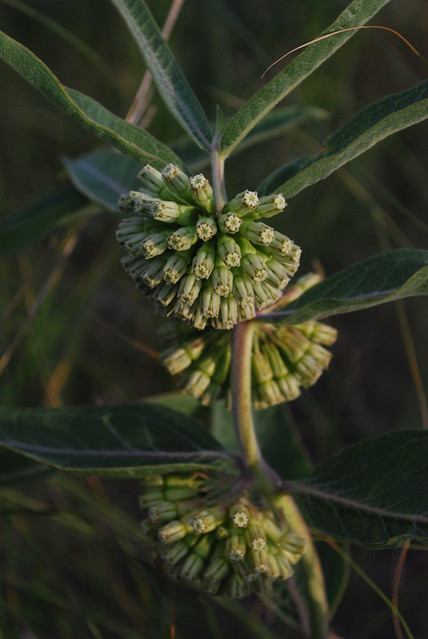
Green milkweed perennial herb rises from a taproot. The leaves and stems contain a milky juice. It is usually found as scattered, individual plants. The stems are usually erect but sometimes recline on the ground with the tips ascending. They are thinly hairy and unbranched below the inflorescence. There are 5 to 12 pairs of leaves per stem. The leaves are opposite, 1½″ to 5½″ long, ¼″ to 2½″ wide, pointed at the tip, and highly variable in shape. They are usually lance-shaped. In favorable conditions they may be broadly inversely egg-shaped, broadly oval, or nearly circular. In dry areas they are often long, linear lance-shaped, and very narrow. They are attached to the stem on short leaf stalks. The margins are untoothed and wavy. The lower surface is downy. Leaf shape of this species is highly variable. Some authorities recognize up to three varieties based on the shape of the leaves: var. lanceolata, var. linearis, and var. obovata. However, there is a near continuum of leaf shape from nearly circular to nearly linear, making delineation by leaf shape impossible. The inflorescence is usually 1 to 3 dense, umbrella-like clusters (umbels) near the top of the stem. They are attached to the side of the stem near the upper leaf nodes. They do not arise from the leaf axils. The clusters are 2″ to 3″ in diameter, are on a short stalk, and droop downward. They typically have 20 to 80 flowers. The structure of the typical milkweed flower is unique and instantly recognizable. There are 5 petals bent backward at the base and hanging downward. Subtending the petals are 5 much shorter, light green, lance-shaped sepals. There are 5 stamens. Formed from the filament of each stamen is a petal-like appendage. The appendage consists of a tubular hood surrounding an awl-shaped horn in the center of the hood. The stamens and the stigma are fused together into a crown-like structure (gynostegium). Each stigma has a long slit designed to catch the legs of a pollinating insect. A small, dark, sticky gland above this slit is attached to pollen sacs from adjacent anthers. These glands are designed to break off as an insect pulls its leg free of the slit, and remain attached to the insects leg. The flowers are pollinated by larger insects strong enough to lift off with the pollen sacs attached. Smaller insects are caught in a death trap or leave behind their detached legs. The flowers of this plant are shaped like the typical milkweed flower. They are ⅓″ to ½″ tall. The petals are light green. They bend backward at the base, hang downward, then curl upward near the tip. They are attached directly below the hoods without a separating column. The hoods are light green or greenish-white. They have no horns. The fruit is a narrow, spindle-shaped pod. It is 3″ to 6″ long and ½″ to 1″ wide. It is held erect or ascending on an erect stalk. |
Height |
8″ to 20″ |
Flower Color |
Light green |
Similar Species |
Oval-leaf (Asclepias ovalifolia) leaves are smaller, 2″ to 3″ long. The leaf margins are not wavy. The inflorescence is a loose cluster of 5 to 20 flowers. There is one cluster at the end of the stem and possibly 1 or 2 clusters in the uppermost leaf axils. The flowers are greenish-white or greenish-purple, and have horns within the hoods. Prairie milkweed (Asclepias hirtella) is a much taller plant, 16″ to 40″ tall at maturity. The leaves are longer and narrower, lance-shaped to linear, and alternate. It has 2 to 10 flower clusters. The flowers are tinged with purple. The petals are separated from the hoods by a distinct column. Whorled milkweed (Asclepias verticillata) has extremely narrow, linear leaves in whorls of 3 to 6. The flower heads have only 10 to 20 flowers. The flowers have horns within the hoods. The petals are separated from the hoods by a distinct column. |
Habitat |
Dry. Prairies, fields, upland woods, inland sands, barrens, roadsides. |
Ecology |
Flowering |
June to August |
Faunal Associations |
Milkweeds are the only plants that Monarchs lay their eggs on. The eggs are laid on the underside of healthy young leaves. |
Toxicity |
This and other milkweeds contain cardiac glycosides and may be poisonous to both humans and livestock. |
Pests and Diseases |
|
Use |
|
Distribution |
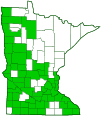
||
|
Sources |
|
| 6/25/2024 | ||
Nativity |
||
Native |
||
Occurrence |
||
|
||
Taxonomy |
|
Kingdom |
|
Subkingdom |
Pteridobiotina |
Phylum |
Tracheophyta (Vascular Plants) |
Class |
|
Order |
Gentianales (Gentians, Dogbanes, Madders, and Allies) |
Family |
Apocynaceae (Dogbane) |
Subfamily |
Asclepiadoideae (milkweeds) |
Tribe |
Asclepiadeae |
Subtribe |
Asclepiadinae |
Genus |
|
Subordinate Taxa |
|
|
|
Synonyms |
|
Acerates lanceolata Acerates linearis Acerates viridiflora Acerates viridiflora var. ivesii Acerates viridiflora var. lanceolata Acerates viridiflora var. linearis Asclepias ivesii Asclepias lanceolata Asclepias nutans Asclepias viridiflora var. lanceolata Asclepias viridiflora var. linearis Gomphocarpus viridiflorus Otanema lanceolata Otanema latifolia Otanema ovata |
|
Common Names |
|
green antelopehorn milkweed green comet milkweed green milkweed short green milkweed |
|
Glossary
Axil
The upper angle where the leaf stalk meets the stem.
Gynostegium
A crown-like structure of plants of the genus Asclepias formed by the fusion of the anthers with the stigmas.
Linear
Long, straight, and narrow, with more or less parallel sides, like a blade of grass.
Node
The small swelling of the stem from which one or more leaves, branches, or buds originate.
Rhizome
A horizontal, usually underground stem. It serves as a reproductive structure, producing roots below and shoots above at the nodes.
Umbel
A flat-topped or convex, umbrella-shaped cluster of flowers or buds arising from more or less a single point.
Visitor Photos |
||
Share your photo of this plant. |
||
This button not working for you? |
||
Dan W. Andree |
||
 |
 |
|
 |
|
|
MinnesotaSeasons.com Photos |
||
|
||
 |
 |
|
Flowering plant |
||
 |
 |
|
Flowering plant |
||
|
||
|
||
|
Fruiting plant | |
 |
 |
|
Inflorescence |
||
 |
 |
|
Broad leaves |
Narrow leaves | |
 |
 |
|
Broad leaves |
Narrow leaves | |
 |
 |
|
Infructescence |
||
 |
 |
|
Fruit |
||

Slideshows |
Asclepias viridiflora |
|
A. viridiflora |
|
About
Green-flowred Milkweed |
Green Comet Milkweed for sale |
About
Published on Jun 27, 2013 Green Comet Milkweed http://www.tnnursery.net/green-comet-... Green Comet Milkweed for sale at TN Nursery. The Green Comet Milkweed will look good in a natural area. It will give green flowers and will bloom from June through September. |

Visitor Videos |
||
Share your video of this plant. |
||
This button not working for you? |
||
|
Other Videos |
||
DSCN7945Preying mantid eating a bumblebee on Asclepias viridiflora |
About
Published on Jul 20, 2015 |
Doug Tallamy says bring Nature Home CATRO_Title_04_01.asf |
About
Uploaded on Jul 22, 2010 Doug Tallamy Bringing Nature Home, Asclepas verticillata, Whorled milkweed, Asclepias viridiflora, short-green milkweed Pinnacle Prairie wildflowers, seed pods of blunt-leaf milkweed Asclepias amplexicaulis, Joe Neal, Joe Woolbright, Doug James, Stump Prairie. |

Visitor Sightings |
||
Report a sighting of this plant. |
||
This button not working for you? |
||
| Dan W. Andree June 2024 |
Location: Frenchman’s Bluff SNA |
 |
MinnesotaSeasons.com Sightings |
||
|
Created: Last Updated: © MinnesotaSeasons.com. All rights reserved. |