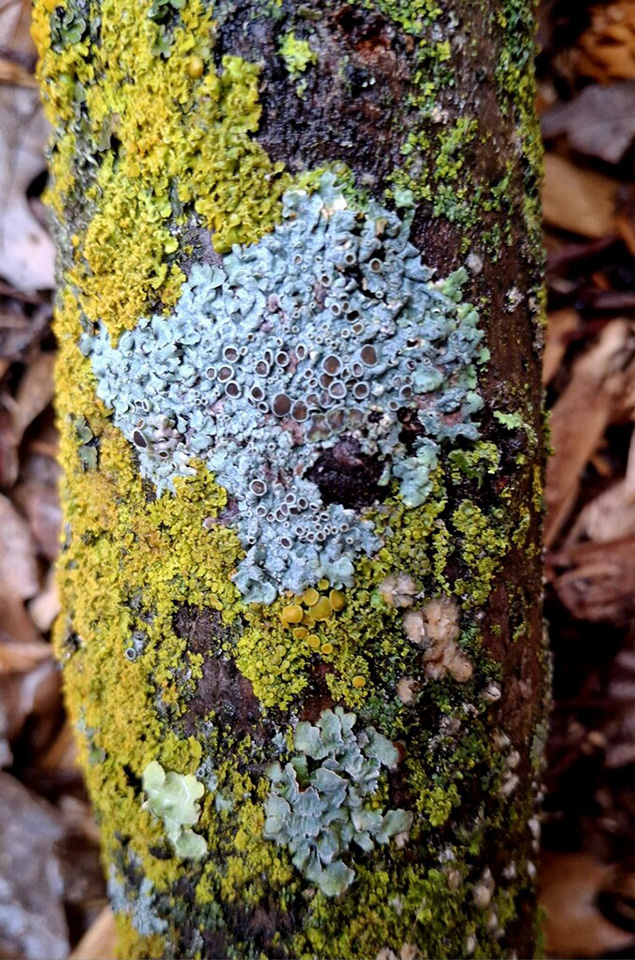
Candleflame Lichen - Species Profile
Conservation • Description • Ecology • Distribution • Taxonomy

Conservation Status
IUCN Red List
not listed
NatureServe
NNR - Unranked
SNR - Unranked
Minnesota
not listed
Description
Candleflame Lichen, also called Lemon Lichen, is a small, very widespread, very common, foliose lichen. It occurs worldwide on all continents, including Antarctica. It occurs throughout the United States, but it is most common east of the Great Plains, and it is absent from the Great Basin.
Candleflame Lichen is found in a wide variety of habitats. It is common in young well-lit forests, but it is less common in mature forests with a dense canopy. It is very tolerant of pollution and is common in urban and suburban areas. When it is the dominant lichen species in an area it is an indication of high nitrogen in the environment. It grows mostly on nutrient-rich bark of trees, especially on maple, ash, willow, and elm. It also grows on debarked wood, fence posts, and walls. It is less common on rock.
The fruiting body is small, less than ⅜″ (1 cm) in diameter, and cushion-like (suborbicular). Adjacent fruiting bodies often merge to form a large mass. The vegetative body (thallus) is leaf-like (foliose) and divided into small, loosely overlapping lobes. The lobes are flattened, about ⅜″ (1 cm) long, and 1⁄128″ to 1⁄64″ (0.5 to 1.0 mm) wide. The upper surface may be flat, wavy, or raised, fan-like. It is lemon yellow to orangish yellow when exposed to the sun, pale to yellowish green in the shade. The margins are finely scalloped. Cortex-free areas of the thallus (soralia), appearing as horizontal, crescent-shaped slits on and near the margins or at the tips of the lobes, produce granular clusters of cells (soredia). The lower surface is white to pinkish. It is held to the substrate by scattered, unbranched, white, root-like structures (rhizines).
Disk-like, spore-producing structures (apothecia) are rare. When present, they are 1⁄128″ to 1⁄64″ (0.5 to 1.0 mm) in diameter. The disk is the color of the thallus but darker. The margin is smooth at first, becoming uneven and granular with age.
Similar Species
Ecology
Substrate
Tree bark
Growth Form
Foliose
Habitat
Well-lit young forests, urban and suburban areas.
Hosts
Distribution

Sources
Biodiversity occurrence data published by: Minnesota Biodiversity Atlas (accessed through the Minnesota Biodiversity Atlas Portal, bellatlas.umn.edu. Accessed 1/18/2025).
The Consortium of North American Lichen Herbaria (CNALH) https://lichenportal.org/cnalh/index.php. Accessed 1/18/2025.
Mycology Collections Portal (MyCoPortal) https://www.mycoportal.org/portal/collections/index.php). Accessed 1/18/2025.
Candelaria concolor (Dicks.) Arnold in GBIF Secretariat (2023). GBIF Backbone Taxonomy. Checklist dataset https://doi.org/10.15468/39omei accessed via GBIF.org. Accessed 1/18/2025.
Fink, B. (1910). The Lichens of Minnesota. United States: U.S. Government Printing Office.
Fink, Bruce. (1899). Contributions to a Knowledge of the Lichens of Minnesota. Retrieved from the University Digital Conservancy, https://hdl.handle.net/11299/177988.
Occurrence
Very common and widespread
Taxonomy
Kingdom
Fungi (Fungi)
Subkingdom
Dikarya
Phylum
Ascomycota (Sac Fungi)
Subphylum
Pezizomycotina
Class
Candelariomycetes
Subclass
Candelariomycetidae
Order
Candelariales
Family
Candelariaceae
Genus
Candelaria (Candleflame Lichens)
Mycobiont
Candelaria concolor
Photobiont
green algae other than Trentepohlia
Class
The order Candelariales has traditionally been placed in the subclass Candelariomycetidae of the class Candelariomycetes. A recent genome-level analysis was conducted of symbiotic ascomycetes, fungi that form mutualistic relationships with other organisms (Díaz-Escandón et al., 2022). The authors merged six classes, including Candelariomycetes, and gave the new class the name Lichinomycetes, which is the oldest name among the six. With the merger, the subclass Candelariomycetidae became obsolete.
Acceptance of the reclassification has been mixed. This is the situation as of April 2026:
- Index Fungorum and Consortium of Lichen Herbaria (LichenPortal) place the order Candelariales in the class Candelariomycetes, subclass Candelariomycetidae.
- GBIF places it in the class Candelariomycetes with no subclass.
- MycoBank places it in the class Lichinomycetes, subclass Candelariomycetidae.
- iNaturalist places it in the class Lichinomycetes with no subclass.
- The Information System on Italian Lichens. Version 8.0 (ITALIC 8.0) places it in the class Lecanoromycetes, subclass Candelariomycetidae.
- Mycology Collections Portal (MycoPortal), ITIS, and NatureServe place it in the class Lecanoromycetes with no subclass.
Subordinate Taxa
Synonyms
Blasteniospora concolor
Caloplaca concolor
Caloplaca laciniosa
Candelaria concolor var. concolor
Candelaria concolor var. effusa
Candelaria concolor var. stellata
Candelaria vulgaris f. citrina
Candelariella concolor
Lecanora concolor
Lecanora laciniosa
Lichen concolor
Lobaria concolor
Parmelia parietina var. concolor
Physcia concolor
Physcia parietina var. concolor
Physcia parietina var. laciniosa
Teloschistes concolor
Xanthoria concolor
Common Names
Candleflame Lichen
Elfin Candleflame Lichen
Lemon Lichen