Common Powderhorn - Species Profile
Conservation • Description • Ecology • Distribution • Taxonomy

Conservation Status
IUCN Red List
not listed
NatureServe
NNR - Unranked
Minnesota
not listed
Description
Common Powderhorn is a widespread and very common lichen in Europe, Asia, and North America. In the United States it is found from the east coast to the Midwest, including Minnesota, on the west coast, and in the Rocky Mountains. It grows in the shade on decaying stumps and logs and often at the bases of trees. It rarely grows on bare ground. It is resistant to pollution and can be found in urban areas.
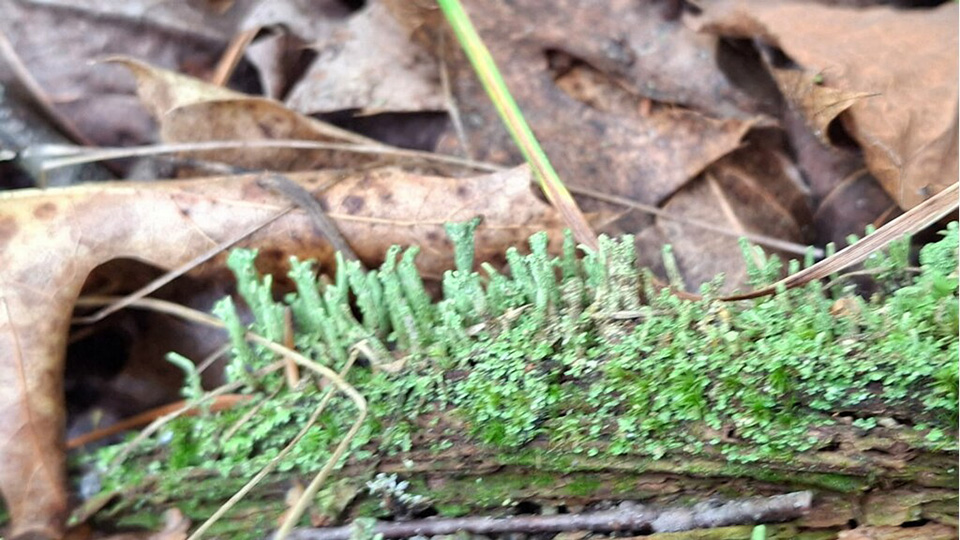
Common Powderhorn produces two types of vegetative growth (thallus). The primary thallus is composed entirely of green to grayish-green, flat, overlapping, leaf-like scales (squamules) that adhere closely to the substrate. Each of these basal squamules is ⅛″ to ⅜″ long and 1 ⁄16″ to 3 ⁄16″ wide. The margins are always deeply incised and often lobed. The underside is white and lacks a layer of protective tissue (cortex). The margins and the underside are sparsely to densely covered with tiny granules (soredia).
The secondary thallus is a green to grayish-green, slender, vertical stalk (podetium) that rises from the center of a basal squamule. The podetia is hollow, more or less curved, usually unbranched, 5 ⁄16″ to 1¾″ tall, and 1 ⁄32″ to 1 ⁄16″ wide. The tip is usually slender and tapers to a point. Rarely, it ends in a very small, 1 ⁄32″ to 1 ⁄16″ (1 to 2 mm) wide cup. The cortex is thin at the base becoming thinner as it approaches the top. It does not extend to the tip or to the interior of the cup. The upper two-thirds of the podetia is mealy due to a covering of soredia, and there are usually small squamules near the base.
The disk-shaped reproductive structures (apothecia) common on many lichens are rarely produced by Common Powderhorn. When present, they are at the tip of the podetia, brown, and less than 1 ⁄16″ (1.0 to 1.5 mm) in diameter.
Similar Species
Smooth-footed Powderhorn (Cladonia ochrochlora) squamules may be almost entire, unlobed and not incised. Podetia are grayish, thicker, and often branched or twisted. Cups at the tip are usually present. The cortex of the podetia is thick and extends well above the base.
Ecology
Substrate
Ground
Growth Form
Fruticose
Habitat
Decaying stumps and logs and often at the bases of trees
Hosts
Distribution

Sources
Biodiversity occurrence data published by: Minnesota Biodiversity Atlas (accessed through the Minnesota Biodiversity Atlas Portal, bellatlas.umn.edu. Accessed 9/14/2026).
The Consortium of North American Lichen Herbaria (CNALH) https://lichenportal.org/cnalh/index.php. Accessed 9/14/2026.
Mycology Collections Portal (MyCoPortal) https://www.mycoportal.org/portal/collections/index.php). Accessed 9/14/2026.
Cladonia coniocraea (Flörke) Spreng. in Bánki, O., Roskov, Y., Döring, M., Ower, G., Hernández Robles, D. R., Plata Corredor, C. A., Stjernegaard Jeppesen, T., Örn, A., Pape, T., Hobern, D., Garnett, S., Little, H., DeWalt, R. E., Miller, J., Orrell, T., Aalbu, R., Abbott, J., Abreu, C., Acero P, A., et al. (2026). Catalogue of Life (2026-08-26 XR). Catalogue of Life Foundation, Amsterdam, Netherlands. https://doi.org/10.48580/dgyy9
Fink, B. (1910). The Lichens of Minnesota. United States: U.S. Government Printing Office.
Occurrence
Widespread and very common
Taxonomy
Kingdom
Fungi (Fungi)
Subkingdom
Dikarya
Phylum
Ascomycota (Sac Fungi)
Subphylum
Pezizomycotina
Class
Lecanoromycetes (Common Lichens)
Subclass
Lecanoromycetidae (Shield Lichens, Sunburst Lichens, Rosette Lichens, and Allies)
Order
Lecanorales (Shield Lichens, Rim Lichens, and Allies)
Family
Cladoniaceae (Spindles and Structured Lichens)
Genus
Cladonia (Pixie Cup and Reindeer Lichens)
Mycobiont
Cladonia coniocraea
Photobiont
green algae other than Trentepohlia
Subordinate Taxa
Synonyms
Baeomyces coniocraeus
Capitularia coniocraea
Cenomyce coniocraea
Cenomyce coniocraea var. ramulosa
Cladonia coniocraea f. ramulosa
Cladonia fimbriata f. coniocraea
Cladonia fimbriata f. ramulosa
Cladonia fimbriata ssp. coniocraea
Cladonia fimbriata var. coniocraea
Cladonia fimbriata var. conioctaea
Common Names
Bighorn Cladonia
Common Powderhorn
Common Powderhorn Lichen