Gabled False Morel - Species Profile
Conservation • Description • Habitat • Ecology • Distribution • Taxonomy

Conservation Status
IUCN Red List
not listed
NatureServe
not listed
Minnesota
not listed
Description
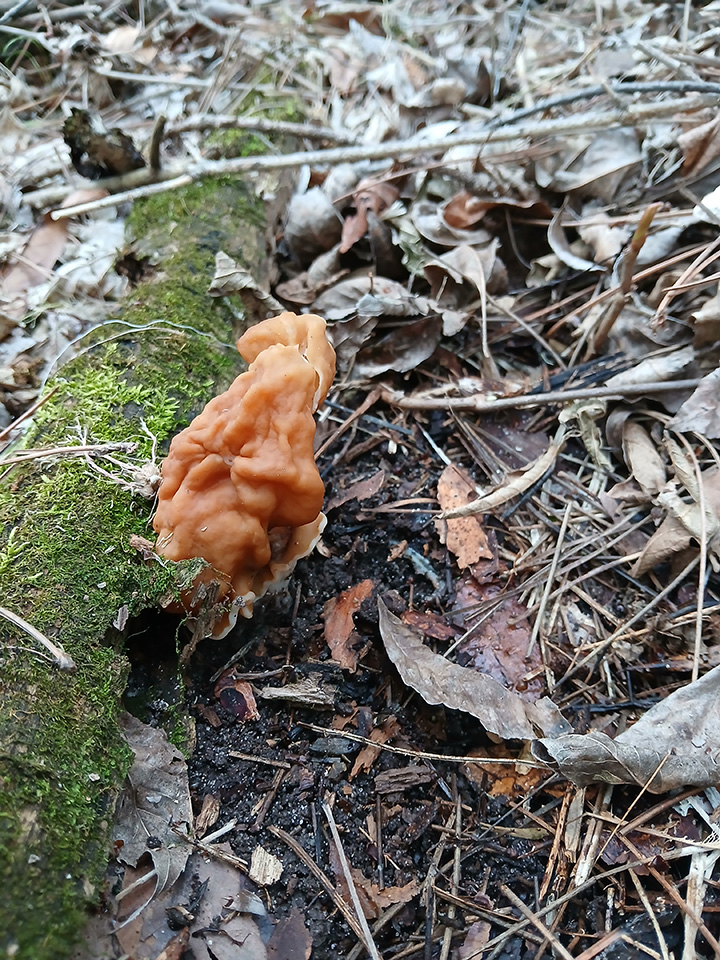
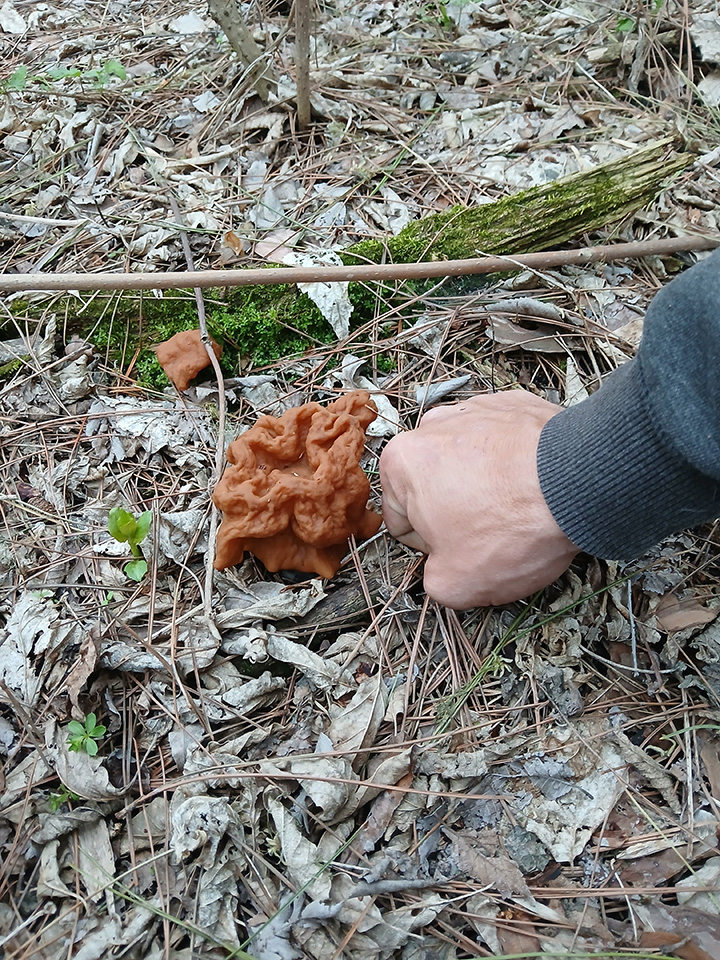
Gabled False Morel is the most common false morel in Minnesota and Wisconsin. It is found in the spring, alone or in groups, on the ground under hardwood trees. It is saprobic, obtaining nutrients from rotting wood, and might also be mycorrhizal, having a mutually beneficial relationship with the tiny rootlets of trees. It may exhibit both traits at different parts of its life cycle.
The cap is 1¼″ to 3½″tall and 2″ to 4″ wide, hollow, and loosely wrinkled. It is usually saddle-shaped or winged, divided into 2 or 3 strongly projecting lobes that are fused to each other. The upper surface is tan to reddish-brown and hairless. The lower surface is pale buff to tan, downy, and exposed in places. The margins are free from the stalk.
The stalk is white, hollow, ¾″ to 3½″tall, and ¾″ to 2″in diameter. It is irregular in shape, widened and ribbed near the base.
The flesh is brittle, whitish, and chambered. It is edible but due to its similarity in appearance to poisonous false morels, eating is not recommended.
Similar Species
Habitat and Hosts
Under hardwoods
Ecology
Season
Late May to early June
Distribution

Sources
Biodiversity occurrence data published by: Minnesota Biodiversity Atlas (accessed through the Minnesota Biodiversity Atlas Portal, bellatlas.umn.edu. Accessed 5/17/2026).
Discina brunnea (Underw.) Raitv. in GBIF Secretariat (2023). GBIF Backbone Taxonomy. Checklist dataset https://doi.org/10.15468/39omei accessed via GBIF.org. Accessed 5/17/2026.
Mycology Collections Portal (MyCoPortal) https://www.mycoportal.org/portal/collections/index.php). Accessed 5/17/2026.
Occurrence
Common and widely distributed in eastern North America
Taxonomy
Kingdom
Fungi (Fungi)
Subkingdom
Dikarya
Phylum
Ascomycota (Sac Fungi)
Subphylum
Pezizomycotina
Class
Pezizomycetes
Subclass
Pezizomycetidae
Order
Pezizales
Family
Discinaceae
Tribe
Discineae
Genus
Neogyromitra
Genus
The genus Gyromitra (sensu lato) has undergone significant revision following recent molecular studies of the family Discinaceae. A major 2023 family-level study (Wang & Zhuang) initiated the breakup of the broad genus by reviving and establishing several distinct genera. Because the historic placement of this species in the genus Gyromitra was rendered invalid by these findings, some major database sources defaulted to an earlier validly published name, Discina brunnea. However, a comprehensive 2025 phylogenomic analysis (Dirks et al.) has since refined the boundaries of the stipitate, lobed false morels. Under this current framework, species with distinctly multi-lobed caps and coarsely reticulate spores are placed in the resurrected genus Neogyromitra, making the current accepted name Neogyromitra brunnea.
Subordinate Taxa
Synonyms
Discina brunnea
Gyromitra brunnea
Gyromitra fastigiata
Gyromitra underwoodii
Helvella underwoodii
Common Names
Elephant Ears
Gabled False Morel