Harris’s three-spot - Species Profile
Conservation • Description • Habitat • Ecology • Distribution • Taxonomy
Hodges #
9286
Conservation Status
IUCN Red List
not listed
NatureServe
NNR - Unranked
SNR - Unranked
Minnesota
not listed
Description
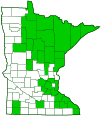
Harris’s three-spot is an uncommon, native, medium-sized moth. It occurs in the United States east of the Great Plains and in southern Canada from Nova Scotia west to Alberta.
Adults are active from late May to early August in Minnesota. The larvae feed on the foliage of various trees and shrubs, including apple, blueberry, cherry, honeysuckle, and willow.
Adults are ⅝″ to ¾″ (17 to 20 mm) in length and have a 1 3⁄16″ to 1 7⁄16″ (30 to 36 mm) wingspan. The overall appearance strongly resembles a foliose lichen, complete with fruiting bodies (apothecia).
The thorax is covered with dark brown, overlapping, spoon-shaped scales, and there are four tufts of erect, dark brown, hair-like scales. The front (anterior) tuft is slightly bulging. The pair of lateral tufts and the rear (posterior) tuft are almost completely fused, forming one very large tuft. The abdomen has one large and three similar but smaller tufts.
The forewings are white and are crossed by jagged, irregular, broken, black lines. On each wing, there are three large, warm brown, circular spots with white borders, one in the basal area, one near the wing tip, and one near the anal angle. There is also a circular spot in the upper median area (orbicular spot) and a kidney-shaped spot at the end of the discal cell (reniform spot). The orbicular spot is white with a black border and a black dot in the center. The reniform spot is white with a black border and an irregular black spot in the center. The two spots are conjoined.
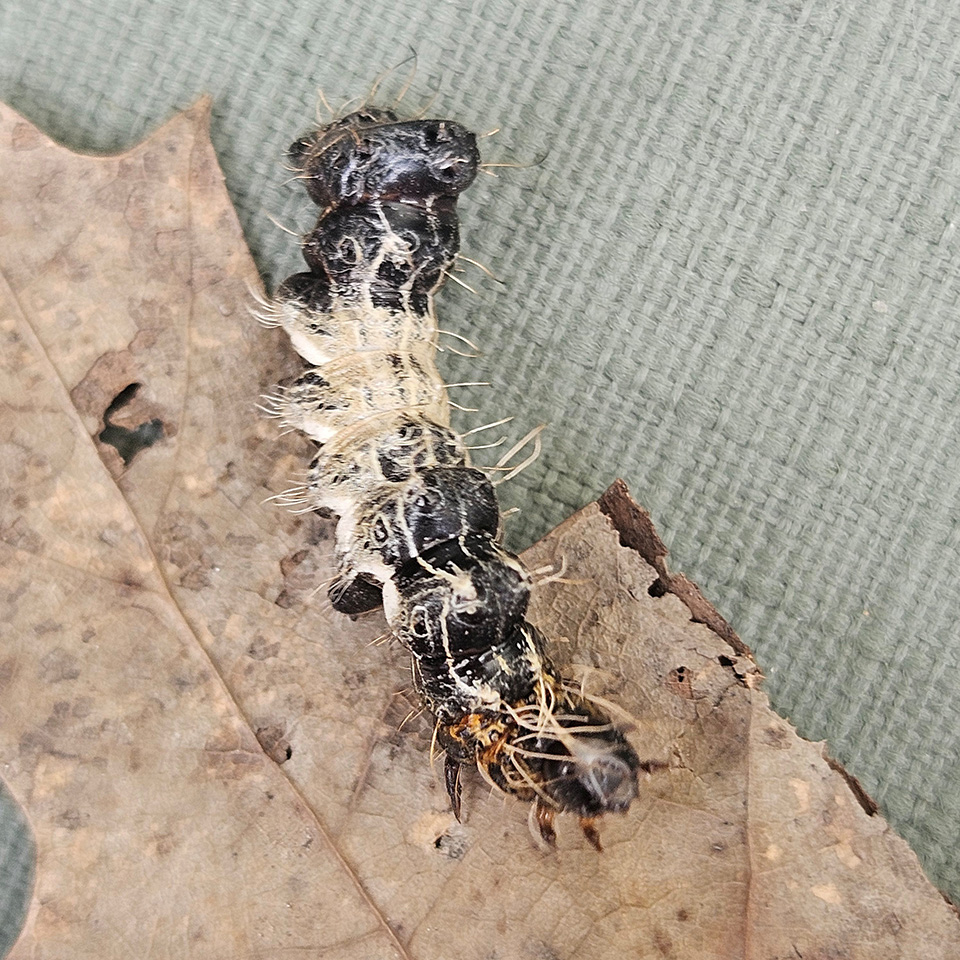
The caterpillar’s appearance has been described as “unmistakably bizarre”, “most peculiar”, and “a strange animal”. It resembles both a bird dropping and a spider. The abdominal leg-like structures (prolegs) are unusually long, especially the front pair. The body is shiny black with white markings, and it is less than 1⅜″ (35 mm) long. Abdominal segments 1 to 3 (A1 to A3) are humped, and A8 is grotesquely humped. A3 to A7 each have a white, saddle-shaped marking that continues as a streak on the outer face of each proleg. There are long, white, stiff, erect, bristle-like setae on the upper (dorsal) surface of the thorax and each abdominal segment, and long, white, hair-like setae above each proleg. The discarded head capsules of the previous stages (instars) often remain dangled from the long thoracic dorsal setae.
Size
Total length: ⅝″ to ¾″ (17 to 20 mm)
Wingspan: 1 3⁄16″ to 1 7⁄16″ (30 to 36 mm)
Similar Species
Habitat
Ecology
Season
One generation per year in Minnesota: Late May to early August
Behavior
When disturbed, the caterpillar will raise the front part of its body, splay its legs outward, and rapidly sway back an forth, presumably mimicking a part of a dead leaf swaying in the wind.
Life Cycle
The final instar caterpillar bores into wood, excavating a chamber in which it will pupate and overwinter.
Larva Food/Hosts
Adult Food
Distribution
Sources
Biodiversity occurrence data published by: Minnesota Biodiversity Atlas (accessed through the Minnesota Biodiversity Atlas Portal, bellatlas.umn.edu. Accessed 8/11/2026).
Harrisimemna trisignata Walker, 1856 in Bánki, O., Roskov, Y., Döring, M., Ower, G., Hernández Robles, D. R., Plata Corredor, C. A., Stjernegaard Jeppesen, T., Örn, A., Pape, T., Hobern, D., Garnett, S., Little, H., DeWalt, R. E., Miller, J., Orrell, T., Aalbu, R., Abbott, J., Abreu, C., Acero P, A., et al. (2026). Catalogue of Life (2026-07-17 XR). Catalogue of Life Foundation, Amsterdam, Netherlands. https://doi.org/10.48580/dgykv
Quinn, Edward. M., and Ron Danielson. April 27, 2009. A Survey of Lepidoptera in Three Priority Areas of the Minnesota State Parks System. https://files.dnr.state.mn.us/eco/nongame/projects/consgrant_reports/2009
/2009_quinn_danielson.pdf.
Occurrence
Uncommon – widespread but not abundant
Taxonomy
Order
Lepidoptera (Butterflies and Moths)
Superfamily
Noctuoidea (Owlet Moths and Allies)
Family
Noctuidae (Cutworm Moths and Allies)
Subfamily
Acronictinae
Genus
Harrisimemna
Subordinate Taxa
Synonyms
Grammophora trisignata
Harrisimemna sexguttata
Common Names
Harris three-spot
Harris’ three-spot
Harris’ three-spot moth
Harris’s three-spot
Harris’s three-spot moth
