alder spittlebug - Species Profile
Conservation • Description • Habitat • Ecology • Distribution • Taxonomy
Conservation Status
IUCN Red List
not listed
NatureServe
not listed
Minnesota
not listed
Description
Alder spittlebug is a common, small, froghopper. It occurs in the United States east of the Great Plains and across southern Canada.
Immature nymphs are famously known as spittlebugs for the protective frothy masses they inhabit. They are found in moist, low-lying areas such as stream banks, marshes, and the shrubby understory of damp woodlands. The humid microclimates prevent their spittle masses from drying out. Their presence is closely tied to their known host plants, which in Minnesota includes speckled alder (Alnus incana), gray birch (Betula populifolia), common witch-hazel (Hamamelis virginiana), beaked hazelnut (Corylus cornuta), and American hophornbeam (Ostrya virginiana).
Winged adults are active from June through October. They are commonly called froghoppers due to their blunt, frog-like appearance and impressive jumping ability. While the nymphs are often host-specific, adults feed on and are found on a much wider range of deciduous trees and shrubs. It is suspected that the nymphs also utilize a broader range of plants than currently documented.
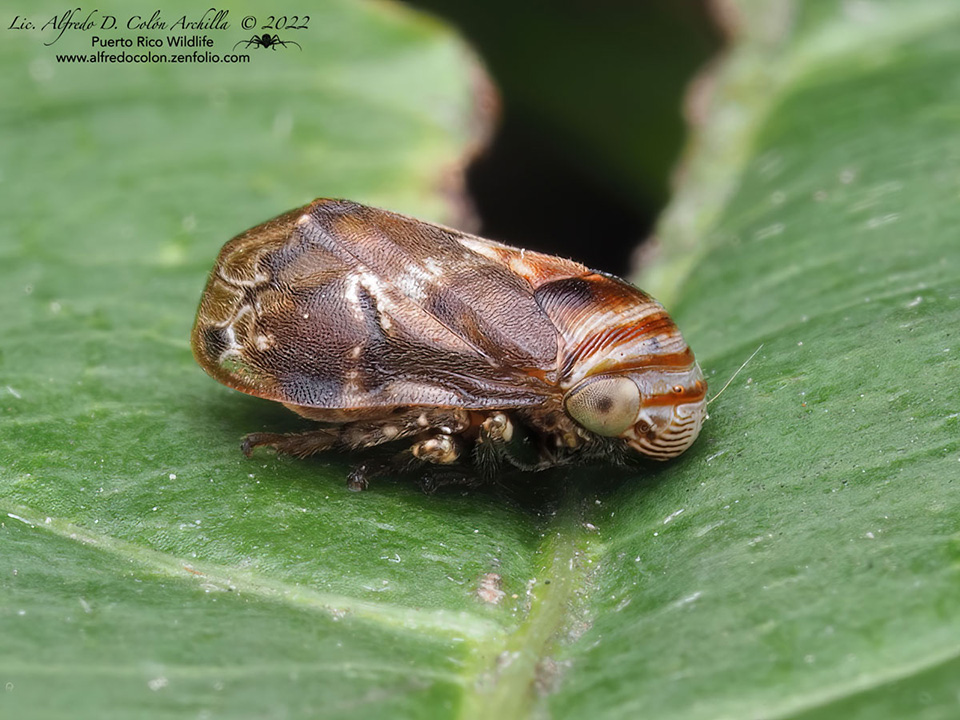
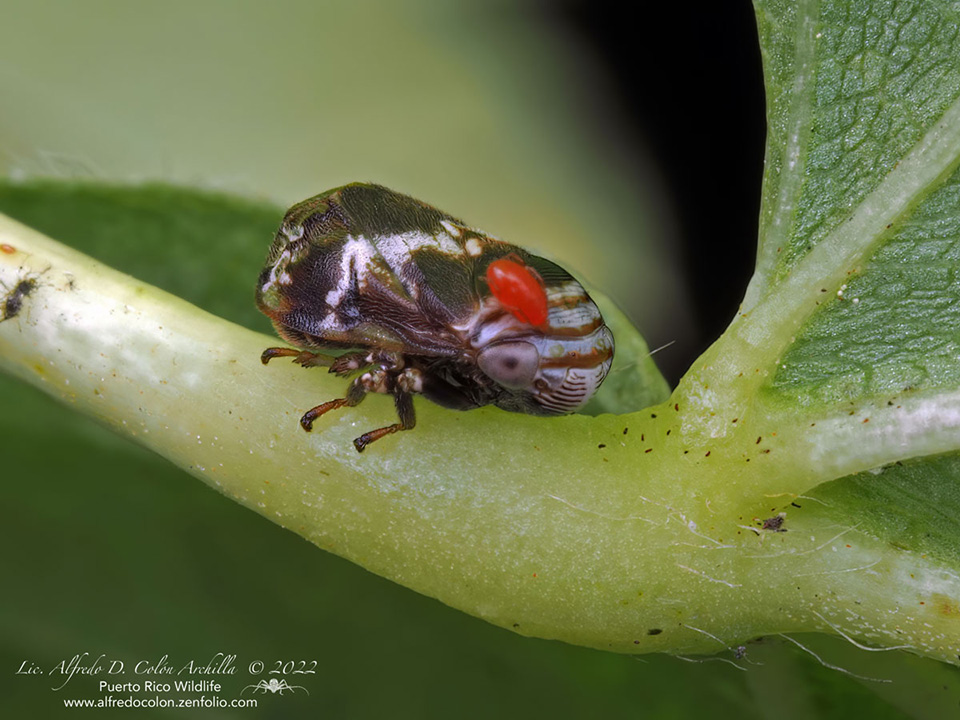
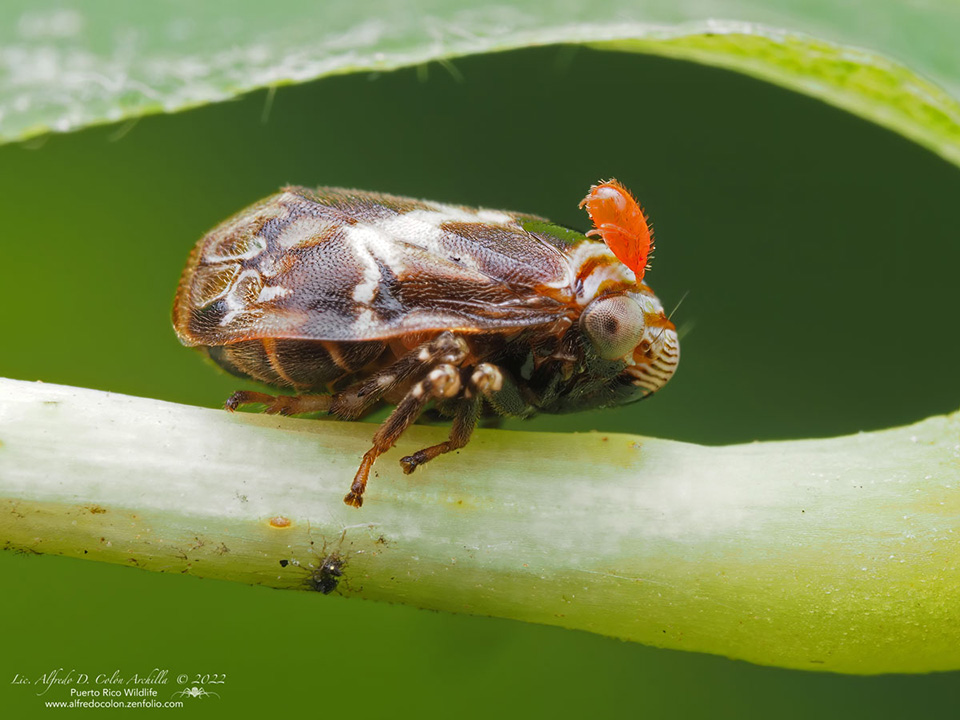
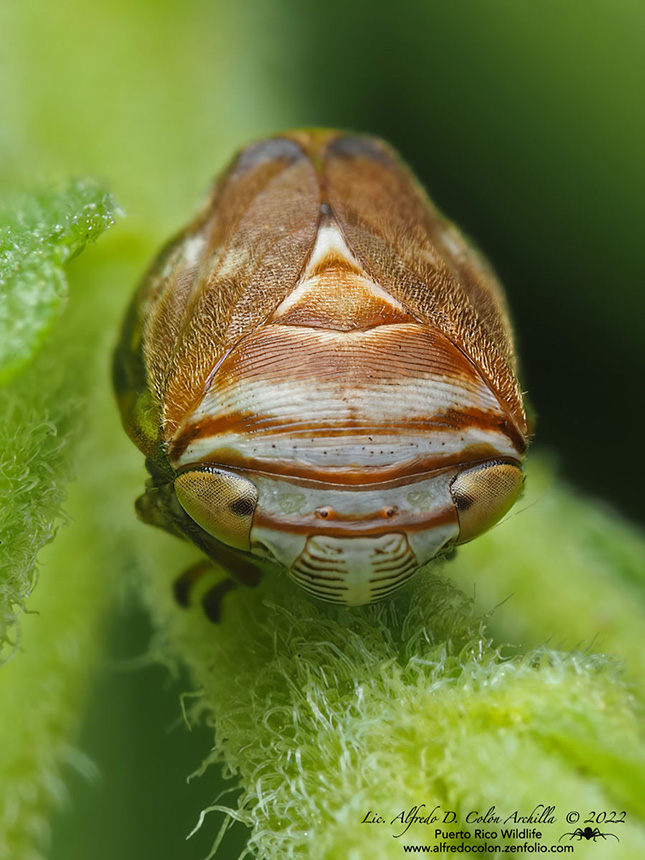
Females are 3⁄16″ (4.4 to 5.3 mm) in length. The body is short and oval, almost globe-shaped, and the coloration is somewhat variable.
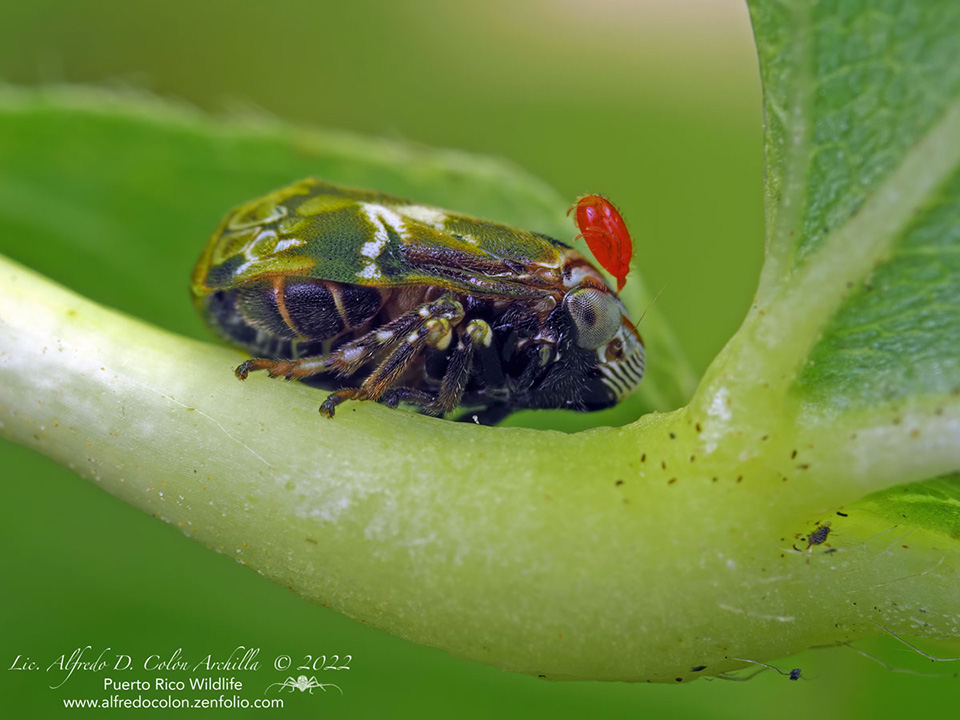
The head is much wider than long. It is pale (pale yellowish or whitish) with dark (brown, yellowish brown, reddish brown, or blackish brown) markings. The head and the front part of the plate on the first segment of the thorax (pronotum) are at an angle with the rest of the body. The upper part of the head (vertex) is very narrow. There are two large, broad, compound eyes in line with the vertex and two small simple eyes (ocelli) on the vertex. A dark line across the front margin of the vertex is slightly ridged, the ocelli are nearer to the front margin than to the pronotum, and there is a dark line connecting the ocelli. The plate on the face above the upper lip (clypeus) has about 7 to 9 parallel, equally spaced, dark lines that are interrupted in the middle. The bottom tip of the clypeus and the underside of the head are entirely dark.
The pronotum is wider than long, transversely wrinkled, and hairless. It is mostly pale, but it has two narrow transverse dark lines, and on the rear margin there is a broad dark band.
The plate between the wing bases (scutellum) is triangular and a little more than two times longer than wide. It is mostly dark, usually with pale markings near the tip.
The forewings (hemelytra) are convex and are abruptly curved downward (deflected) at the rear. The surface is very hairy, more so than in other species in the genus. The coloration is variable but is generally dark with a pale V-shaped band. There is a convex, blackened, “eyespot” near the tip of each elytron.
Males are a little smaller, ⅛″ to 3⁄16″ (4.0 to 4.7 mm) in length, and are darker in color.
Size
Female total length: 3⁄16″ (4.4 to 5.3 mm)
Male total length: ⅛″ to 3⁄16″ (4.0 to 4.7 mm)
Similar Species
Habitat
Moist, low-lying areas including stream banks, marshes, and the shrubby understory of damp woodlands
Ecology
Season
One or two generations per year: June through October
Behavior
Life Cycle
Nymph Food/Hosts
In Minnesota, speckled alder (Alnus incana), gray birch (Betula populifolia), common witch-hazel (Hamamelis virginiana), beaked hazelnut (Corylus cornuta), and American hophornbeam (Ostrya virginiana), and probably additional deciduous trees and shrubs.
Adult Food
A broad range of deciduous trees and shrubs
Distribution
Sources
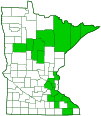
Biodiversity occurrence data published by: Minnesota Biodiversity Atlas (accessed through the Minnesota Biodiversity Atlas Portal, bellatlas.umn.edu. Accessed 3/25/2026).
Clastoptera obtusa (Say, 1825) in GBIF Secretariat (2023). GBIF Backbone Taxonomy. Checklist dataset https://doi.org/10.15468/39omei accessed via GBIF.org. Accessed 3/25/2026.
Occurrence
Common
Taxonomy
Order
Hemiptera (True Bugs, Hoppers, Aphids, and Allies)
Suborder
Auchenorrhyncha (True Hoppers)
Infraorder
Cicadomorpha (Spittlebugs, Cicadas, Leafhoppers and Treehoppers)
Superfamily
Cercopoidea (Spittlebugs and Froghoppers)
Family
Clastopteridae (Clastopterid Spittlebugs)
Subfamily
Clastopterinae
Tribe
Clastopterini
Genus
Clastoptera
Subordinate Taxa
Synonyms
Aphrophora obtusa
Cercopis obtusa
Clasptoptera obtusa
Clastopera obtusa
Clastopetera obtusa
Clestoptera obtusa
Ptyelus obtusus
Common Names
alder spittlebug