Assassin Bugs (Family Reduviidae) - Species Profile
Overview • Description • Distribution • Taxonomy
Overview
Reduviidae is a large family of true bugs known as assassin bugs. They occur worldwide on every continent except Antarctica. They get their name from the way they attack and kill their prey with sharp stabs.
The majority of this family consists of predatory hunters that target other arthropods. While most focus on insect prey, certain species are known to feed on vertebrate blood and may even transmit pathogens to humans. Due to their formidable beak, larger individuals should be handled with caution as they can inflict a painful stab.
Assassin bugs are typically seen on foliage, though some species are often encountered in houses.
Reduviidae by the Numbers
Reduviidae is one of the largest families in the order Hemiptera. There are currently 7,650 described species in 1,048 genera in 24 subfamilies worldwide, 195 species in 55 genera in 11 subfamilies in North America north of Mexico, and at least 18 species in 11 genera in 6 subfamilies in Minnesota.
Description
Adults are ½″ to 1½″ (12 to 36 mm) in length. Most are brownish or black, but some are brightly colored.
On most species, the head is elongate and narrowed behind the eyes, producing a distinct, narrow “neck,” and there is a transverse groove between the eyes. The mouthparts are modified into a short beak used for stabbing victims. The beak has three segments, is usually curved, and it fits into a groove on the underside of the thorax when not in use. The groove is cross-ridged between the bases of the forelegs. Sounds are produced when the tip of the beak is rubbed against these ridges. The antennae are long and thin. They have four segments, and sometimes one or more of the segments is divided into subsegments. Most species have two large compound eyes and two small simple eyes (ocelli); however, members of the subfamily Emesinae lack ocelli entirely.
The body may be oval or slender and elongated. Sometimes it is nearly parallel sided, and sometimes it is greatly elongated like a walking stick.
On the front legs, the third leg segment (femur) is usually thickened and strong, used for grasping and holding prey.
Distribution
Sources
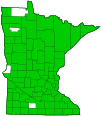
Biodiversity occurrence data published by: Minnesota Biodiversity Atlas (accessed through the Minnesota Biodiversity Atlas Portal, bellatlas.umn.edu. Accessed 4/30/2026).
Reduviidae in GBIF Secretariat (2023). GBIF Backbone Taxonomy. Checklist dataset https://doi.org/10.15468/39omei accessed via GBIF.org. Accessed 4/30/2026.
Taxonomy
Order
Hemiptera (True Bugs, Hoppers, Aphids, and Allies)
Suborder
Heteroptera (True Bugs)
Infraorder
Cimicomorpha
Superfamily
Reduvioidea
Subordinate Taxa
The internal classification of Reduviidae is subject to ongoing revision. Taxonomic authorities vary on the total number and nomenclature of subfamilies; for instance, the group Saicinae is frequently debated, appearing in some classifications as a distinct subfamily and in others as a tribe (Saicini) within the subfamily Emesinae.
Subfamily Bactrodinae 
Subfamily Centrocnemidinae
Subfamily Cetherinae
Subfamily Chryxinae
Subfamily Ectrichodiinae (Millipede Assassins)
Subfamily Elasmodeminae
Subfamily Emesinae (Thread-legged Bugs) 
Subfamily Hammacerinae (=Microtominae)
Subfamily Harpactorinae
Subfamily Heteropinae
Subfamily Holoptilinae (Featherleg Bugs)
Subfamily Manangocorinae
Subfamily Nanokeralinae
Subfamily Pasirinae
Subfamily Peiratinae (Corsairs)
Subfamily Phimophorinae
Subfamily Phymatinae (Ambush Bugs)
Subfamily Physoderinae
Subfamily Pseudocetherinae
Subfamily Psophidinae
Subfamily Reduviinae
Subfamily Saicinae
Subfamily Salyavatinae
Subfamily Sphaeridopinae
Subfamily Stenopodainae
Subfamily Triatominae (Kissing Bugs)
Subfamily Tribelocephalinae
Subfamily Vesciinae
Subfamily Visayanocorinae
Synonyms
Common Names
Assassin Bugs