blotchwing spider wasp - Species Profile
Conservation • Description • Habitat • Ecology • Distribution • Taxonomy

Conservation Status
IUCN Red List
not listed
NatureServe
not listed
Minnesota
not listed
Description
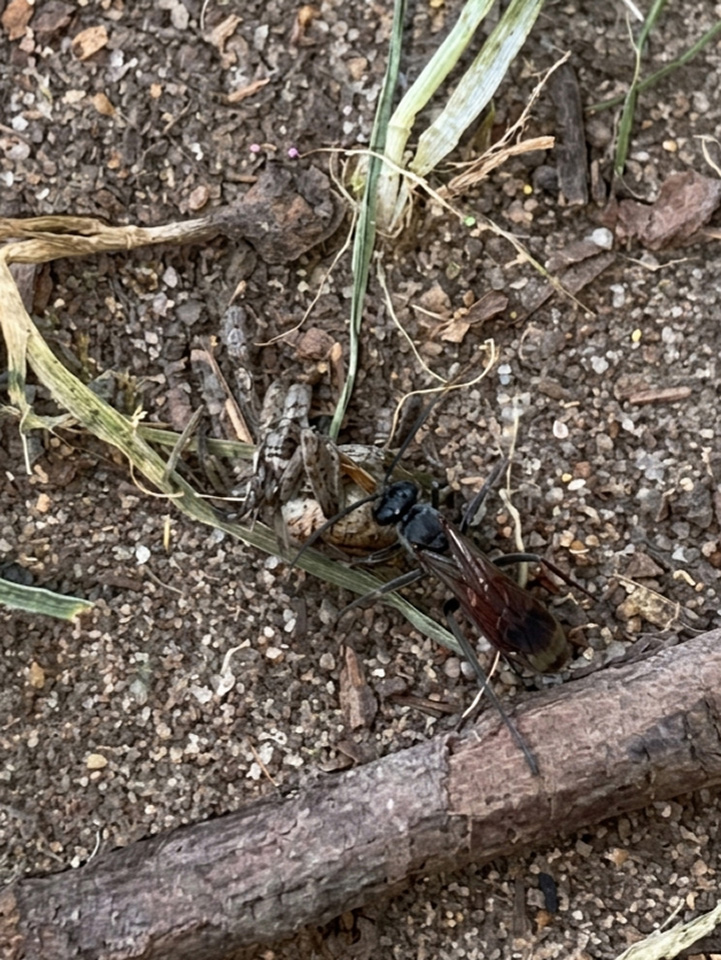
Blotchwing spider wasp is a medium-sized wasp but a small wasp. It occurs in western Europe and eastern North America. Adults are slender, black and red, and ¼″ to ⅜″ long. Females are larger than males.
The head is wider than long and entirely black. There are two large compound eyes on the side of the head and three small simple eyes in a triangle on the top. The compound eyes strongly converge at the top. The antennae are thread-like and black. On the female they have 12 segments, on the male they have 13 segments. The tips of the mandibles are reddish.
The thorax has three segments. The exoskeletal plate covering upper part of the first segment (pronotum) is relatively short but extends to the bases of the wings. It is more or less triangular when viewed from the side, more or less horseshoe-shaped when viewed from above. -The front is perpendicular to the upper surface. The second segment has a line-like groove (suture) across the side (mesopleuron).
The first two segments of the abdomen and the basal portion of the third segment are brownish-red. The remainder is black. On the female, there is a short ovipositor at the tip of the last segment. The ovipositor also functions as a sting.
The legs are long, slender, and mostly black. The second segment (trochanter) of each leg is complete, not divided into two segments. There is a pair of spines at the tip of the fourth segment (tibia) of the middle and rear legs. The spines on the hind leg are of equal length. The third segment (femur) and tibia on the hind leg are brownish-red. The femurs on all legs are covered with short, silvery hairs. The tibiae on the hind leg is toothed on the upper side.
The wings are clear. The female has a dark spot near the tip of each forewing.
Size
Total length: ¼″ to ⅜″
Similar Species
Habitat
Woodland edges and openings
Ecology
Season
Late spring to early Autumn
Behavior
Adults are often found on flowers.
Life Cycle
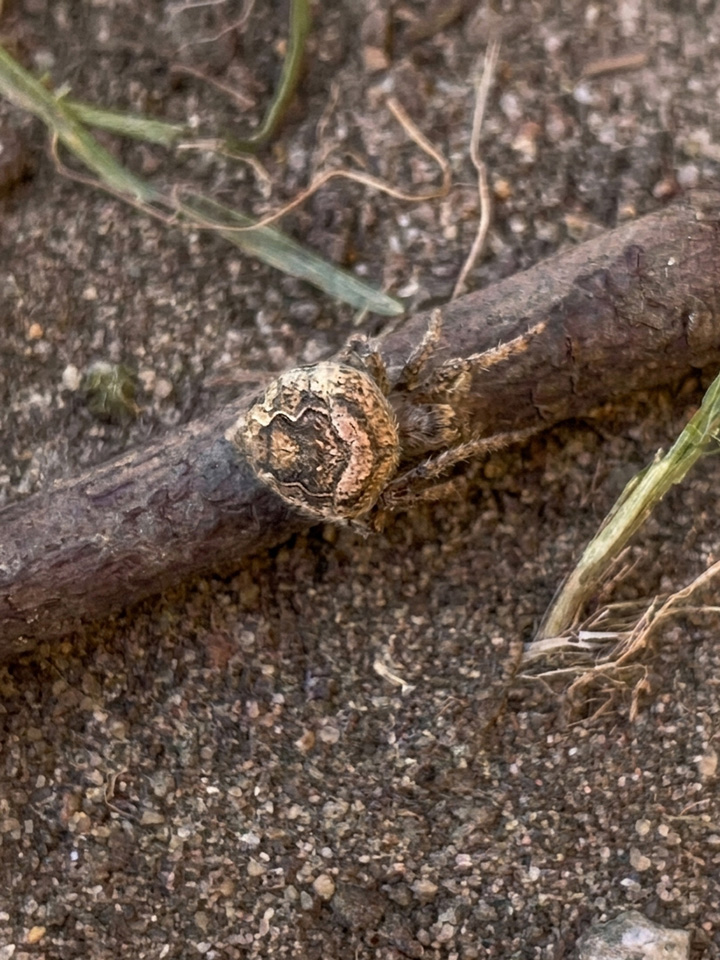
The female wasp preys on spiders that are immature but usually larger, sometimes five or six times the mass, of the wasp. When she catches a spider she stings it first between the fangs to immobilize these weapons, then in the body to paralyze the prey. She hangs it from a low twig using silk from the spinnerets of the captured prey. She then excavates a burrow in sandy soil, returning repeatedly to the prey to protect it from scavengers and to ensure that it is still paralyzed. The burrow is diagonal, about to 1½″ deep, and has a ⅜″ long cell at the bottom. Once that is completed, she drags the spider into the cell, deposits a single egg, and covers the burrow. When the egg hatches, the larva affixes itself to the upper surface of the host spider and feeds from the outside.
Larva Food/Hosts
Immature orb weaver spiders, including bordered orbweaver (Larinioides patagiatus), humpbacked orbweaver (Eustala anastera), marbled orbweaver (Araneus marmoreus), starbellied orbweaver (Acanthepeira stellata), and at least one species of Neoscona.
Adult Food
Distribution

Sources
Caliadurgus fasciatellus (Spinola, 1808) in Bánki, O., Roskov, Y., Döring, M., Ower, G., Hernández Robles, D. R., Plata Corredor, C. A., Stjernegaard Jeppesen, T., Örn, A., Pape, T., Hobern, D., Garnett, S., Little, H., DeWalt, R. E., Miller, J., Orrell, T., Aalbu, R., Abbott, J., Abreu, C., Acero P, A., et al. (2026). Catalogue of Life (2026-06-19 XR). Catalogue of Life Foundation, Amsterdam, Netherlands. https://doi.org/10.48580/dgy8b
Occurrence
Taxonomy
Order
Hymenoptera (Ants, Bees, Wasps, and Sawflies)
Suborder
Apocrita (Narrow-waisted Wasps, Ants, and Bees)
Infraorder
Aculeata (Ants, Bees, and Stinging Wasps)
Superfamily
Pompiloidea (Spider Wasps, Velvet Ants and Allies)
Family
Subfamily
Pepsinae
Tribe
Priocnemini
Genus
Caliadurgus
Subordinate Taxa
Synonyms
Agenia calcarata
Ageniella calcarata
Anoplius labiatus
Anoplius unimacula
Caliadurgus fasciatellus alienatus
Caliadurgus fasciatellus fasciatellus
Caliadurgus fasciatellus gyllenhali
Caliadurgus hyalinatus
Caliadurgus hyalinatus alienatus
Caliadurgus hyalinatus hyalinatus
Caliadurgus hyalinatus rupex
Calicurgus duplonota
Calicurgus fasciatellus
Calicurgus fasciatellus duplonota
Calicurgus fasciatellus gyllenhali
Calicurgus fasciatellus strittianus
Calicurgus gyllenhali
Calicurgus hyalinatus
Calicurgus hyalinatus alienatus
Calicurgus hyalinatus duplonota
Calicurgus hyalinatus duplonotatus
Calicurgus hyalinatus fasciatellus
Calicurgus hyalinatus gyllenhali
Calicurgus hyalinatus rupex
Calicurgus hyalinatus strittianus
Calicurgus mimeticus
Calicurgus odontellus
Calicurgus rupex
Calicurgus ruspex
Calicurgus strittianus
Ceropales annulata
Cryptocheilus alienatus
Pompilus albispinus
Pompilus alienatus
Pompilus annularis
Pompilus annulatus
Pompilus bivirgatus
Pompilus bivirgulatus
Pompilus calcaratus
Pompilus curtus
Pompilus fasciatellus
Pompilus fasciatellus fasciatellus
Pompilus fascipennis
Pompilus labiatus
Pompilus maculipennis
Pompilus odontellus
Pompilus rupex
Pompilus ruspex
Pompilus unimacula
Priocnemis alienatus
Priocnemis fasciatellus
Priocnemis fuscopennis
Priocnemis gyllenhali
Pseudagenia calcarata
Salius fasciipennis
Salius gyllenhali
Salius rupex
Salius ruspex
Common Names
blotchwing spider wasp