carrot wasp - Species Profile
Conservation • Description • Habitat • Ecology • Distribution • Taxonomy
Conservation Status
IUCN Red List
not listed
NatureServe
not listed
Minnesota
not listed
Description
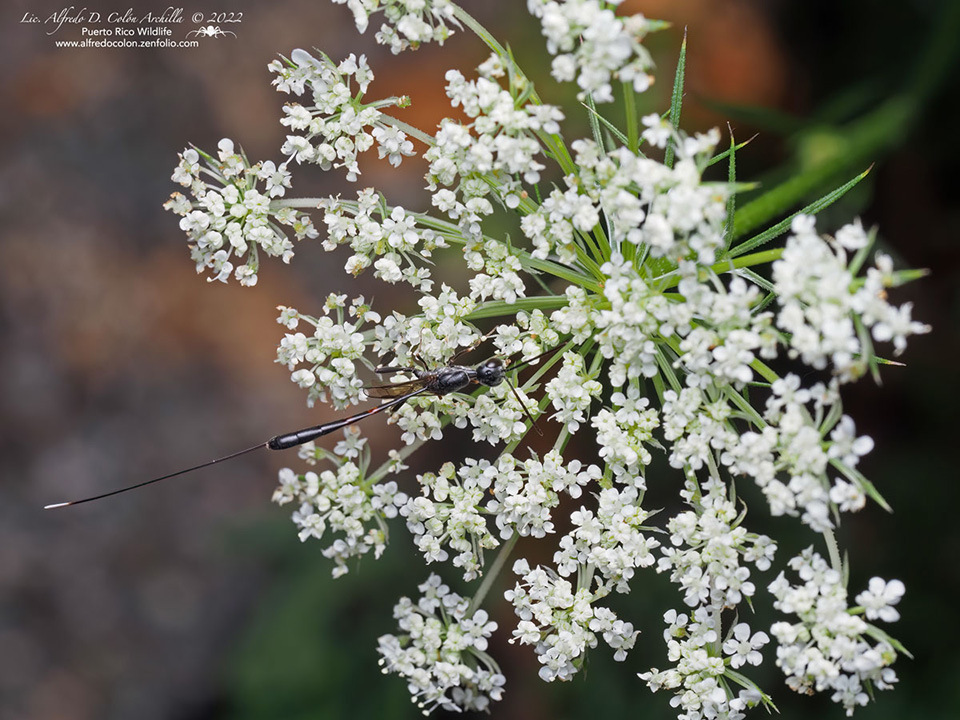
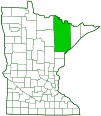
Gasteruption tarsatorium is a large, parasitoid, carrot wasp. There are two geographically distinct subspecies: the eastern subspecies G. t. tarsatorium occurs in eastern North America, and the northern and western subspecies G. t. solaris occurs from Nova Scotia to Alaska, and south through the Western United States to Arizona and Texas. Either subspecies might be found in northern Minnesota, which lies in the transition zone between the northern boreal forest and the eastern broadleaf forest.
Adults are active from mid-May through early September, but their peak flight period is mid-May through early June.
Females of the eastern subspecies G. t. tarsatorium are ⅝″ to ¾″ (15 to 18 mm) in length, mostly black with some white and reddish-brown (ferruginous) markings, and variously pitted (punctate).
The head is black and shiny, and it is clearly separated from the thorax by a long neck. The top of the head is shiny, and is covered with fine, closely spaced punctures. The back of the head is shallowly concave when viewed from above. The ridge at the back of the head (occipital carina) is separated from the head by a sharp groove, and it is sharply bent backward (reflexed). The jaws (mandibles) are brown. The compound eyes are conspicuously covered with dense, short hairs. The antennae are short, black, and thread-like. They have 13 segments, the scape and pedicel at the base, and a whip-like section (flagellum) with 11 segments. The scape is medium to dark reddish-brown on the underside.
The thorax is black. The plate on the first thoracic segment (pronotum) has a pair of distinct, sharply angled, forward projecting teeth on the front margin and usually a dull reddish-brown spot at each rear corner. The plate on the side of the first segment (propleuron) does not have coarse transverse wrinkles. The large plate on the second thoracic segment (mesonotum) has fine punctures above and some large strong punctures on the lateral lobes. The sides of the thorax are densely hairy and are dull between the punctures. The small, scale-like plate covering the wing base (tegula) is reddish-brown.
The abdomen is very long, slender, and mostly black. It is attached to the thorax high, far above the bases of the hind legs (coxae). It is very slender at the base, gradually widening as it approaches the tip. The abdomen is mostly black with a narrow, diffuse, reddish-brown margin on the rear of segments 2, 3, and 4. The ovipositor is very long, longer than the abdomen, and 2.1 times the length of the forewing. It is black except for the exposed portion of the white sheath at the tip.
The forewing has a closed cell on the front (costal) margin. In the median area, there is only a single cross vein (recurrent vein) and a single closed medial cell.
The front and middle legs are mostly brown to reddish-brown beyond the two black basal segments. The fourth segment (tibia) has a white stripe on the upper side extending from the base to the tip, but the stripe is sometimes interrupted in the middle. On the hind legs, the second basal segment (trochanter) has two segments. The tibia is swollen and mostly dark with a small pale area near the base. The last part of each leg (tarsus), corresponding to the foot, has five segments. Most of the first and second segments are usually white.
The male is slightly smaller than the female. The antennae have 14 segments. The abdomen lacks an ovipositor and is more club-shaped, skinnier at the base and more swollen at the tip.
On the northern and western subspecies G. t. solaris, the scape is entirely black or dark brown. The pronotum is entirely black, with no reddish-brown spot at the rear corners. The legs are often more uniformly blackish except for white rings on the tibia.
Size
Body length: ⅝″ to ¾″ (15 to 18 mm)
Similar Species
Habitat
Ecology
Season
Mid-May through early September
Behavior
Life Cycle
Third stage (instar) larvae overwinter in cocoons. They pupate in the spring and emerge as adults in spring or early summer.
Larva Food/Hosts
The larva develops in the cell of the host nest, consuming the host larva followed by the food collected for it in that cell. When that is consumed, it may move on to an adjacent cell.
Adult Food
Flower nectar
Distribution
Occurrence
Taxonomy
Order
Hymenoptera (Ants, Bees, Wasps, and Sawflies)
Suborder
Apocrita (Narrow-waisted Wasps, Ants, and Bees)
Superfamily
Evanioidea (Aulacid, Carrot, and Ensign Wasps)
Family
Gasteruptiidae (Carrot Wasps)
Subfamily
Gasteruptiinae
Genus
Gasteruption
Subordinate Taxa
Gasteruption tarsatorius sollaris  (?)
(?)
Gasteruption tarsatorius tarsatorius (?)
Synonyms
Gasteruption tarsatorius
Rhydinofoenus tarsatorius
Common Names
This species has no common name. The common name of the Family Gasteruptiidae is Carrot Wasps, and it is applied here for convenience.
