chalcidoid wasp - Species Profile
Conservation • Description • Habitat • Ecology • Distribution • Taxonomy
Conservation Status
IUCN Red List
not listed
NatureServe
not listed
Minnesota
not listed
Description
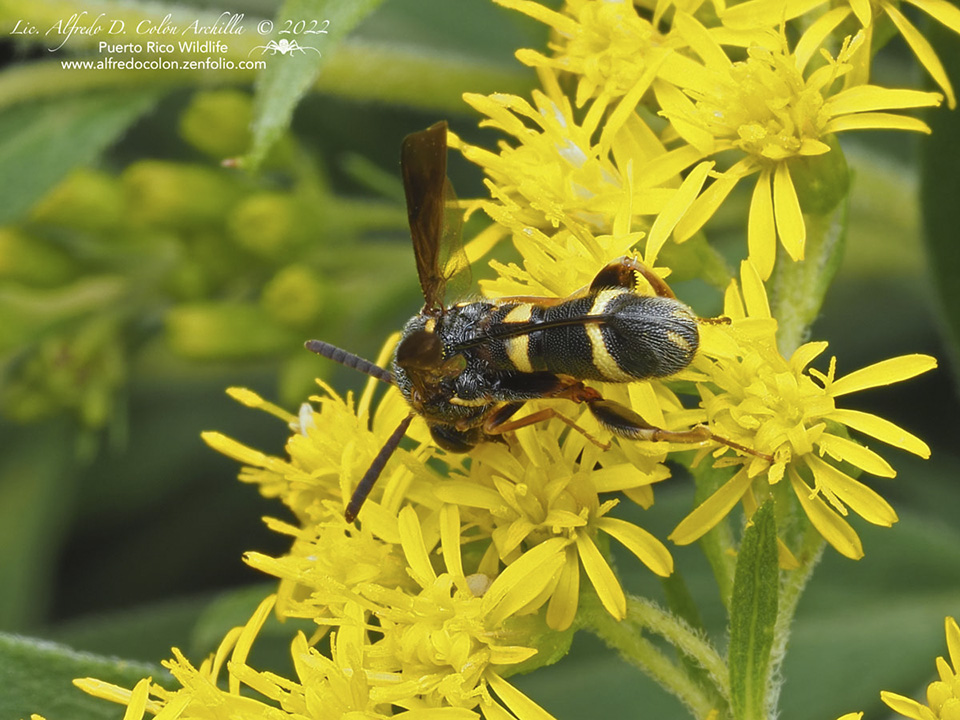
Leucospis affinis is a common, small to medium-sized, parasitoid wasp. It occurs throughout the United States, southern Canada, and northern Mexico. It is the largest and most widely distributed species in the genus Leucospis, and the only species whose range extends into northern North America.
There are three recognized subspecies of Leucospis affinis, and L. a. affinis is the only one that occurs in Minnesota. The following description is of the subspecies L. a. affinis. Even within this subspecies, the coloration is highly variable geographically. In the southwest, the yellow color is often replaced with whitish. In the southeast, especially at lower latitudes, the color is often extensively yellow, sometimes predominantly yellow.
Adults are active from May through October, and they are usually found on flowers. The larvae feed on the larvae of bees in the family Megachilidae.
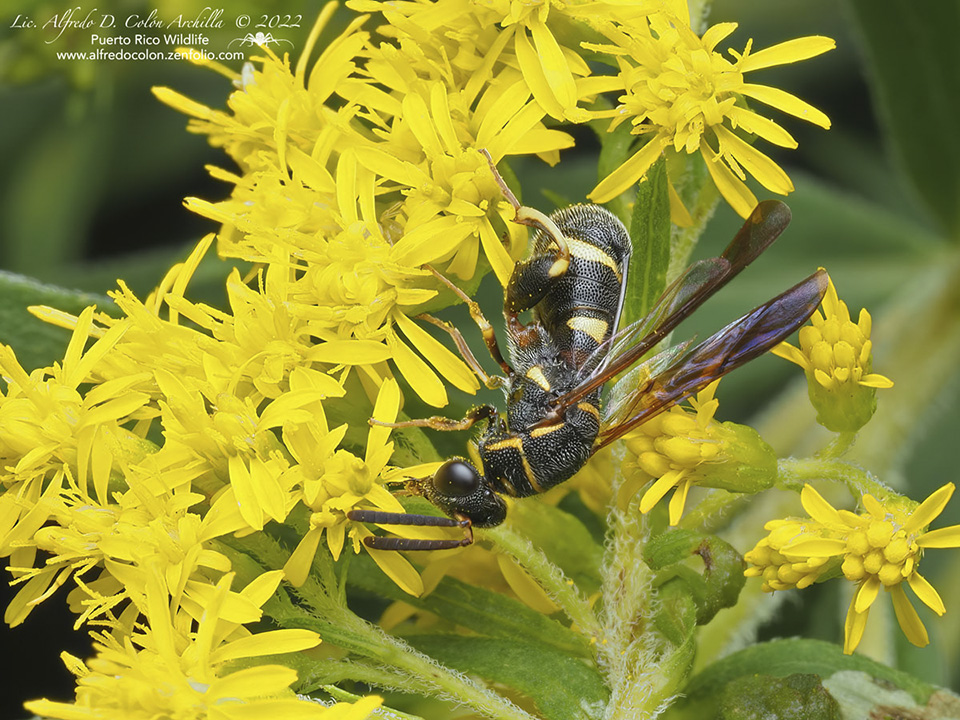
The female is ⅛″ to ½″ (3.9 to 11.5 mm) in length and black with bright yellow markings. The body is somewhat hump-backed in appearance. The yellow markings and folded wings are a form of Batesian mimicry, making it look like a stinging wasp, which discourages predators like birds.
The antennae are black, they have 12 segments, and they are bent (elbowed). The underside of the basal segment (scape) is yellow.
The plate on the upper side of the first thoracic segment (pronotum) is relatively large and squarish. It is narrower in the middle and wider at the sides, but it does not extend back to the structure covering the forewing bases (tegulae). The lateral and rear margins are yellow, and there is a yellow band across all or just part of the front margin. The large plate on the middle segment of the thorax (mesoscutum) has no longitudinal grooves. Its lateral margins are yellow. The small plate at the rear of the mesothorax (scutellum) is undivided. The rear margin is yellow. The principal plate on each side of the thorax (mesopleuron) has a broad, shallow, diagonal groove (mesopleural furrow). The rear plate (metapleuron) has a diagonal yellow stripe.
On the rear part of the body (metasoma), the first and fifth segments (tergites) have a yellow band on the rear margin. The fourth tergite has a short vertical streak on each side. The last part of the metasoma (epipygium) has a pair of long vertical streaks at the rear. The ovipositor is long and is curved upward and forward over the abdomen when not in use. This feature is normal in the pupal stage of parasitic wasps with long ovipositors, but it is retained in adulthood among wasps in the family Leucospidae.
On the front and middle legs, the third segment (femur) is mostly black, yellow just at the tip. The fourth segment (tibia) is mostly black but with a yellow stripe on the upper (outer) surface. On the front legs, the spur at the tip of the tibia is large and curved. On the middle legs, the spur at the tip of the tibia is small. On the hind legs, the third segment (femur) is greatly enlarged, mostly black, yellow just at the tip. On all legs, the last part (tarsus), corresponding to the foot, has five segments.
The forewings have few veins, and they are weakly to moderately tinted smoky brown. In photos they appear darker because they are folded longitudinally when at rest, doubling or tripling the thickness of membrane that light must pass through. The hindwings are elongate oval.
The male is smaller, ⅛″ to ⅜″ (3.6 to 9.8 mm) in length. The antennae have 13 segments. The first, fourth, and fifth tergites have a yellow band at the rear margin. The epipygium has a single, elongate but short, yellow spot at the tip.
Size
Female total length: ⅛″ to ½″ (3.9 to 11.5 mm)
Male total length: ⅛″ to ⅜″ (3.6 to 9.8 mm)
Similar Species
Habitat
Ecology
Season
May through October
Behavior
Life Cycle
The life cycle begins when a female wasp locates the nest of a host bee, typically within the family Megachilidae. She taps the exterior with her antennae to assess the development and suitability of the host larva inside. Once a host is selected, she uses her long, specialized ovipositor to penetrate the nest wall and deposit a single egg. Upon hatching, the Leucospis larva acts as a parasitoid, feeding on the host larva throughout its development. This process eventually kills the host, after which the wasp larva pupates and emerges from the nest as a free-living adult.
Larva Food/Hosts
Larva of bees in the family Megachilidae
Adult Food
Flower nectar
Distribution
Sources
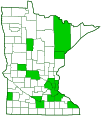
Biodiversity occurrence data published by: Minnesota Biodiversity Atlas (accessed through the Minnesota Biodiversity Atlas Portal, bellatlas.umn.edu. Accessed 4/29/2026).
Leucospis affinis Say, 1824 in GBIF Secretariat (2023). GBIF Backbone Taxonomy. Checklist dataset https://doi.org/10.15468/39omei accessed via GBIF.org. Accessed 4/29/2026.
Occurrence
Common and widespread
Taxonomy
Order
Hymenoptera (Ants, Bees, Wasps, and Sawflies)
Suborder
Apocrita (Narrow-waisted Wasps, Ants, and Bees)
Infraorder
Proctotrupomorpha
Superfamily
Chalcidoidea (Chalcidoid Wasps)
Family
Leucospidae
Genus
Leucospis
Subordinate Taxa
Leucospis affinis affinis 

Leucospis affinis dubiosa
Leucospis affinis floridana
Synonyms
Leucospis basalis
Leucospis bicincta
Leucospis canadensis
Leucospis druraei
Leucospis dubiosa
Leucospis fraterna
Leucospis subnotata
Common Names
This species has no common name. The common name of the family Chalcidoidea is chalcidoid wasps, and it is applied here.