cherry dagger - Species Profile
Conservation • Description • Habitat • Ecology • Distribution • Taxonomy
Hodges #
9229
Conservation Status
IUCN Red List
not listed
NatureServe
NNR - Unranked
SNR - Unranked
Minnesota
not listed
Description
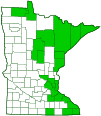
Cherry dagger, also called speared dagger, is a common, medium-sized moth. It occurs in the United States east of the Great Plains and in the west from Washington State and Oregon east to Montana and Colorado. It occurs across southern Canada. It is locally common in the eastern U.S., including in Minnesota.
Adults are active in June and July in Minnesota, from May to September in some other parts of its region. They are found in woodlands, shrublands, prairie thickets, fields, and power line rights-of-way – anywhere their host species grow. The larvae feed on cherries and plums, especially black cherry (Prunus serotina), chokecherry (Prunus virginiana), pin cherry (Prunus pensylvanica), and American plum (Prunus americana). Many sources include oak as a host, but that is based on a single record from northern red oak (Quercus rubra) in 1962, which is believed to be erroneous. Early stage (instar) larvae feed on the leaf uppersides.
Adults are ⅞″ (22 to 23 mm) in length and have a 1⅜″ to 1¾″ (34 to 45 mm) wingspan. Moth size is sometimes given in terms of forewing length, which for this species is ¾″ (19 to 20 mm).
The forewings are powdery medium gray to charcoal gray with darker gray mottling, dark gray transverse lines, and black longitudinal dashes. The basal, antemedial (AM), and postmedial (PM) lines are doubled. The basal and AM lines are filled with ground color. The PM line is weakly scalloped and has lighter filling. The subterminal line is pale gray. The terminal line is defined by a series of black spots which extend onto the fringe. The circular spot in the upper median area (orbicular spot) is bordered with black and filled with the ground color or with pale whitish gray. The kidney-shaped spot in the lower median area (reniform spot) is similar. The two spots are connected by a black bar. This is a feature that distinguishes this species from all other dagger moths in the eastern U.S. The dash in the basal area is thick, runs to the AM line, and ends with three prongs. There is a long black dash in the anal area and a short one in the subterminal area.
The hindwing on the male is pale whitish gray, on the female is dirty white and light brownish gray. On both sexes there is a faint discal dot, a diffuse PM line, and shading in the submarginal area.
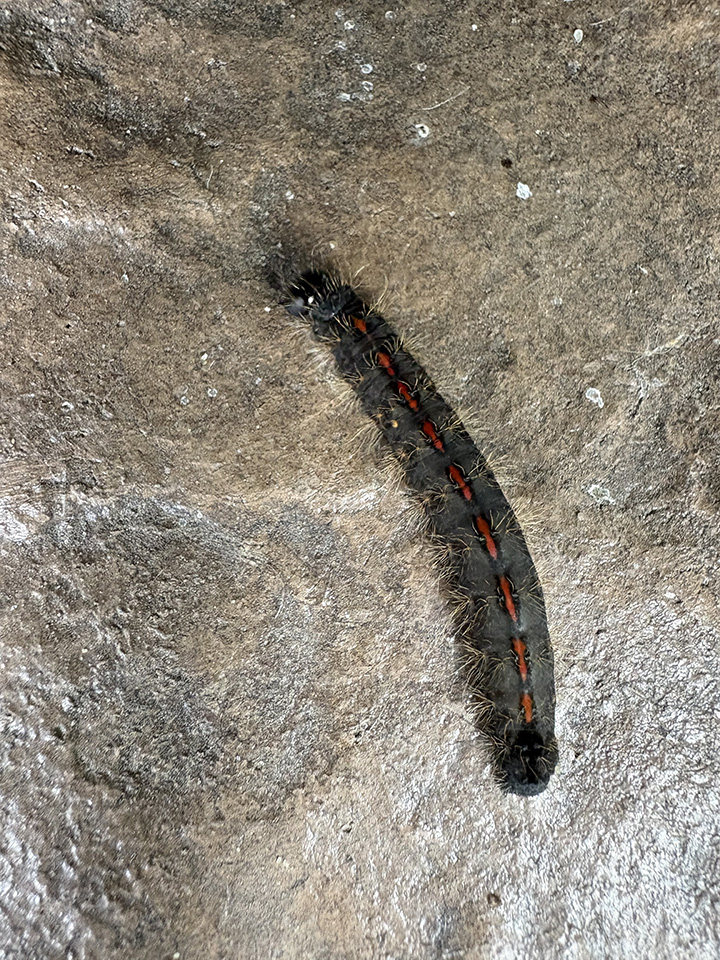
The last instar caterpillar is up to 1 9⁄16″ (4 cm) long. It has a shiny black head capsule and a charcoal gray body. There is a black-bordered, red, longitudinal stripe on abdominal segments 1 through 7 (A1 to A7) that form a continuous but broken middorsal stripe. A8 has a black middorsal stripe. The second-to-last (penultimate) instar is green with a yellow middorsal stripe. The head capsule is yellow on the sides, cherry red on the top (vertex).
Size
Total length: ⅞″ (22 to 23 mm)
Forewing length: ¾″ (19 to 20 mm)
Wingspan: 1⅜″to 1¾″ (34 to 45 mm)
Similar Species
Habitat
Woodlands, shrublands, prairie thickets, fields, and power line rights-of-way
Ecology
Season
One generation in Minnesota: June and July
Behavior
Life Cycle
Larva Food/Hosts
Cherries and plums (Prunus spp.)
Adult Food
Distribution
Sources
Biodiversity occurrence data published by: Minnesota Biodiversity Atlas (accessed through the Minnesota Biodiversity Atlas Portal, bellatlas.umn.edu. Accessed 7/23/2026).
Acronicta hasta Guenée, 1852 in Bánki, O., Roskov, Y., Döring, M., Ower, G., Hernández Robles, D. R., Plata Corredor, C. A., Stjernegaard Jeppesen, T., Örn, A., Pape, T., Hobern, D., Garnett, S., Little, H., DeWalt, R. E., Miller, J., Orrell, T., Aalbu, R., Abbott, J., Abreu, C., Acero P, A., et al. (2026). Catalogue of Life (2026-07-17 XR). Catalogue of Life Foundation, Amsterdam, Netherlands. https://doi.org/10.48580/dgykv
Quinn, Edward. M., and Ron Danielson. April 27, 2009. A Survey of Lepidoptera in Three Priority Areas of the Minnesota State Parks System. https://files.dnr.state.mn.us/eco/nongame/projects/consgrant_reports/2009
/2009_quinn_danielson.pdf.
Occurrence
Locally common
Taxonomy
Order
Lepidoptera (Butterflies and Moths)
Superfamily
Noctuoidea (Owlet Moths and Allies)
Family
Noctuidae (Cutworm Moths and Allies)
Subfamily
Acronictinae
Genus
Acronicta (Dagger Moths)
Subgenus
Agriopodes
Section
Acronicta hasta (Cherry and Unmarked Daggers and Allies)
Subordinate Taxa
Synonyms
Acronicta furcifera
Acronicta manitoba
Acronicta telum
Acronicta wanda
Common Names
cherry dagger
cherry dagger moth
forked dagger moth
speared dagger
speared dagger moth
