clavate tortoise beetle - Species Profile
Conservation • Description • Habitat • Ecology • Distribution • Taxonomy

Conservation Status
IUCN Red List
not listed
NatureServe
NNR - Unranked
Minnesota
not listed
Description
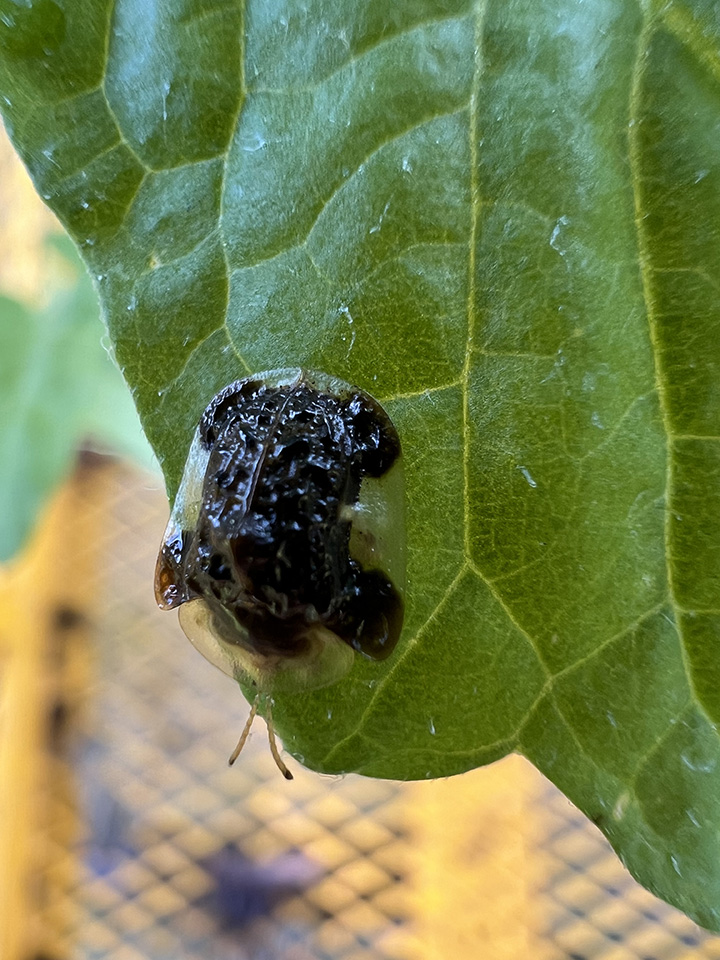
Clavate tortoise beetle is fairly common in North and Central America. In the United States it occurs from the northeast to the Great Plains. It is easily recognized by the wrinkled upper surface with a dark teddy bear-like pattern.
Adults are tortoise-shaped, ¼″ to 5 ⁄16″ (6.5 to 7.5 mm) long, 3 ⁄16″ to ¼″ (5.5 to 6.3 mm) wide, oval when viewed from above, and convex when viewed from the side. The female is larger than the male.
The upper thoracic plate (pronotum) and hardened wing covers (elytra) are green and translucent. The edges are spread out, flattened, and thin, and extend over the head and legs. The front (anterior) edge of the pronotum is broadly rounded. A large, opaque, dark brown spot covers most of the elytra and extends onto the pronotum. The spot resembles a teddy bear, with the the teddy bear’s “head” on the pronotum and the front and hind “legs” reaching the elytral margins. The plate between the wing bases (scutellum) is also dark brown. There is also at least some gold coloration adjacent to the edges of the brown spot. The upper surface of the elytra is very rough with wrinkles, rounded projections, and a prominent peak in the middle behind the scutellum.
The head is completely concealed when viewed from above. The eyes are not notched. The antennae are long but less than half as long as the body. They are mostly pale but some of the terminal segments are black. Segment 3 is slightly longer than segment 2, and segment 8 is distinctly longer than wide. The antennae are extended when at rest. There is no groove on the underside of the prothorax for them to be tucked into. The plate on the face above the mouth (clypeus) is completely horizontal.
The last part of each leg (tarsus), corresponding to the foot, has five segments. The fourth segment is very short and is concealed within the broadened tip of the third segment, making the tarsus appear to have only four segments. The last segment bears a pair of claws. The dilation at the base of each claw is angular.
Size
Total length: ¼″ to 5 ⁄16″
Similar Species
Habitat
Ecology
Season
Behavior
Adults eat round holes in the leaves.
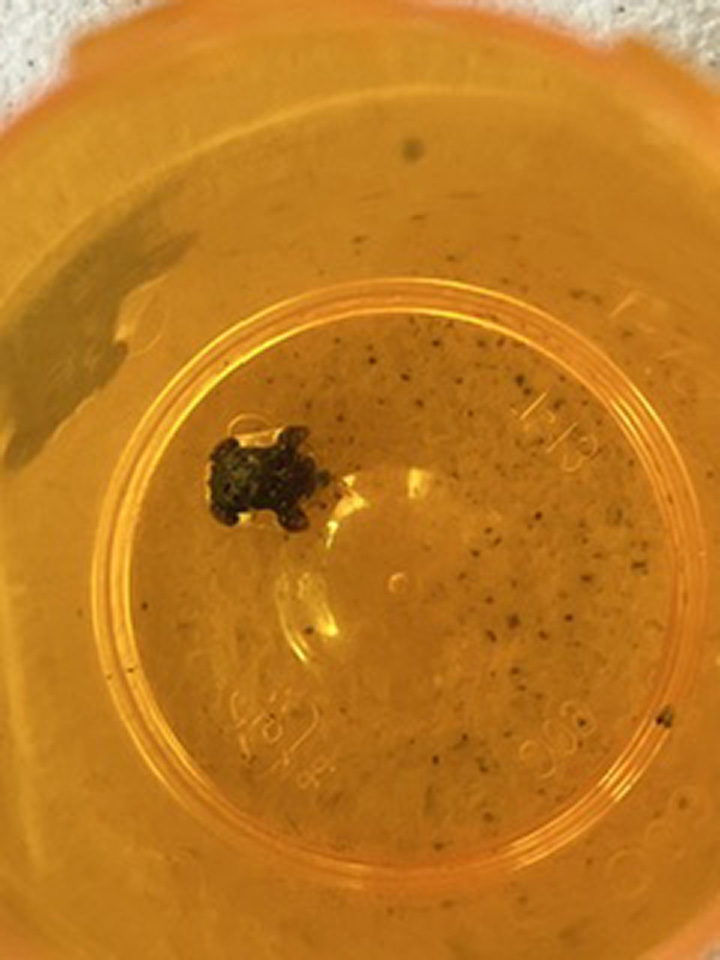
The larvae carry dried fecal matter over their body, presumably as a form of camouflage. The fecal matter is attached to a forked appendage on the last abdominal segment, and is held suspended over the body.
Life Cycle
Larva Food/Hosts
Adult Food
Groundcherry (Physalis spp.) and nightshade (Solanum spp.)
Distribution

Sources
Biodiversity occurrence data published by: Minnesota Biodiversity Atlas (accessed through the Minnesota Biodiversity Atlas Portal, bellatlas.umn.edu. Accessed 6/8/2026).
Helocassis clavata (Fabricius, 1798) in GBIF Secretariat (2023). GBIF Backbone Taxonomy. Checklist dataset https://doi.org/10.15468/39omei accessed via GBIF.org. Accessed 6/8/2026.
Occurrence
Fairly common
Taxonomy
Order
Coleoptera (Beetles)
Suborder
Polyphaga (Water, Rove, Scarab, Long-horned, Leaf, and Snout Beetles)
Infraorder
Cucujiformia
Superfamily
Chrysomeloidea (Leaf Beetles and Allies)
Family
Chrysomelidae (Leaf Beetles)
Subfamily
Cassidinae (Tortoise and Hispine Beetles)
Tribe
Genus
Helocassis
Genus
In World Catalogue of the Cassidinae, published in 1999, Polish taxonomist Lech Borowie proposed transferring eight species from the genus Plagiometriona to the new genus Helocassis. The move was then and now remains controversial. Most North American sources reject the move. Two notable exceptions are Integrated Taxonomic Information System (ITIS) and iNaturalist. A discussion on BugGuide.net gives a detailed – even exhaustive – explanation of their reasoning for rejecting the move in 2005 – Tortoise Beetle Taxonomy. However, by 2022, BugGuide had accepted the move. NatureServe and Discover Life continues to use the name Plagiometriona clavata for this species.
Subordinate Taxa
clavate tortoise beetle (Helocassis clavata clavata) 
clavate tortoise beetle (Helocassis clavata testudinaria)
Synonyms
Cassida clavata
Coptocycla testudinaria
Plagiometriona clavata
Common Names
clavate tortoise beetle
translucent tortoise beetle