fulminating long-horned beetle - Species Profile
Conservation • Description • Habitat • Ecology • Distribution • Taxonomy
Conservation Status
IUCN Red List
not listed
NatureServe
NNR - Unranked
Minnesota
not listed
Description
Fulminating long-horned beetle is a medium-sized, early season, round-necked longhorn beetle. It occurs in the United States from Maine to Maryland, west to Minnesota and Missouri, and south along the Appalachian Mountains to North Carolina. It also occurs in southern Canada in Quebec, Ontario, and Manitoba.
Adults are active from May to July, with peak activity occurring in June. The larvae are found under the bark and in the sapwood of hardwood trees, especially chestnut, oak, and walnut.
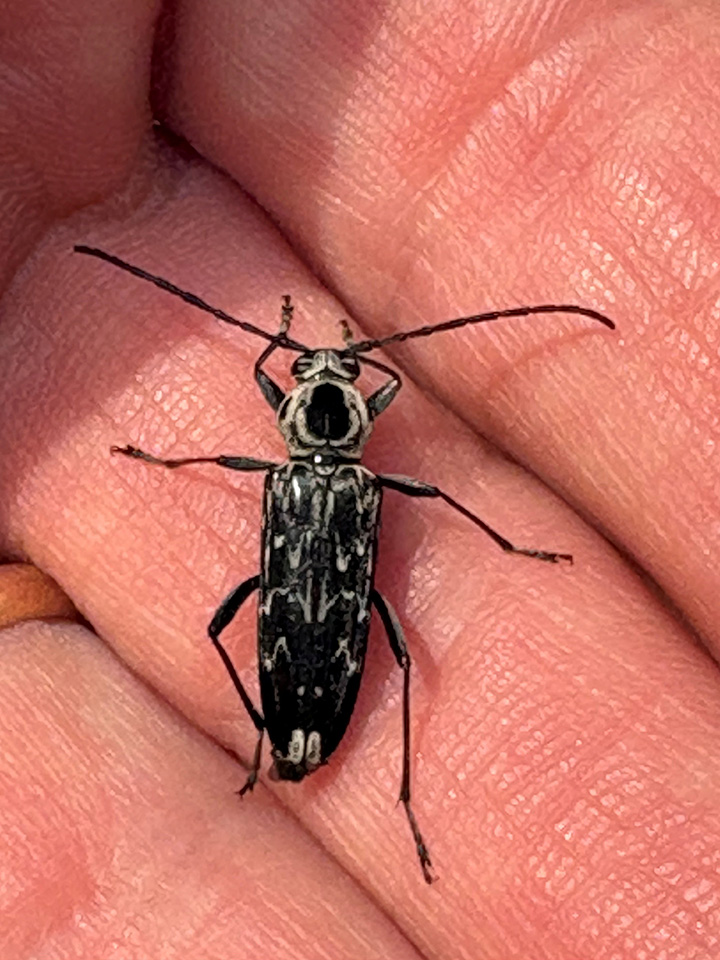
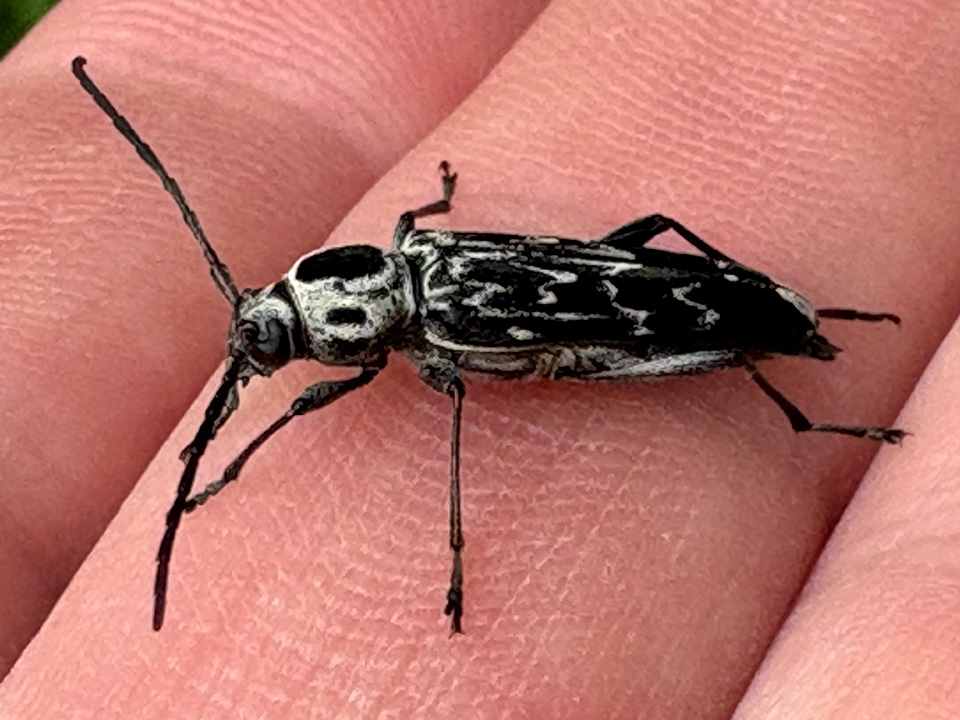
Adults are ½″ to ⅞″ (12.0 to 22.0 mm) in length. The body is nearly cylindrical and significantly elongated. It is entirely black with patterns of dense white hairs.
The head is slightly elongated. The eyes are deeply notched, partially surrounding the base of each antenna. The antennae are long, reaching at least the second third of the wing covers (elytra). The bases of the antennae are closely spaced. The face is slanted forward. The plate on the face (clypeus) is well developed.
The plate covering the first segment of the thorax (pronotum) is oblong, almost spherical. Dense white hairs form a distinctive, large, black spot in the middle and a distinct, smaller black eyespot on each side. On the underside of the third segment of the thorax, a plate on each side (metepimeron) is four times longer than wide, and it extends over the rear angles of the first segment.
The elytra are parallel sided, and they are cut off (truncated) in the rear, exposing the last segment of the abdomen. Dense white hairs form five narrow, sharply angled, transverse bands crossing both elytra.
The legs are long. On each leg, the third segment (femur) is gradually thickened toward the end. The last part of each leg (tarsus), corresponding to the foot, has five segments. The fourth segment is very short and is concealed within the broadened tip of the third segment, making the tarsus appear to have only four segments.
Size
Total length: ½″ to ⅞″ (12.0 to 22.0 mm)
Similar Species
Habitat
Ecology
Season
May to June
Behavior
Adults will come to light and to baited traps.
Life Cycle
Larva Food/Hosts
Adult Food
Distribution

Sources
Biodiversity occurrence data published by: Minnesota Biodiversity Atlas (accessed through the Minnesota Biodiversity Atlas Portal, bellatlas.umn.edu. Accessed 6/6/2026).
Sarosesthes fulminans (Fabricius, 1775) in GBIF Secretariat (2023). GBIF Backbone Taxonomy. Checklist dataset https://doi.org/10.15468/39omei accessed via GBIF.org. Accessed 6/6/2026.
Occurrence
Taxonomy
Order
Coleoptera (Beetles)
Suborder
Polyphaga (Water, Rove, Scarab, Long-horned, Leaf, and Snout Beetles)
Infraorder
Cucujiformia
Superfamily
Chrysomeloidea (Longhorn Beetles and Allies)
Family
Cerambycidae (Longhorn Beetles)
Subfamily
Cerambycinae (Round-necked Longhorn Beetles)
Tribe
Clytini
Genus
Sarosesthes
Subordinate Taxa
Synonyms
Arhopalus fulminans
Arhopalus fulminaus
Callidium fulminans
Cerambyx fulminans
Clytus fulminans
Sarosethes fulminans
Common Names
fulminating long-horned beetle