giant mayfly - Species Profile
Conservation • Description • Habitat • Ecology • Distribution • Taxonomy

Conservation Status
IUCN Red List
not listed
NatureServe
N5 - Secure
SNR - Unranked
Minnesota
not listed
Description
Giant mayfly is a common, large, burrowing mayfly. It is very widespread, occuring in the United States and southern Canada from the east coast to the Great Plains and on the west coast. It is mostly absent from the desert and mountain regions in the west. It is the most common mayfly in the Midwest, and it is common in Minnesota. Larvae are found in organic, silty or mucky bottoms of lakes, ponds, and rivers, usually about three meters below the water surface. They feed on organic material suspended in the water. Immature adults (subimagos) are found on trees and bushes on shores near the bodies of water from which they emerged. Adults are found flying in swarms over land near the water body.
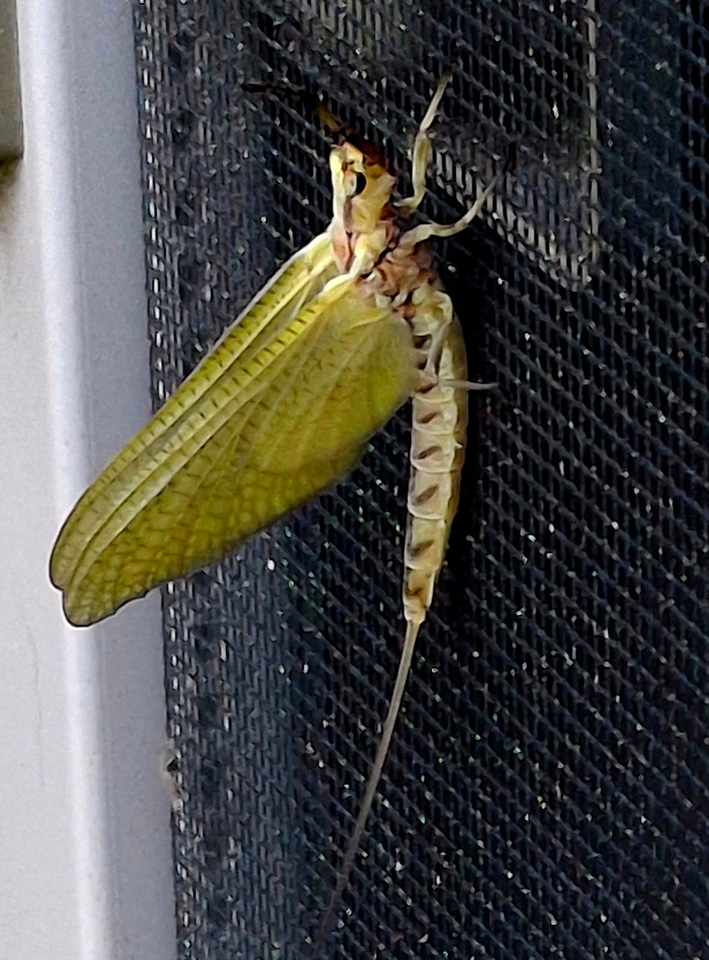
The adult is soft-bodied and, as the common name suggests, large, 5⁄16″ to 1 1⁄16″ (8.3 to 27.3 mm) in length. It may be the largest mayfly in the United States. The female tends to be larger than the male and has smaller eyes. Color and markings are highly variable. It may be may be yellow, yellowish-brown, brown, or even white.
The antennae are short, bristle-like, and inconspicuous. The mouth parts are small, poorly developed, and non-functional.
There are two hair-like, very long, sensory appendages (cerci) at the tip of the abdomen. The cerci may be as long as the body.
On the hind leg the last part of the leg (tarsus), corresponding to the foot, has 4 segments.
The forewings are clear, large, triangular, and have many veins. They are held together above the body when at rest. There are five cross veins at the tip of each wing. The second terminal branch of the front (anterior) branch of the first fork of the media vein is designated as the M2 vein. The M2 extends downward at the base toward the first cubitus vein Cu1 then bends abruptly upward and continues straight to the outer margin. The hindwings are much smaller than the forewings. The R4+5 vein on the hindwing is not forked.
Size
Total length: 5⁄16″ to 1 1⁄16″ (8.3 to 27.3 mm)
Similar Species
Habitat
Larvae are found in organic, silty or mucky bottoms of lakes, ponds, and rivers. Immature adults are found on trees and bushes on shores near the bodies of water from which they emerged. Adults are found flying in swarms over land near the water body.
Ecology
Season
One generation per year, peaking in August.
Behavior
Life Cycle
The female lays eggs on the water surface. Each egg sinks to the bottom where it overwinters. The nymph hatches in the spring. It creates a U-shaped tunnel in the sediment where it spends most of its life. It lives in the water from 6 months to 3 years, undergoing up to 30 molts. Eventually, it swims to the water surface while at the same time breaking through the larval skin. This subadult stage has functional wings and is called a subimago. It flies to nearby vegetation and molts one last time, emerging as an adult. Emergences are synchronized and can produce swarms so large that they can bee seen by weather satellites. Snow plows are sometimes used to clear dead mayflies off of roads.
Larva Food/Hosts
Organic material suspended in the water.
Adult Food
Adults do not feed
Distribution

Sources
Biodiversity occurrence data published by: Minnesota Biodiversity Atlas (accessed through the Minnesota Biodiversity Atlas Portal, bellatlas.umn.edu. Accessed 7/9/2026).
Hexagenia limbata (Serville, 1829) in Bánki, O., Roskov, Y., Döring, M., Ower, G., Hernández Robles, D. R., Plata Corredor, C. A., Stjernegaard Jeppesen, T., Örn, A., Pape, T., Hobern, D., Garnett, S., Little, H., DeWalt, R. E., Miller, J., Orrell, T., Aalbu, R., Abbott, J., Abreu, C., Acero P, A., et al. (2026). Catalogue of Life (2026-05-15 XR). Catalogue of Life Foundation, Amsterdam, Netherlands. https://doi.org/10.48580/dgxsq
Occurrence
Common
Giant mayfly is one of the most widespread mayflies in North America and the most common mayfly in the Midwest. Local populations can be enormous.
Taxonomy
Order
Ephemeroptera (Mayflies)
Suborder
Furcatergalia
Infraorder
Scapphodonta
Superfamily
Ephemeroidea
Family
Ephemeridae (Burrowing Mayflies)
Subfamily
Hexageniinae
Genus
Hexagenia (Giant Mayflies)
Subordinate Taxa
Synonyms
Ephemera limbata
Hexagenia affiliata
Hexagenia angulata
Hexagenia californica
Hexagenia carolina
Hexagenia elegans
Hexagenia kanuga
Hexagenia limbata californica
Hexagenia limbata limbata
Hexagenia limbata occulta
Hexagenia limbata venusta
Hexagenia limbata viridescens
Hexagenia marilandica
Hexagenia mingo
Hexagenia munda
Hexagenia munda affiliata
Hexagenia munda elegans
Hexagenia munda marilandica
Hexagenia munda munda
Hexagenia occulta
Hexagenia pallens
Hexagenia rosacea
Hexagenia variabilis
Hexagenia venusta
Hexagenia viridescens
Hexagenia weewa
Palingenia limbata
Palingenia occulta
Palingenia viridescens
Common Names
giant mayfly
Michigan hex burrowing mayfly
sandfly