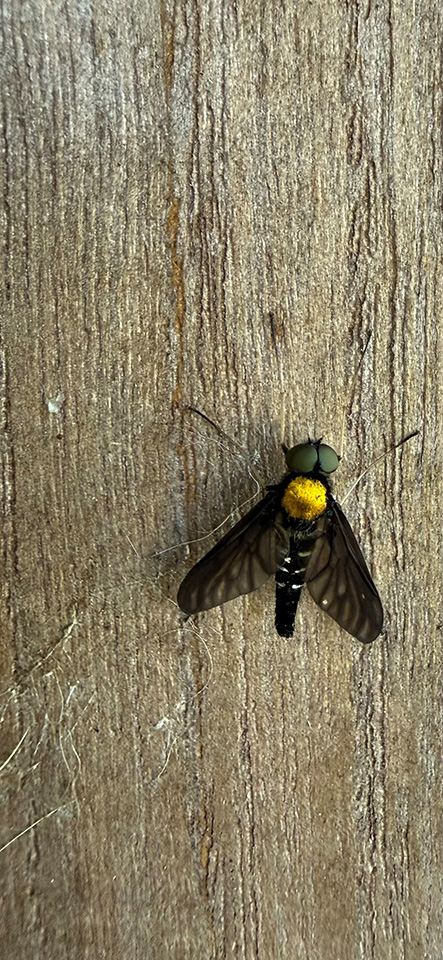
golden-backed snipe fly - Species Profile
Conservation • Description • Habitat • Ecology • Distribution • Taxonomy

Conservation Status
IUCN Red List
not listed
NatureServe
NNR - Unranked
SNR - Unranked
Minnesota
not listed
Description
Golden-backed snipe fly is medium-sized fly. It occurs in the United States from New Hampshire to North Carolina west to Minnesota and Oklahoma, and in southern Ontario Canada. It is common in the east, uncommon in Minnesota. It is found in deciduous woodlands. Larvae are found in water (aquatic) or in moist, organic-rich soil. They prey on earthworms, soft-bodied insects, or grasshopper eggs. Adults prey on other insects but it is thought that they feed little.
Adults are black with highly contrasting white and gold markings. Females are ⅜″ to ½″ (10 to 13 mm) long, males slightly smaller, ⅜″ to ½″ (10 to 12 mm) long.
The head is black and more or less rounded. There are two large compound eyes on the side of the head and three small simple eyes (ocelli) in a triangle on top of the head. The back of the head is densely covered with long black hairs. On the male the compound eyes are very large and meet at the top of the head. On the female the compound eyes are smaller and widely separated. The antennae have three segments. The third segment is cone shaped, is not divided by rings (annulated), and bears a long, slender style (arista) at the end. The arista is distinctly longer than the antenna.
The thorax has three segments. The upper side is densely covered with short golden hairs. This is the feature that gives the fly its common name. The genus name Chrysopilus translates to “gold hair”. The sides of the third segment (metapleura) are densely covered with black hairs.
The abdomen on the male is narrow and tapered. On the female it is broad and is tapered at least on the lower half. Each abdominal segment is black and has a dense band of silvery-white or pale yellow hairs at the end (apex) except for an interruption in the middle.
The wings appear dark but are mostly clear with prominent black veins. There is a broad, smoky brown border along the leading edge (costal margin). The veins usually have broad borders tinged dark smoky brown. The anal cell is longer than the second basal cell and is closed before the wing margin.
The legs are relatively long and mostly pale. On the front legs the fourth segment does not have spurs at the end. On the hind legs there is just one spur at the end of the tibia.
Size
Male: ⅜″ to ½″ (10 to 12 mm)
Female: ⅜″ to ½″ (10 to 13 mm)
Similar Species
Habitat
Deciduous woodlands
Ecology
Season
Early to mid-spring
Behavior
Adults perch on low vegetation.
Life Cycle
Little is known about the life cycle.
Larva Food
Earthworms, soft-bodied insects, or grasshopper eggs
Adult Food
Insects
Distribution

Occurrence
Taxonomy
Order
Suborder
Brachycera
Infraorder
Orthorrhapha
Parvorder
Tabanomorpha (Snipe Flies and Allies)
Family
Rhagionidae (Snipe Flies)
Subfamily
Chrysopilinae
Genus
Chrysopilus
Subfamily
The genus Chrysopilus was formerly included in the subfamily Rhagioninae. In 1903 it was separated with five other genera into the new subfamily Chrysopilinae, but this was ignored by most authors. A recent molecular and morphological analysis of the family Rhagionidae (Kerr, 2004) supported the separation of the subfamily Chrysopilinae to include Chrysopilus and two other genera.
Subordinate Taxa
Synonyms
Leptis thoracicus
Common Names
golden-backed snipe fly