half-belted blue-black spider wasp - Species Profile
Conservation • Description • Habitat • Ecology • Distribution • Taxonomy
Conservation Status
IUCN Red List
not listed
NatureServe
not listed
Minnesota
not listed
Description
Half-belted blue-black spider wasp is a medium-sized predatory wasp. It occurs in the United States from Maine to Florida, west to Minnesota, Nebraska, and Arizona. It also occurs in southern Ontario Canada.
Adults are active from June through August. They are found in open areas with sandy soil or clay. They prey on Wolf Spiders (Lycosidae) and Jumping Spiders (Salticidae). They primarily feed on nectar from a wide variety of wildflowers. While females have been observed consuming the hemolymph (blood) of their spider victims, this serves as a temporary protein boost to fuel the task of transporting prey to their burrows.
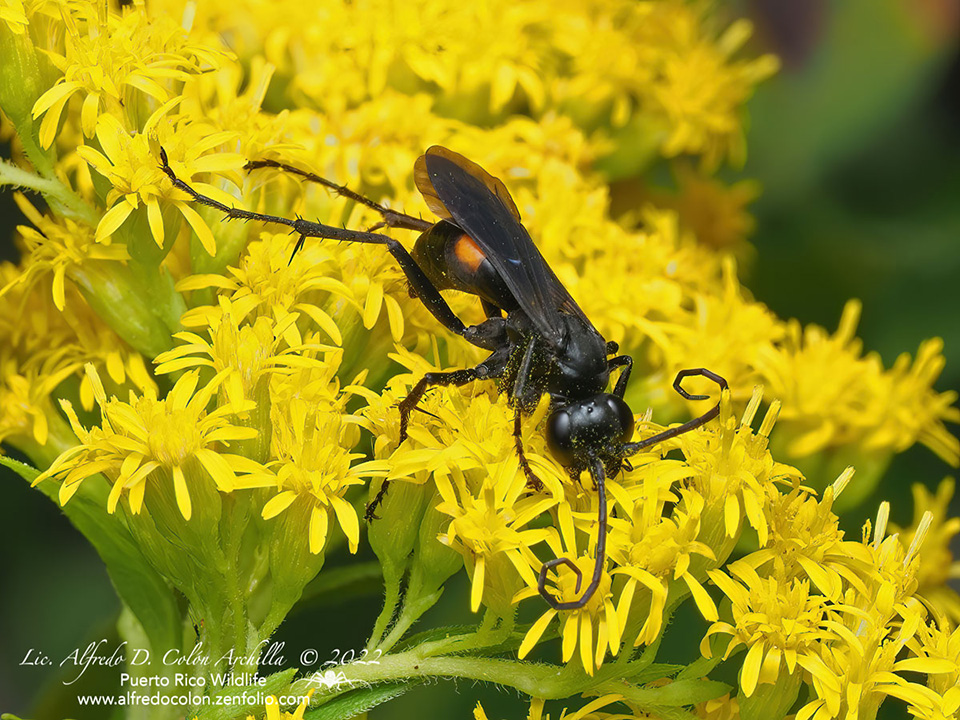
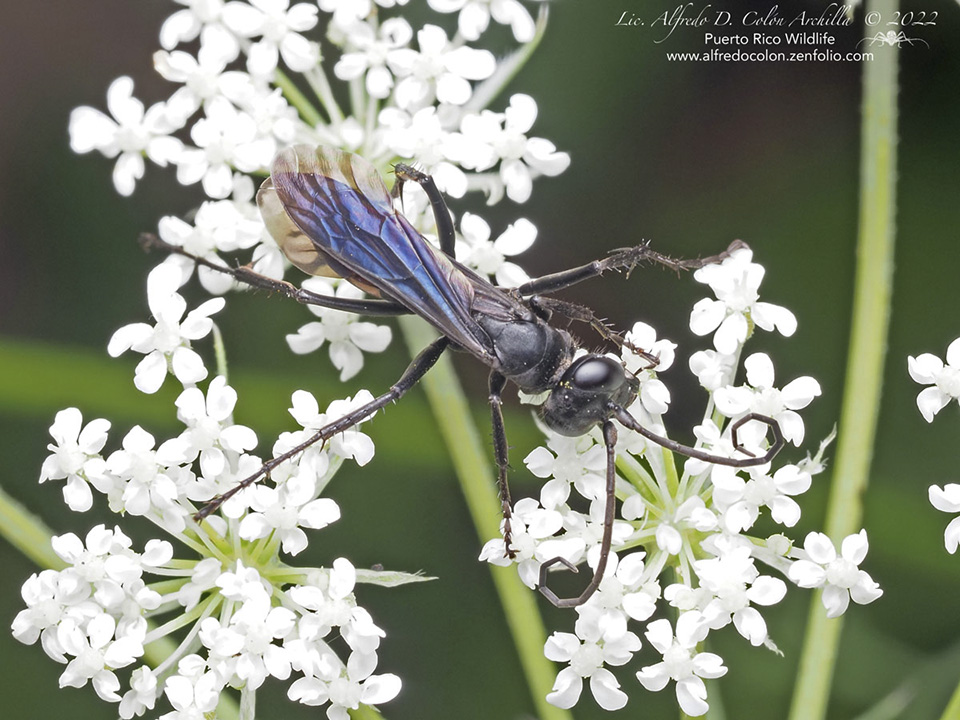
Females are 7⁄16″ to ¾″ (11 to 20 mm) in length, averaging ⅝″ (15.5 mm) in length. The body is bluish black.
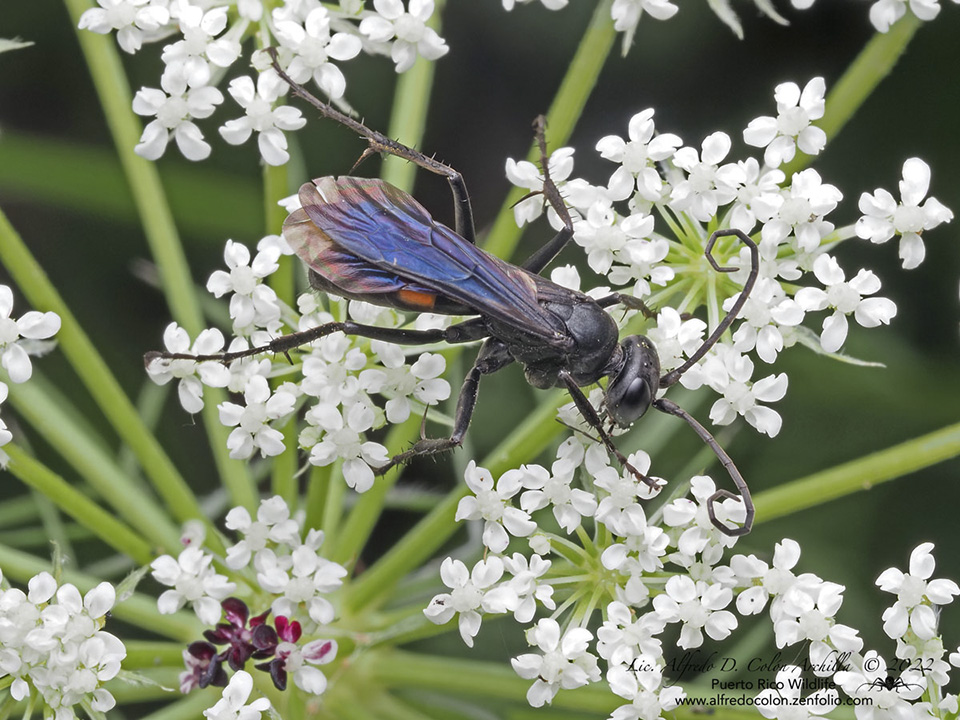
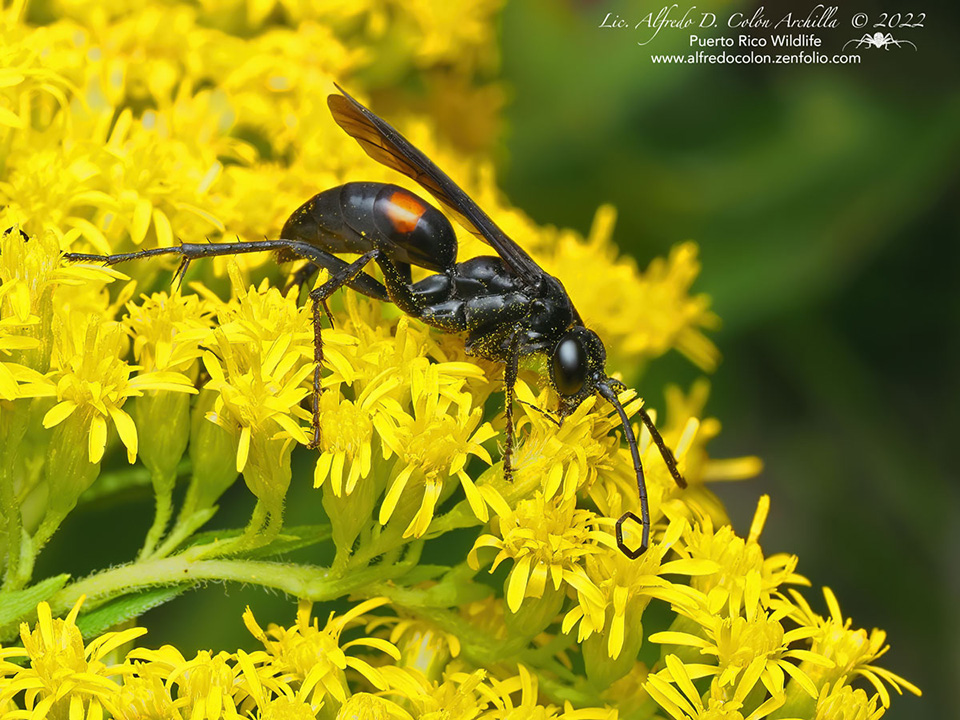
The head is entirely black except there is often a narrow pale streak along the outer margin of each compound eye. The antennae are thread-like, they have 12 segments, and they are short relative to other members of the genus. They are often seen rolled up or coiled at the tip. This feature, common to all female spider wasps, allows it to “drum” the surface of the leaf litter (antennal palpation) and detect the chemical trail of its prey.
The thorax and abdomen are entirely black except for a broad orange band across the second visible abdominal segment (tergite 2).
The legs are long and black. The last part of each leg (tarsus), corresponding to the foot, has 5 segments. On the front legs, the last tarsal segment has a “comb” consisting of 3 to 5, usually 4, strong spines. On the rear legs, the last tarsal segment also has spines underneath. On all legs, the claws on the last tarsal segment are toothed (dentate).
The forewings are smoky dark and relatively short, typically not reaching beyond the tip of the abdomen. The marginal cell is about 2.5 times longer than wide, the second submarginal cell is usually about 1.5 times wider than long, and the third submarginal cell is usually triangular or nearly triangular.
Males are smaller, ¼″ to ⅝″ (6.5 to 17 mm) in length, averaging ½″ (12 mm) in length. The orange band on the abdomen frequently extends onto tergite 3. The tarsal claws are split (bifid).
Size
Female total length: 7⁄16″ to ¾″ (11 to 20 mm)
Male total length: ¼″ to ⅝″ (6.5 to 17 mm)
Similar Species
Habitat
Open areas with sandy soil or clay
Ecology
Season
June through August
Behavior
When hunting, the wasp moves in a frantic, zigzagging pattern across the ground, flicking its wings and drumming its antennae against the leaf litter. This “antennal palpation” allows it to detect the chemical signatures of silk trails or hormonal scents left behind by spiders. The rapid wing flicking is designed to startle a concealed spider into moving and revealing its position. Upon locating its prey, the wasp quickly delivers a sting to the spider's underside to paralyze it.
Life Cycle
Larva Food
Captured and paralyzed spiders
Adult Food
Flower nectar
Distribution
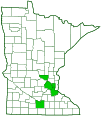
Occurrence
Taxonomy
Order
Hymenoptera (Ants, Bees, Wasps, and Sawflies)
Suborder
Apocrita (Narrow-waisted Wasps, Ants, and Bees)
Infraorder
Aculeata (Ants, Bees, and Stinging Wasps)
Superfamily
Pompiloidea (Spider Wasps, Velvet Ants and Allies)
Family
Subfamily
Pompilinae
Tribe
Anopliini
Genus
Anoplius (Blue-black Spider Wasps)
Subgenus
Arachnophroctonus
Subordinate Taxa
Synonyms
Anoplius marginalis
Pompilus bilunatus
Pompilus bilunulatus
Pompilus semicinctus
Psammochares semicincta
Common Names
half-belted blue-black spider wasp