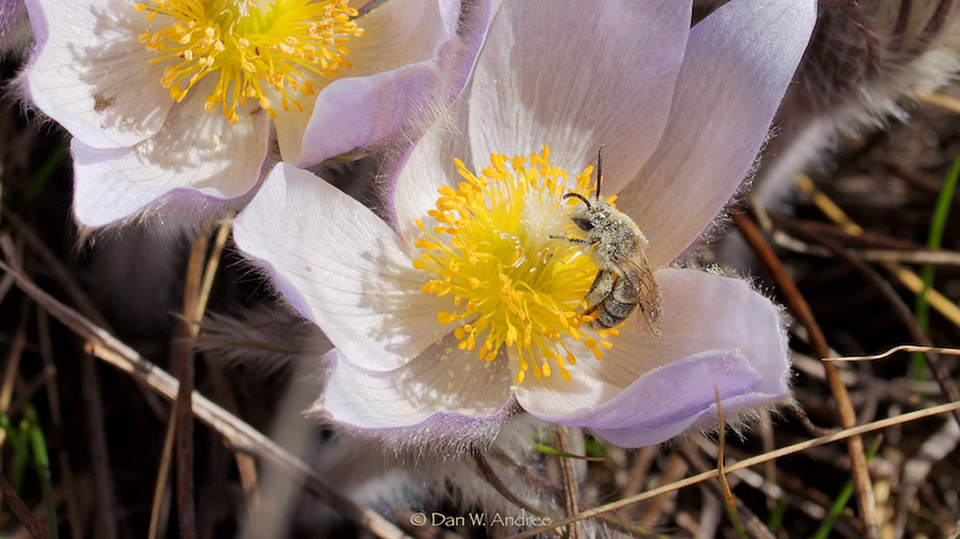
ligated furrow bee - Species Profile
Conservation • Description • Habitat • Ecology • Distribution • Taxonomy

Conservation Status
IUCN Red List
not listed
NatureServe
NNR - Unranked
SNR - Unranked
Minnesota
not listed
Description
Ligated furrow bee is a very common, medium-sized, ground-nesting, eusocial bee. It occurs in the United States, Mexico, Central America, northern South America, and southern Canada. In the United States it occurs in each of the lower 48 states. It is common in the southern half of Minnesota, uncommon to absent in the north. It is found in a wide variety of habitats, especially in sandy areas. Adults are generalist feeders and can be found on a very wide variety of flowers.
The female is 5⁄16″ to ⅜″ (8 to 10 mm) in length. The head and body are entirely black with pale hairs and without a greenish cast. The head is much wider than long and appears thick. The compound eyes are parallel. On the face there is just a single line-like groove extending downward from the base of each antenna (subantennal suture). The cheeks are much wider than the eyes and are strongly hooked with a prominent knob-like projection at the base. The tongue is short.
The small plates (tegulae) covering the wing bases are coppery.
Each abdominal segment (tergum) has a band of whitish hairs at the bottom (apically). This feature distinguishes the genus Halictus from the closely related genus Lasioglossum, which has bands at the top (basally). The bands on the first two terga are narrow and inconspicuous, the remaining bands are distinct.
The wings are mostly translucent with yellowish veins and a yellowish cell (stigma) on the leading edge (costal margin) just before the marginal cell. The marginal cell is pointed but not sharply pointed. There are three submarginal cells. The first cell is longer than the third. The veins dividing the submarginal cells are dark and prominent. The basal vein is strongly arced at the base, like the letter J.
The male is smaller, ¼″ to ⅜″ (7 to 9 mm) in length. The head is as wide as long. The compound eyes converge slightly at the bottom. The cheeks are not as wide as the eyes. The legs are black at the base. The fourth leg segment (tibia) is brownish-gray on the underside, yellowish on the upper side.
Size
Female: 5⁄16″ to ⅜″ (8 to 10 mm)
Male: ¼″ to ⅜″ (7 to 9 mm)
Similar Species
Habitat
A wide variety of habitats, especially sandy areas
Ecology
Season
Several overlapping generations per year: early spring to autumn
Behavior
Sometimes large numbers build their nests close together.
Life Cycle
A young, hibernating, reproductive female (gyne) emerges in the spring. She builds a nest in the ground consisting of an 8″ to 3′ deep vertical tunnel with many short side tunnels. She lays a single egg in each side tunnel, provisions it with pollen, then seals the tunnel. The nest has a mound of dirt surrounding the entrance and looks like an ant hill.
Larva Food
Flower pollen
Adult Food
Flower nectar and pollen
Distribution

Sources
Biodiversity occurrence data published by: Minnesota Biodiversity Atlas (accessed through the Minnesota Biodiversity Atlas Portal, bellatlas.umn.edu. Accessed 5/7/2026).
Halictus ligatus Say, 1837 in GBIF Secretariat (2023). GBIF Backbone Taxonomy. Checklist dataset https://doi.org/10.15468/39omei accessed via GBIF.org. Accessed 5/7/2026.
Occurrence
Very common, locally abundant
Taxonomy
Order
Hymenoptera (Ants, Bees, Wasps, and Sawflies)
Suborder
Apocrita (Narrow-waisted Wasps, Ants, and Bees)
Infraorder
Aculeata (Ants, Bees, and Stinging Wasps)
Superfamily
Apoidea (Bees and Apoid Wasps)
Epifamily
Family
Halictidae (Sweat Bees)
Subfamily
Halictinae (Sweat and Furrow Bees)
Tribe
Halictini
Suntribe
Halictina
Genus
Halictus (Furrow Bees)
Subgenus
Odontalictus
Species complex
Halictus ligatus is probably a species complex that may be split into multiple species in the future.
Subordinate Taxa
Synonyms
Common Names
ligated furrow bee
ligated gregarious sweat bee