mossy rose gall wasp - Species Profile
Conservation • Description • Habitat • Ecology • Distribution • Taxonomy
Conservation Status
IUCN Red List
not listed
NatureServe
NNA - Not applicable
Minnesota
not listed
Description
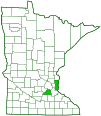
Mossy rose gall wasp is a relatively tiny, Old World wasp. It is native to Europe and was introduced into North America. It was first recorded in Toronto in 1868. In the U.S., it now occurs in the east from Maine to South Carolina, west to Minnesota, Kansas, and Alabama, and in the west from Washington State to California, east to Montana and Colorado. Since mossy rose gall wasp attacks only European ornamental roses, especially Rosa rubiginosa, R. canina, R. majalis, and R. rugosa, populations in North America remain clustered in gardens, parks, old homesteads, and urban edges where these roses were planted and occasionally naturalized.
The adult female is very small, about ⅛″ (4 mm) long. The body is laterally compressed. The head and thorax are entirely black. The thorax is strongly arched, appearing hunched. The abdomen is reddish yellow in front (the basal segments), becoming black toward the rear. The legs are pale yellowish red to reddish yellow.
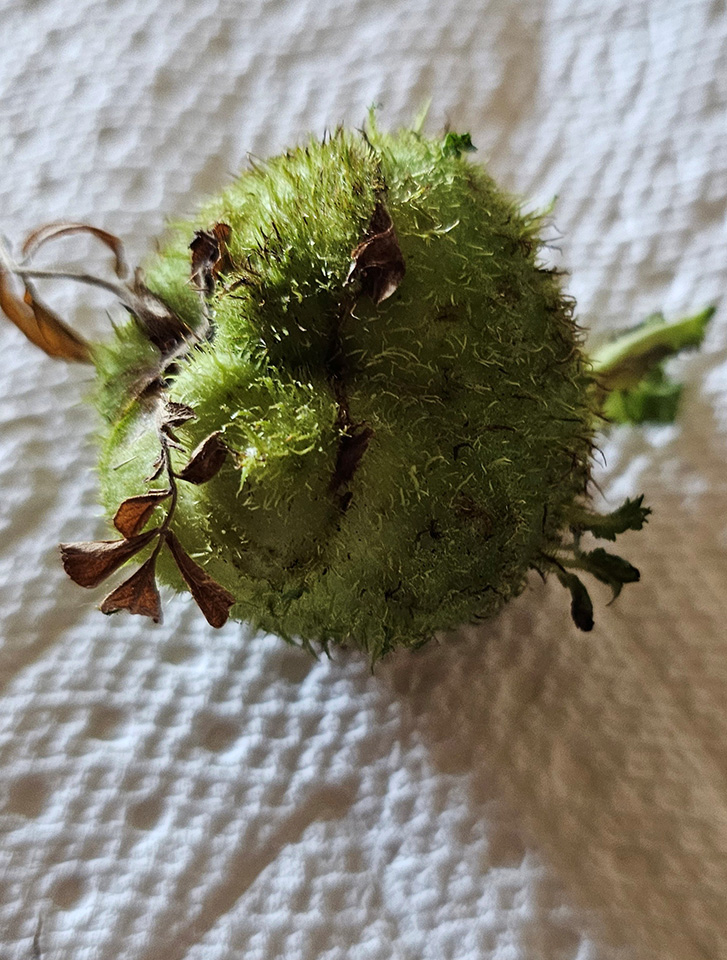
Mossy rose gall wasps are rarely noticed in the field, but they are easily identified by the abnormal plant growth (gall) they produce on rose stems. In the spring, small galls appear on stems of rose shrubs. They enlarge throughout the growing season and are fully formed by the end of August. They have up to 60 chambers, each with a single larva, and they are covered with spreading, brightly colored, moss-like filaments. Mature galls are 1″ to 4″ (2.5 to 10 cm) in width and often have live or dead leaves protruding from them. They turn brown in the fall.
Size
Adult: about ⅛″ (4 mm)
Gall: 1″ to 4″ (2.5 to 10 cm)Similar Species
Spiny rose gall wasp (Diplolepis bicolor) gall is covered with short, straight, stiff spines.
Habitat
Gardens, parks, old homesteads, and urban edges
Ecology
Season
One generation per year: April and May
Behavior
Life Cycle
The female inserts from a few to up to 60 eggs directly into unopened terminal or axillary leaf buds. The eggs hatch in 10 to 15 days. Their feeding and salivary secretions cause the leaf bud tissue to transform into a woody, nutritive cell surrounding each larva. The outer cells produce branched, moss-like filaments to cover and protect the chambers. The gall enlarges throughout the growing season, reaching full size in late summer or early fall. The larvae pupate in their cells and overwinter.
The mossy rose gall wasp spends almost its entire life cycle in an immature stage inside a chamber in the gall. Adults emerge in April and May, surviving only 5 to 12 days.
Larva Food/Hosts
Adult Food
Adults do not feed.
Distribution
Sources
Diplolepis rosae (Linnaeus, 1758) in Bánki, O., Roskov, Y., Döring, M., Ower, G., Hernández Robles, D. R., Plata Corredor, C. A., Stjernegaard Jeppesen, T., Örn, A., Pape, T., Hobern, D., Garnett, S., Little, H., DeWalt, R. E., Miller, J., Orrell, T., Aalbu, R., Abbott, J., Abreu, C., Acero P, A., et al. (2026). Catalogue of Life (2026-07-17 XR). Catalogue of Life Foundation, Amsterdam, Netherlands. https://doi.org/10.48580/dgykv
Occurrence
Taxonomy
Order
Hymenoptera (Ants, Bees, Wasps, and Sawflies)
Suborder
Apocrita (Narrow-waisted Wasps, Ants, and Bees)
Infraorder
Proctotrupomorpha
Superfamily
Cynipoidea (Gall Wasps and Allies)
Family
Diplolepididae
Subfamily
Diplolepidinae (Rose Gall Wasps)
Tribe
Diplolepidini
Genus
Diplolepis
Subordinate Taxa
Synonyms
Cynips bedeguaris
Cynips rosae
Diplolepis bedeguaris
Diplopepis rosae
Rhodites rosae
Common Names
mossy rose gall wasp
Robin’s-pincushion gall wasp
rose bedeguar gall
